Showing posts with label Vintage Japanese. Show all posts

Sunday, May 19, 2024

GRECO: TV-500 Les Paul Junior

Picked up this Greco TV-500 Les Paul Junior recently, and there's not a massive amount of information out there, so I thought I should jot a few things down.

I'm fairly sure it's the same as the Ibanez 2343, given the relationship between the two brands - Greco for the domestic market in Japan, Ibanez for export. 

It only appears in the1975 Greco catalog and was listed for 50,000 yen.  Looking at the catalog, I'd love to get my hands on the SG version too.  

Great little player, well balanced and the intonation is surprisingly good given the style of lighting bolt bridge that it has (came with 10-52 Moonshiner strings).

GRECO TV-500 LES PAUL JUNIOR SPECS

  • 1975, made in Japan - I think FujiGen Gakki but could be wrong 
  • No serial number
  • Cherry finish - although they all seem to fade to chocolate
  • Pancake mahogany construction for the body (multiple pieces)
  • Set neck, also mahogany, slim profile (two piece - neck / headstock is one piece, it has extra bit on the heel to add thickness)
  • Weighs a little over 3kg
  • Rosewood fretboard, 22 frets
  • Usual Gibson scale length 24 and 3/4 inches
  • Mother of pearl inlays
  • Gotoh star tuners
  • Lightning bolt bridge
  • Chrome hardware
  • Tortoise pickguard
  • Speed knobs
  • Maxon P-90 that measures in at 8.3k
  • Full-size pots
  • Greenie cap
  • Fifties wiring (very neat and shielded)


GRECO TV-500 Les Paul Junior 1975 made in japanGRECO TV-500 Les Paul Junior 1975 made in japan

GRECO TV-500 Les Paul Junior 1975 made in japanGRECO TV-500 Les Paul Junior 1975 made in japan

GRECO TV-500 Les Paul Junior 1975 made in japanGRECO TV-500 Les Paul Junior 1975 made in japan

GRECO TV-500 Les Paul Junior 1975 made in japanGRECO TV-500 Les Paul Junior 1975 made in japan

GRECO TV-500 Les Paul Junior 1975 made in japanGRECO TV-500 Les Paul Junior 1975 made in japan

Looks like the original case, based on the condition and it matches a catalog item.  Vintage stickers from Japanese music stores add to the charm


Monday, March 6, 2023

GUITAR: Profile Silhouette Telecaster - 1980s Japan

I know, this is not a pedal and it's also just a Telecaster - not exactly big news - but hey, it's my blog and I'll post what I want.   

Picked up this Profile Silhouette Telecaster on the weekend for a pretty decent price - second-hand Squier money.  It had been sitting in a case in a garage for years - it used to belong to the sellers' auntie.  I could not find a reference to this model anywhere, and there's very limited information available about these guitars in general, hence the length of this post.

The story goes something along these lines:  Sometime in the 1980s the owner of an Australian music store took his favourite US made Strat to Japan and said "build some of these".  Turned out they were very close to American Fenders and were half the price at the time.  This sounds like a reasonable premise.

What I've read but can't verify:  This is supposed to have pre-dated Fender Japan.  Some say they were made in the Cushin Gakki factory, which is where Japanese Charvel and Jackson were made.  Some say made by FujiGen.

PROFILE SILHOUETTE TELECASTER CUSTOM

What I think I have so far;

  • Two-piece Ash body, possibly Sen given the Japanese connection (bound front and back)
  • Rock maple neck, fat C I would say
  • Kluson style tuners, stamped "Deluxe"
  • Weird bridge, the same as Tokai Breezysounds (but with original tele bridge string spacing)
  • No identifying marks to be found in terms of serial numbers etc.  Just a mark where a sticker was on the back of the neck plate
  • Code in the neck pocket is 8-116
  • Noble pots, which seem to be common on decent Japanese guitars from this period
  • Standard greenie 47n cap
  • DM-30 three-way switch, also common on Japanese guitars from the period
  • Poly finish 
  • 5 Screw scratch plate


Profile Silhouette Telecaster - 1980s Japan

Profile Silhouette Telecaster - 1980s Japan

I think this mark on the plate is where the Made in Japan sticker once was.

Profile Silhouette Telecaster - 1980s Japan


The bridge looks identical to a Tokai Breezysound, minus the Tokai branding.  Obviously a departure from a traditional Telecast here - they've clearly gone for function rather than sticking with vintage correct.

It is however vintage correct spacing, not the smaller import size.


Nice fully machined metal knobs, hardware has a decent patina and despite not being correct for a Tele, I quite like the switch end.


I've read that some folks think that all Profile guitars had plywood bodies.  This one most certainly does not.  Solid wood, no front and back veneer to hide cheap wood underneath.


Regular Tele thickness


Nice skunk stripe and I'm pretty sure this is rock maple.


The neck join is really tidy - no stress fractures around the finish 


It has Noble pots, which were in a lot of the better Japanese guitars back in the day.  As expected, the wiring is not great.


47n cap, 500k pots.  One linear, the other log


Pickups are not ceramic, that much is obvious - no identifying marks.  


Some kind of code in the neck pocket.


Sunday, January 29, 2023

ACE TONE: FM-3 Fuzz Master

I'd somehow missed this one.  The Ace Tone FM-3 Fuzz Master is similar to the Ace Tone FM-2 in looks and name, but that's where the similarities end.   The FM-2 is based on the Univox Super Fuzz and the FM-3 is a Big Muff variant.

Schematic can be found here on Kit Rae's BMP site.  Basically take a Big Muff, and add an additional tone control with its own volume pot attached to it, then switch between the Big Muff circuit and the boost circuit.   No you cannot route one in the other, as they share input and output sections.  Nice idea though...  

The tone controls are a little different, as they use a combination of values not found on any of the many EHX circuits.  There's still the scoop, but it just has a different response.  I haven't compared it to a Big Muff, as which Big Muff should it be compared to?

For those with keen eyes, yes the resistor in the collector of Q1 is really 150k, not 15k as one might expect to see.    I'm not sure about the 100k on the input to ground either, but it was on the traced version found on FreeStompBoxes - link to the thread and schematic here.  It's not on the Kit Rae schematic.  


ACE TONE FUZZ MASTER FM-3  -  VERO LAYOUT

ACE TONE FUZZ MASTER FM-3  -  GUITAR EFFECT DIY VERO LAYOUT


Sunday, January 8, 2023

AIWA: TP-1011 Reel to Reel Preamp

The AIWA TP-1011 is the reel-to-reel tape preamp Richie Blackmore from Deep Purple used to drive his Marshall.  I'm not a huge Deep Purple fan, but I do like the sound of some of these old reel-to-reel preamps.  This layout is for the stock circuit running at 18v.  If I ever get around to breadboarding the mods I tried in LTspice, I'll post another layout.   

Here's the discussion on FSB, including a verified layout with a trimmer to control the first gain stage.


AIWA TP-1011 REEL TO REEL PREAMP - VERO LAYOUT

AIWA TP-1011 REEL TO REEL PREAMP - VERO LAYOUT


Build notes (comments below from ConvergentSound);
  • The stock version sounds awful at 9v
  • Replacing the 56k with a pot is necessary to control gain

SCHEMATIC AND POTENTIAL MODS

Reduce down from 18v to 9v.  18v had mountains of output level on tap - I can see how stories of Blackmore cooking amps could be true.

  • Reduce coupling cap size to roll off some low frequencies   
  • Very flat response with the stock circuit
  • Aiming for clean boost all the way to fuzz
  • Try NPN germanium for Q3   
  • Trimmer to control gain of the first stage (as per FSB thread)


AIWA: TP-1011 reel to reel preamp schematic with mods.  For guitar effect pedal builds


NOTE:  images below are from the modded circuit running at 9 volts.   The original will distort quite quickly, which seems to be normal.  Basically to the point of fuzz.  

AIWA TP-1011 REEL TO REEL PREAMP - Mods on LTspice

AIWA TP-1011 REEL TO REEL PREAMP - Mods on LTspice

Sunday, October 23, 2022

SHIN-EI: Companion Fuzz FY-2

A classic Japanese guitar effect - the Shin-Ei Companion Fuzz - it has its roots in the Fuzzrite, with a notch filter at the output.  


SHIN-EI COMPANION FUZZ FY-2 - VERO LAYOUT

SHIN-EI COMPANION FUZZ FY-2 - VERO LAYOUT


FY-2 SCHEMATIC

SHIN-EI COMPANION FUZZ FY-2 - SCHEMATIC

Usual notch filter response.


It's a fairly broken-looking wave - not the infamous volume drop compared to the input level, which is normally fixed by adding a gain recovery stage.


FY-2 VIDEO DEMO


Saturday, October 22, 2022

ELECTRA: Modular Powered Circuits - MPC11 Frognose Amp

Onto the Frognose - weird name right?  It's based on the LM386 IC, which is an audio amplifier capable of driving a small 8-ohm speaker.

In the configuration below, it's capable of 20x gain, so it's a pretty decent booster.

If you aren't familiar with the LM386, two of them are used in the Earthquaker Devices Acapulco Gold, and one is used in the D*A*M Sonic Titan with a JFET boost in front.  So if you put the Electra Power Overdrive in front of this, and added an extra cap to the LM386 you would have something resembling the Sonic Titan, or my version of this, the Kool Thing Distortion.  Not bad....  


FROGNOSE MPC11 - SCHEMATIC

Schematic was drawn by Steve - thanks Steve, hope you don't mind me posting it here.   

FROGNOSE MPC11 - GUITAR EFFECT


As you can see, the Frognose is an almost part-for-part copy of the implementation provided by the manufacturer of the LM386.


VIDEO DEMO


Friday, October 21, 2022

ELECTRA: Modular Powered Circuits - MPC2 Dynamic Fuzz

Continuing with the Electra guitar effects - the MPC2 Dynamic Fuzz.  What's unusual about this one is that the pot acts as a clean blend - one side from the input buffer, the other from the fuzz.  Given that this is a cartridge that is inserted into the back of a guitar, the pot is permanently mounted on the front of the guitar next to the usual volume, tone and switching (which is rather complicated).

Apart from that it's not super interesting, although I am keen to get it on the breadboard as it looks ripe for mods.   

It's basically a buffer, boost, then something similar to an Electra Distortion at the end.  It's not a massive boost, in part I think it's probably there to make sure the output is in phase with the clean signal at the blend pot.

ELECTRA MPC2 DYNAMIC FUZZ - VERO LAYOUT

ELECTRA MPC2 DYNAMIC FUZZ - GUITAR EFFECT VERO LAYOUT

ELECTRA MPC2 DYNAMIC FUZZ SCHEMATIC


ELECTRA MPC2 DYNAMIC FUZZ SCHEMATIC


SPICE SIM RESULTS


VIDEO DEMO


Monday, October 17, 2022

ELECTRA: Modular Powered Circuits - Tube Sound MPC8, AKA the Electra Distortion

Recently the Electra Distortion grabbed my attention again, so as I often do, I went digging for more information on the Electra MPC series guitar effects (modular powered circuits).  

One problem; Electra doesn't appear to have ever made a Distortion module.  Interesting...   

Then I read what we know as the Electra Distortion is really the Tube Sound Module, and it had just been mislabeled as a Distortion by the internet.  OK, that can happen -  basically, take the Power Overdriver and add clipping diodes.

During my search, I found the schematics of the entire MPC range, care of pinkjimmiphoton on Free Stompboxes.  On closer inspection, the Tube Sound is nothing like the Power Overdrive.  So my question is - was the Electra Distortion ever a real thing, or does someone's early mod on a Power Overdrive now have a life of its own?  Was there another version?  

Naturally, I'm not even close to being the first person to have this thought.  It turns out that there were two versions - but neither was ever called a Distortion.


POWER OVERDRIVE MPC5

The power overdrive is actually a clean boost, with low frequencies dropping off around 100hz - they called it an overdrive as the boost was meant to overdrive an amp.  Makes sense.   

POWER OVERDRIVE MPC5 GUITAR EFFECT


TUBE SOUND MPC8 - ALTERNATE VERSION

So after looking at the alternate version of the Distortion / Tube Sound, I'm even more confused than I was when I started writing this.  

I ran the alternate version on LTspice, and nothing really happened - boost yes; anything resembling distortion, no.   I tried high-gain transistors and different diodes, and nothing really happened.  Maybe a tiny little bit of clipping, but it was so small, I'm not sure anyone would notice.  

I did of course try flipping the diodes and resistor after Q2 to ground, and then it looked a lot like one would expect.  Quite similar to the Electra Distortion.  

TUBE SOUND MPC8


Below is with the diodes flipped to ground, which is not how the circuit is drawn, but it did get a result.


TUBE SOUND MPC8 AKA THE ELECTRA DISTORTION

So onto the common version.   

I'm still kind of curious about this one, as people say that it's the same as the Overdrive but with diodes, but there's clearly no 120k resistor on the input, or a pot controlling the input level, which in turn reduces the effect of the clipping diodes.

Either way, it’s still a great little circuit.


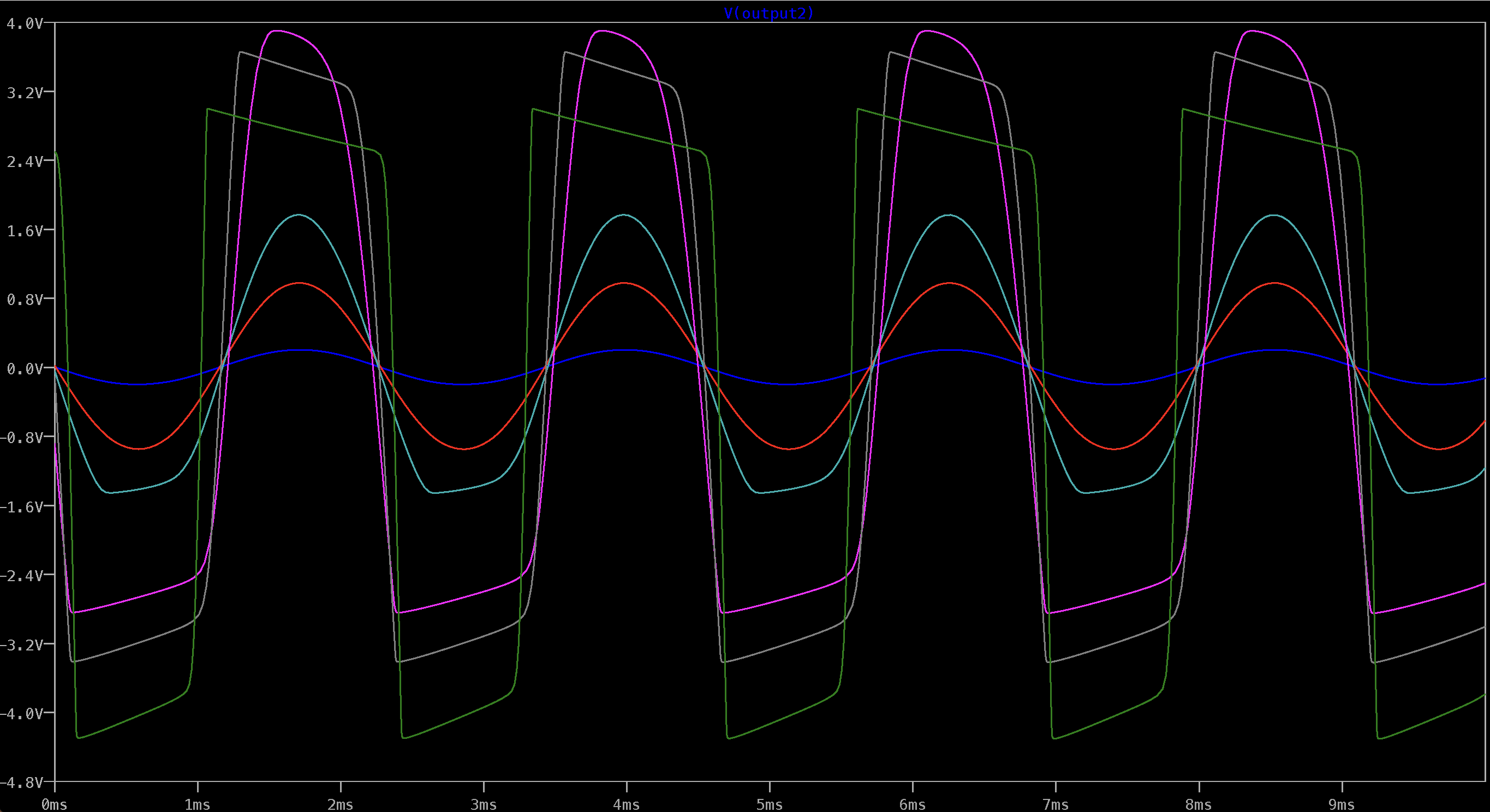
The trace below compares three options.   

1) the Tube Sound - the Power Overdrive with diodes added.  Includes the 120k resistor on the input and the input level pot

2) the Distortion - as above, but no 120k input resistor or pot at the front
  
3) The classic Distortion - as shown above

As you can see, there are varying levels of clipping occurring, in numerical order as listed above.