After recently finishing a mojo size / vintage transistor Tone Machine that has been sitting on the bench for way too long, I decided to do a regular layout, as the practicality of some of my other layouts for the Foxx is probably not for everyone (maybe even me in retrospect).
So I've done a standard Foxx with the Aion Vulcan mods, and then took the Vulcan mods a step further by using a rotary switch for the mids.
By changing from an SPDT switch to a 2-pole rotary for the mids on the Vulcan, the optional 22k resistor in the tone stack can also be switched in and out. So instead of three different mid-range options, you now have six, including a stock Tone Machine setting.
The rotary switch looks like this on the schematic.
Unlike the Aion Vulcan, the rotary switch does not sum the capacitors (placed parallel), which is why there's a 3n3 on the rotary in place of the 2n2 on the Vulcan. This also provides a bit of room to move in the selection of the 1n capacitor. While 1n provides a sound of its own, it could easily be a little larger - maybe a 1n5 or similar. I’d even suggest keeping the 3n3 and the 15n and pick a value in between to replace the 1n. Maybe a 6n8 or a 10n.
FOXX TONE MACHINE / AION FX VULCAN - VERO LAYOUT
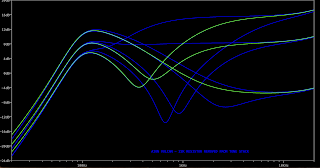
FOXX TONE MACHINE / AION FX VULCAN - LTSPICE
You can get an idea of the stock response and the range of the Aion Vulcan with these. 100% Sustain, Tone swept from 0 to 50% and 100%.
Adding the optional 22k resistor into the tone stack increases the mid-range scoop, similar to a Big Muff.
The standard Foxx TM uses a lot of 10u caps, whereas the Vulcan’s uses 1u - it makes zero difference to the frequency response.
FOXX TONE MACHINE / AION FX VULCAN ON THE SCOPE
Start your device at low levels - this uses a straight sine wave.
This is it sweeping through the six-tone settings, with the tone being turned from bass to treble on every setting. The first three are 1n, 3n3, and 15n with the additional 22k resistor in. The last three are 1n, 3n3 and 15n without the 22k resistor. The second last one is a stock TM.
Diode switching - in, out and octave. Note the changes to the harmonics