Showing posts with label Philips. Show all posts

Monday, December 8, 2025

PHILIPS: Model 976B PA Amplifier

Philips 976B - I have had one previously that I documented here.   

PHILIPS MODEL 976B VALVE PA AMPLIFIER 

This is a small Australian-made valve PA amplifier from the mid to late fifties - about 8 watts, intended for 100v line systems running multiple speakers.  These were also sold as Steanes Sounds Systems using the same model number, marketed as a compact portable PA system, often with a couple of speakers and a mic on a stand. 

It's mostly original; it has had the filter caps bypassed replaced and a repaint at some stage. 


I had to add a power switch, and input and output jacks.  The original power cord was really short and not in the best shape, so that went as well.   


2 x 6M5 in the power stage, for about 8watts.

I replaced the original output transformer, as I was not keen on the configuration options.  It's sounding great with a M1120.  


The original filter caps have been left in place, with new ones added in the chassis.  I don't love the mounting method (or lack of), but at least the caps they used look the part.


PHILIPS 976B SCHEMATIC & TECHNICAL MANUAL


PHILIPS 976B AMPLIFIER SCHEMATIC

PHILIPS 976B SCHEMATIC & TECHNICAL MANUAL
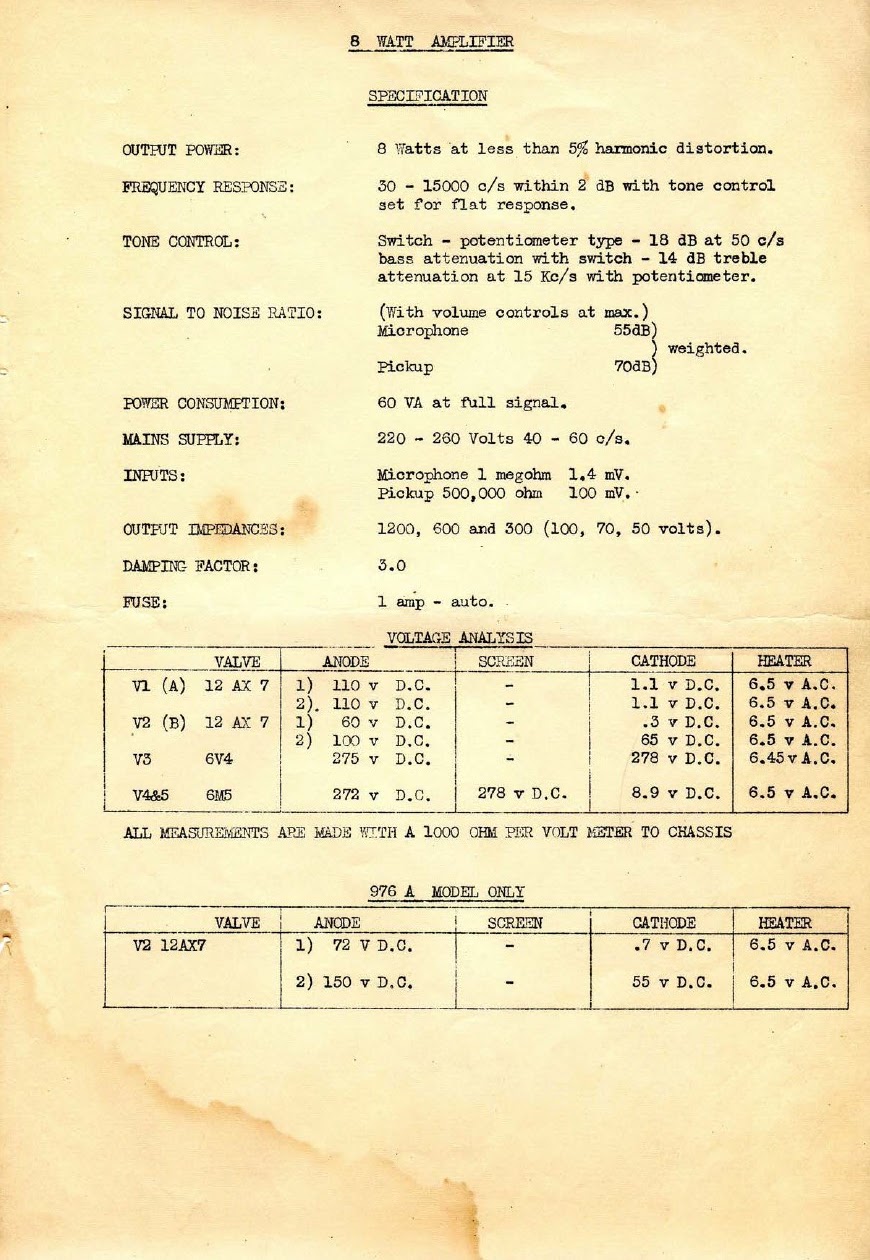

PHILIPS 976B SCHEMATIC & TECHNICAL MANUAL

PHILIPS 976B SCHEMATIC & TECHNICAL MANUAL

PHILIPS 976B SCHEMATIC & TECHNICAL MANUAL


MODS / CHANGES

I've left it close to stock in terms of the circuit, as I thought it sounded pretty good. 
  • Added input & output jacks
  • Replaced the dodgy power lead and added a power switch & a jewel light 
  • Unused PU level pot now a Vox style cut control 
  • Swapped the output transformer due to limitations with secondary impedances 
  • Rebuilt the preamp and phase inverter, as the carbon comp hiss and crackle was just too much
  • Moved the filter caps to some tag stips 
Interestingly, there’s a small amount of bleed around the volume pot. It’s not a major issue—more of a curiosity. The two 12AX7 triodes share a cathode resistor, and there’s plate-to-grid negative feedback on the second stage, which creates an AC path around the pot. That allows a small amount of signal to reach the phase inverter even with the volume turned down.

6V4 RECTIFIER


6M5 POWER PENTODE

6M5 (EL80) pentodes appear to be unique to Australia - they're similar to an EL84, but with a slightly different pinout and a little less power.  It's often referred to as the noval version of the EL41.  Either way, I quite like the sound of these being driven.


Saturday, September 27, 2025

PHILIPS: Model EV4437 PA amplifier

I picked this one up from a factory in an industrial area - apparently, it had been sitting there as long as anyone can remember, and it was actually used to play music at one stage.     

I know one thing for sure - they never opened it up to dust it.

PHILIPS EV4437 PA AMPLIFIER

  • Likely mid to late sixties.
  • ~100w, maybe 120w
  • 6 x Philips 6CM5 valves (it was missing two of them)
  • 12AX7 preamp & phase inverter
  • Solid-state rectifier
It has the standard three knobs - Mic, Pickup and tone control.  The Mic volume has a push/pull switch for bass cut, which just selects between a small and a larger value coupling cap.  The tone control is a bass cut / treble cut, so something a little different there.

PHILIPS Model EV4437 PA ampifer.  Vintage Australian valve amplifier

PHILIPS Model EV4437 PA ampifer.  Vintage Australian valve amplifier

The 6CM5 valves are beam power tetrodes, which were actually designed for TV tubes - something about horizontal deflection, which I know nothing about...    one tested OK, the rest are dead.  

What I do know is that these appeared in quite a few Australian guitar amplifiers, likely due to price and availability.  You can still find these at very reasonable prices online.   I'm not a fan of the cap on the top of the valve - it has over 300v on it, and it's not insulated.  Ouch.  


2 x additional inputs had been added, all attached to the triode used for the mic input.

PHILIPS Model EV4437 PA ampifer.  Vintage Australian valve amplifier

OUTPUT TRANSFORMER

  • Primary impedance ~1.15k P-P
  • Secondary impedances 25 Ω, 50 Ω & 100 Ω
  • Use 50 – 100 for  ~7.9 Ω
  • Use 25 – 50 for   ~4.7 Ω 
There is also a 5w 470 ohm resistor in series with a 22n capacitor across the speaker output, which was not on the schematic below.  I believe this is a Zobel network, which is used to dampen highs around the 15khz mark when using the 100 Ω output.

Calculations below:

Primary: 14.89 Vrms plate-to-plate at 440 Hz

Secondary:

0 – 25:    2.189 Vrms → Vp/Vs = 6.80 → (Vp/Vs)² = 46.3

0 – 50:    3.141 Vrms → Vp/Vs = 4.74 → (Vp/Vs)² = 22.5

0 – 100:  4.379 Vrms → Vp/Vs = 3.40 → (Vp/Vs)² = 11.6

Effective primary impedance:

With 25 Ω load on 0 – 25  = 1.16 kΩ p-p

With 50 Ω load on 0 – 50  = 1.12 kΩ p-p

With 100 Ω load on 0 – 100  = 1.16 kΩ p-p


50 – 100: Vs=1.235 → Vp/Vs = 12.057 → (Vp/Vs)² = 145.364 → Zs needed ≈ 1150/145.364 ≈ 7.9 Ω.

25 – 50:   Vs=0.949 → Vp/Vs = 15.690 → (Vp/Vs)² = 246.182 → Zs needed ≈ 1150/246.182 ≈ 4.7 Ω.

6CM5 OPERATING CONDITIONS

Given the operating conditons list 3.5k p-p for a pair of valves at the same voltages,and I'm planning on running at lower power (not 6 output valves):

Pair of 6CM5:     Use 16 Ω on 25–50 → ≈ 3.9 kΩ p-p 

Quad of 6CM5:    Use 8 Ω on 25–50 → ≈ 2.0 kΩ p-p


I think they put the wrong plate on this amp, as the 4417 is a slave amp from this series.


It's a fixed bias amp, but for some reason, there are 22ohm resistors to ground from the cathodes of the 6CM5 pentodes.  People sometimes put 1ohm resistors here to measure bias, I’m not familiar with this size resistor being used for this purpose.  A 10ohm would make a little more sense, as the mental math would be easier.


PHILIPS EV4437 SCHEMATIC

I haven't completely checked mine against this schematic yet - but there are definitely some differences.  Some I know are mods, some may be factory. 

The power supply is interesting, as it has a number of different feeds for the B+, screen voltages and bias.  Screen voltages run at half of B+


CONVERSION PLANS / REPAIRS

Conversion went pretty well - a bit more work than usual, but the results are decent.  I was getting some pretty nasty distortion in the cathodyne phase inverter, so I made some adjustments there.  The preamp also had quite a lot of gain, which was not helping matters.  

  • Needed new output valves - only came with 4 out of 6, and 3 of them were toast.   
  • Filter caps were not great - enough hum to be concerning.  Replaced with some JJ's, 2 x 100uf, 500v
  • Removed extra inputs that were tacked on the preamp
  • Rewired output transformer for normal speaker impedance 
  • Removed some extra resistors and grounding on the bias supply

  • Replaced 47 ohm screen resistors
  • Preamp - reduced 270k resistors down to 100k.   
  • Tone controls removed and modded to suit guitar (Fender one knob tone control).   
  • Added a power switch and replaced the giant orange power cord.   
  • Replaced 4amp fuse with 1amp.   
  • Dropped bias voltage down from about -30 to -25 with a 27k resistor to ground.  
  • Changed the cathodyne phase inverter - increased resistors and removed negative feedback.   

FURTHER READING

Full evaluation by Tim Robbins - Dalmura site, although this is for the 4437a, which has some additional features

Aussie Guitar Gear Heads

Amplifiers with Valves - EV44 series


Don't know why I even took this photo - this is the shed in an industrial area of Brisbane where the amp was found.


Thursday, January 30, 2025

Philips: 956C Valve PA Amplifier, 30 watt

This is an unbranded Philips or Steanes model 956C valve PA amplifier - it's very similar to the Philips 956B that I have, which is why I bought it.  It's a prime candidate for a guitar amp conversion.

The amplifier was unbranded and came from a batch of various types labelled as "Fox Sound Systems" in Sydney, Australia. I suspect that Fox was an installer rather than a manufacturer, as I haven't found any evidence of them producing equipment—they don’t seem to exist as a brand. It’s possible that this was part of a government contract, as these amplifiers were commonly used in the public school system.

PHILIPS / STEANES SOUND SYSTEM 956C VALVE PA HEAD

PHILIPS / STEANS SOUND SYSTEM 956C VALVE PA HEAD

VALVE LINE-UP 

1 x EF86 preamp 
1 x 6N8
1 x 12AX7
2 x EL34 power tubes
1 x GZ32 Rectifier

INPUTS / OUTPUTS / CONTROLS

Inputs:          Pickup & Microphone 
Controls:      PU Volume, Mic Volume, Bass & Treble 
Output:        Speaker binding posts / banana plug

TRANSFORMERS

Power transformer:   A&R, Type 1687B 
B+   405 / 410

Output transformer:  A&R, Type 2503
Output impedance:  300, 150, 100, 75, 15
Red and white: 16ohms  @ 3k7
Green and yellow: 8ohms @ 4k

Kr 165  Vk 23.5

PHILIPS / STEANS SOUND SYSTEM 956C VALVE PA HEAD

Looks pretty clean inside - likely has not been worked on.  Apart from the odd wax capacitor, I can't see any glaring issues.  

Part of the reason that I like these is that there's a decent amount of room to work with inside the chassis, and it has a few options on the back for things like adding a power switch and speaker jacks.

PHILIPS / STEANS SOUND SYSTEM 956C VALVE PA HEAD

Not sure what's going on with the impedance selector and the speaker output posts.   It's not a standard set-up, I need to trace the circuit.

PHILIPS / STEANS SOUND SYSTEM 956C VALVE PA HEAD

Valves are mainly Miniwatt, made in Great Britain, Holland and Australia.  A couple of Japanese EL34s - which I was initially a little disappointed to see, until I read that they're Matsushita valves, made on Mullard machinery and sound the same as the European Mullards.


GUITAR AMPLIFIER CONVERSION

I rebuilt it to resemble the EF86 channel of the Matchless Phoenix—similar to a DC30 but with EL34s. Why? The valve lineup was already similar, the number of knobs matched, and I liked the look of the circuit.  It turned out to be a great decision because I’m really happy with the result.

The signal path is as follows:  Vox EF86 preamp > rotary switch with a variety of capacitor values > volume pot > 12AX7 long tail phase inverter > master volume / treble cut > power valves 


Thursday, October 31, 2024

PHILIPS: 976B Valve PA Amplifier, 8 watts

eBay purchase - it listed a bit on the high side, but after a quick chat the seller revised the price down to something very reasonable, so I couldn't pass it by.

External references:  Tim Robbins blogRadio Museum 

PHILIPS MODEL 976B, VALVE PA AMPLIFIER

Made in Australia in the mid to late 1950s, this compact valve PA head is rated 8 watts.   Here's a link to another more recent purchase of the same model.

PHILIPS 976B pa valve amplifier head

PHILIPS 976B pa valve amplifier head

I wasn't super excited when I cracked the lid open - I think this is referred to in the USA as a 'barn find'.  Fortunately it was mostly superficial and it cleaned up OK.   The transformer rust came off without much effort.  The electrolytic filter caps didn't look good at all, but they seem to be fine.

Worth noting that the output transformer can be changed to a very affordable transformer from Altronics - the M1120 model.  The original is difficult to reconfigure, and to be honest, the little transformer from Altronics sounds great, and will drop pretty much straight in - just as good as a more expensive Hammond.  

PHILIPS 976B pa valve amplifier head


VALVE LINE-UP 

2 x Brimar UK 12AX7 dual triodes
2 x Miniwatt 6M5 pentodes, cathode biased (EL80)
1 x Miniwatt 6V4 full wave rectifier (EZ80).  9 pin miniature type


INPUTS / OUTPUTS / CONTROLS

INPUTS:          PU (phono input for crystal cartridges) & Microphone 
CONTROLS:   PU Volume, Mic Volume, Tone (music / speech)
OUTPUT:         Speaker binding posts, fixed impedance, currently set to 1200 ohms!

TRANSFORMERS

POWER:   
CZ344217
300-CT-300 for B+ 
6.3-CT-6.3 for heaters

OUTPUT:  
OT 903
0, 300, 600, 1200 + 2 ohm FB winding

PHILIPS 976B pa valve amplifier head

An input transformer has been wired in, which is connected to both inputs (PU and Mic in parallel) - the PU volume control has been disconnected.  I doubt this is a factory mod, but who knows.  

I am happy to see a lot of poly caps, as I was expecting mostly the wax paper type that always leak.  These test well, happy to leave them in.

PHILIPS 976B pa valve amplifier head


CONVERSION SCHEMATIC

I converted it to something resembling a Marshall 18watt lite - sounds great, I'm happy with the results.

  • The switched tone pot was converted to a power on/ off switch
  • Completely rebuilt the preamp and phase inverter.
  • Power stage left as is
  • Original electrolytic filter caps left in place
  • Reused coupling caps & pots
  • OT changed to a hammond, as the original was designed for a 100v line system


PHILIPS 976B SCHEMATIC & TECHNICAL MANUAL

PHILIPS 976B SCHEMATIC

PHILIPS 976B SCHEMATIC & TECHNICAL MANUAL

PHILIPS 976B SCHEMATIC & TECHNICAL MANUAL

PHILIPS 976B SCHEMATIC & TECHNICAL MANUAL

PHILIPS 976B SCHEMATIC & TECHNICAL MANUAL

PHILIPS 976B SCHEMATIC & TECHNICAL MANUAL


Monday, October 21, 2024

PHILIPS: Model 956B Valve PA Amplifier

Yep, another valve PA head.  Adding details as I find out more about this one.  

PHILIPS MODEL 956B VALVE PA AMPLIFIER

I'm still looking for information on this one, apart from what appears to be an almost identical amp made by Steane's Sound Systems, Model S304 amplifier.    Steane's operated in Australia somewhere up into the fifties, and was acquired by Philips, or started making amps for Philips (I've read both options).  I have another SSS amp, and they look like they came from the same factory - it's way too similar to be a coincidence, that much is sure.

Philips Model 9565 PA amplifier

Philips Model 9565 PA amplifier

The Interconnect is not connected, and there's no evidence that it ever was, so not sure what it's used for.  This has a different output impedances compared to the SSS model - including a useful 15ohm output.

Philips Model 9565 PA amplifier

Philips Model 9565 PA amplifier

It's pretty clean inside, looks like maybe a coupling cap was changed at one stage, and a standard 1/4" jack was added, but the rest looks about right.

Philips Model 9565 PA amplifier

Quite a few wax paper coupling caps in there, which will no doubt be very leaky and will have to go.  It's really well made, have a look at the way they've joined groups of resistors together & there are some very tidy bends on component leads.  

I hope I can keep as much of this intact as possible.  Could be tricky...  

Philips Model 9565 PA amplifier


VALVE LINE-UP 

Valves were removed by the previous owner and moved into his sales stock.  

EF86
12AX7
2 x EL34, or possibly 6V6GT
5V4G Rectifier

INPUTS / OUTPUTS / CONTROLS

INPUTS:          Pickup & Microphone 
CONTROLS:   PU Volume, Mic Volume, Bass & Treble 
OUTPUT:         Speaker binding posts
MISC:               Interconnect (which is ironically not connected)

TRANSFORMERS

Power:   A&R, marked 2735, 1637
Output:  A&R, marked 2725, ????

300, 150, 75 & 15 ohm options on the output transformer

Philips Model 9565 PA amplifier

Philips Model 9565 PA amplifier


Philips Model 9565 PA amplifier