Showing posts with label Colorsound. Show all posts

Monday, September 29, 2025

COLORSOUND: Treble Booster, Steve Williams (partial trace)

So there are a few bits missing, but if you are familiar with treble boosters, I'm sure you'll work it out.  Being a small and simple circuit, it's a good candidate for breadboarding.

The filter pot is your standard input blend, probably similar to the values that Steve Williams uses in his Pigdog Competition Special boosters, which is followed by a silicon treble booster with a coupling cap and volume pot attached to the end.  So a little different to a Range Master in that sense.  It's more akin to the Guild Treble boosters

Updated layout:  Thanks Zollinger Analog for pointing out that there is actually a link between pins 1 & 2.   I couldn't see what was right in front of me...  the link is sitting on the other side of the pot.

COLORSOUND TREBLE BOOSTER - STEVE WILLIAMS

COLORSOUND TREBLE BOOSTER - STEVE WILLIAMS

Important to note that this is a partial trace - you may have to test this and work a few things out yourself.

COLORSOUND TREBLE BOOSTER - STEVE WILLIAMS


With a 5n / 100n cap and a 100k filter pot, the response on the base of the transistor looks like this.  The output looks about the same with the 100n and 100k pot.  A 47n cap looks pretty similar as well.

COLORSOUND TREBLE BOOSTER - STEVE WILLIAMS - FREQ RESPONSE

Being a silicon boost, they tend to be a cleaner wave than a germanium boost, although this does look to get some dirt as more bass is introduced.  It is just a simulation, so real-life results may differ - and honestly, you never want to hear a silicon treble boost that is not overdriving an amp - horrid...  

COLORSOUND TREBLE BOOSTER - STEVE WILLIAMS - WAVE


Friday, August 8, 2025

COLORSOUND: 1971 Overdriver

The Colorsound Overdriver / Power Boost family went through a few different versions over the years. This layout is for the classic 1971 9V Overdriver version – essentially the 9V successor to the earlier 18V Power Boost, with the same basic three–transistor topology but set up for a standard single-supply pedalboard. It makes a huge, dynamic boost that can run from almost clean to a thick, fuzzy overdrive, with a very effective bass and treble control.

I went with the 1971 9V spec simply because 9V is more convenient, and I had one of the larger Gapco enclosures that suited the longer 0.15" vero format.  This layout also includes a post-gain volume control (master volume).  Original units did not have this, but given how loud the circuit is, most people prefer to keep the master.  If you really want to be vintage-correct you can omit it and wire the output straight from the gain pot.

There is a lot of excellent historical information on the Power Boost / Overdriver on Kit Rae’s site, including a clear explanation of the differences between the 18V Power Boost and the 9V Overdriver, and notes on various reissues.


COLORSOUND 1971 OVERDRIVER – 0.15" VERO LAYOUT


Layout notes: this is a 0.15" stripboard layout sized for a larger vintage-style enclosure. Check transistor pinouts before soldering – the original BC109 devices can be swapped for common modern NPN types if you re-orient the legs correctly. The added volume control is a true output master; if you omit it, take the output directly from the gain pot lug as marked.


COLORSOUND 1971 OVERDRIVER SCHEMATIC


COLORSOUND 1971 OVERDRIVER VIDEO DEMO

Here’s a short demo of this layout in use, showing the range from clean boost through to full overdrive.

Sunday, January 26, 2025

COLORSOUND: Sakata Hybrid One Knob Fuzz Box

Macari's often release pedals that are minor variations on the same circuit - in this case the "Sakata" Colorsound hybrid one knob fuzz has quite a few value changes compared to the previous hybrid they released, which was closer to a stock fuzz box.   Macari's describe the Sakata as being tuned closer to a MK1.5 

I was going to add this to my previous post about the Colorsound hybrid fuzz box, but I thought there are enough differences to deserve it's own post.  For one, this is a positive ground effect, with the previous is a standard negative ground set-up.

Personally, I would not pick up the soldering iron until I'd tested this on a breadboard.  Being a small circuit it will be quick and easy to do, and you can test a few values / transistors to see what you think.

COLORSOUND "SAKATA" ONE KNOB FUZZ 

COLORSOUND "SAKATA" ONE KNOB FUZZ vero layout


Transistors: BC179C for Q1 and an STC TK22C for Q2.  Both PNP transistors.  Like any fuzz face style circuit, transistor choices in this circuit will matter, as will the bias resistors.

Q1:  The BC179C lists hfe in the 380-800 range - it's the PNP compliment to the BC109C if this helps you think of alternatives or as to how it might behave in the circuit.

Q2:  If you can't access a TK22C, try an OC71.  Without knowing the leakage and hfe range of the TK22C they selected, there will be some guess work here, even if you have some on hand (note my point above re breadboarding).

The bias resistors on Q2 look like 520 ohms and 5k6.   The feedback resistor is 100k.  These values are important.  

The input cap is an electrolytic - I can't read the value, which isn't all that important, as once the input cap is over 1uf differences become minor (stock value on the fuzz box is 100n).   A MK1.5 is 4u7 so I'd run with that.  If you don't have a 4u7, 2u2 will be close enough.

Same with the bypass cap that's paired with a 1k resistor.  I can't see the value, it's most likely 22u, which is what appears in a MK1.5, Fuzz Face etc.   

Output cap is 100n 250v.   Stock value is 220n.

Sakata hybrid one knob fuzz

Sakata hybrid one knob fuzz


Thursday, December 26, 2024

COLORSOUND: Hybrid Fuzz Box

The Colorsound Fuzz Box has to be one of my favourite fuzz circuits, due to its simplicity and reliable results.  It's very much a one trick pony, but if you just want a nice thick fuzz, this will to that trick quite well.   The original silicon circuit is said to be a Dick Denny design, found in the Vox V1141 Super Beatle solid state amplifier.

The layout is the same as the traditional all silicon version, with some component values changed - most notably Q2 is now a germanium NPN transistor and the bypass cap has jumped up from 10u to 22u. 

If you want a bit more than the Fuzz Box, check out the D*A*M Meathead series or Drag n Fly, as they appear to be a very close relative to the Fuzz Box.  They're also a good reference to see the range of possible component values to play with.

COLORSOUND HYBRID FUZZ BOX - 0.15" VERO LAYOUT

colorsound one knob hybrid fuzz box vero layout

If you don't have the CV7112, try any low leakage NPN germanium transistor that you can get your hands on, and see how it sounds.  The CV7112 is a mil spec OC140.  

Maybe you will need to tweak the resistor values a little (the 2k2 and 82 ohm in particular), hopefully you have a breadboard that you can experiment on, rather than unsoldering and soldering resistors on the board.

I was testing it on the breadboard with a 10k pot in place of the 2k2 and found that about 4K was the sweet spot for the AC127 I was using.  I also increased the 82 ohm resistor to 120 for higher output.

colorsound hybrid fuzz gut shot

I've not found reliable photos of the low value resistor paired with the 2k2 (the one on the far left). I've left what I consider the stock value of 82 ohms on the layout.  It might be a little different to this - who knows...  increasing the 82 ohm resistor increases output, which might be a good thing in some cases.  It doesn't need a substantial increase to see higher output - even taking up to 120 is noticeable.

I'm sure you've seen other layouts with 820 ohm resistor instead of 82 - debate / clarification on FSB can be found here and on DIY Stompboxes.   I mostly use values that I can see in photos or verified circuit traces.  If you don't have an 82, I'm guessing you probably have a 100 ohm resistor - just use that, it will be fine.


LTSPICE RESULTS

Here's the difference between 10u and 22u on the bypass cap.  


And for the diagram below, this is what happens when the input cap is changed (retaining the 22uf bypass cap).  

In this circuit, the input cap, along with the 150k resistor and the bypass cap, mainly control the frequency response. If you want to tweak the response, the easiest way is to increase the input cap. The 220n cap on the output doesn't do much for the frequency response, so if you're looking for a bit more thickness, you could try swapping the input and output caps. For reference, a Fuzz Face uses a 10n cap on the output, so even dropping to a 100n cap still gives you plenty of room to play with.


No doubt there will be some colouration as a result of the germanium transistor, as it's not entirely unusual for some to sound tonally different to others.  i.e.  fatter or thinner at times, maybe more or less highs.  

LTspice is a handy guide, but it by no means replaces real world testing with a breadboard and a guitar plugged into an amplifier running at an obnoxious level.   

Changing the 82 ohm resistor has no effect on frequency response - the level increase is very obvious.


Wednesday, October 4, 2023

COLORSOUND: Fuzz Straight

I saw this pop-up today at Macari's and thought I'd check it out.  It's a silicon fuzz face variant used as the fuzz board in one of the old Colorsound fuzz wahs - which is not completely unlike the Colorsound Fuzz Box one knob fuzz (which I used for the layout).

It's a great sounding, if not somewhat standard fuzz face variant, but I think the magic here is the volume swell - which will be lost unless you uses a wah enclosure or plug in an expression pedal.

Here's the thread on FSB that includes the schematic At first I thought it was wrong, and someone had a couple of resistors the wrong way around, but then I double checked a few photos, and it is indeed correct.


COLORSOUND FUZZ STRAIGHT


Saturday, August 5, 2023

COLORSOUND x D*A*M: Fuzz Sound

Following on from the previous post, this is the D*A*M version of the Colorsound Fuzz Sound.  Thread on the D*A*M forum can be found here.   Basically take a D*A*M Fuzz Sound, and change the Fuzz pot to an internal trimmer. 

Unlike the regular Park 2 knob with a large 25u coupling cap between the darlington pair and Q3, D*A*M has stuck with the stock 220n cap.  However, the cap from the emitter of the darlington pair to ground has been increased, which provides a bit of a bass boost.  There's also the bigger caps in the filter section, often used by Dave Main, which is also my favourite set-up.  It just drops the cut-off of the high pass filter on the treble side down and helps with the bass response.   It also has a smaller resistor between the tone and volume pot.  

So despite the smaller coupling cap, this has been accounted for elsewhere.

COLORSOUND x D*A*M FUZZ SOUND -  0.15" VERO LAYOUT


COLORSOUND x D*A*M FUZZ SOUND. -  GUITAR EFFECT FUZZ 0.15" VERO LAYOUT


Sunday, August 28, 2022

COLORSOUND: Jumbo Tone Bender

Surprised that I hadn't done a standard vero layout for this earlier...  The Colorsound Jumbo Tone Bender is just a Big Muff missing some diode clipping and the last boost stage (the lack of diodes in the first clipping stage makes up for the lack of boost).

They share nothing in common with their predecessors of the same name, not that Tone Benders MKI, MKII and MKII had any fundamental similarities.  They aren't for everyone, as they can sound quite raw on guitar compared to a regular Big Muff.

The 3n cap in the tone section is sometimes seen as slightly different values - being a BMP tone stack, it's easily modded to suit your taste.  


COLORSOUND JUMBO TONE BENDER -  VERO LAYOUT

COLORSOUND JUMBO TONE BENDER -  GUITAR FX VERO LAYOUT

ORIGINAL SCHEMATIC

COLORSOUND JUMBO TONE BENDER -  SCHEMATIC


VIDEO DEMO


Sunday, April 17, 2022

COLORSOUND: Jumbo Tonebender

Not really a Tonebender; it's really a Big Muff in disguise - minus a couple of diodes and a gain stage.

These were built in the 1970s 


COLORSOUND JUMBO TONEBENDER - VERO LAYOUT

COLORSOUND JUMBO TONEBENDER - VERO LAYOUT


COLORSOUND JUMBO TONEBENDER - VIDEO DEMO


Wednesday, April 28, 2021

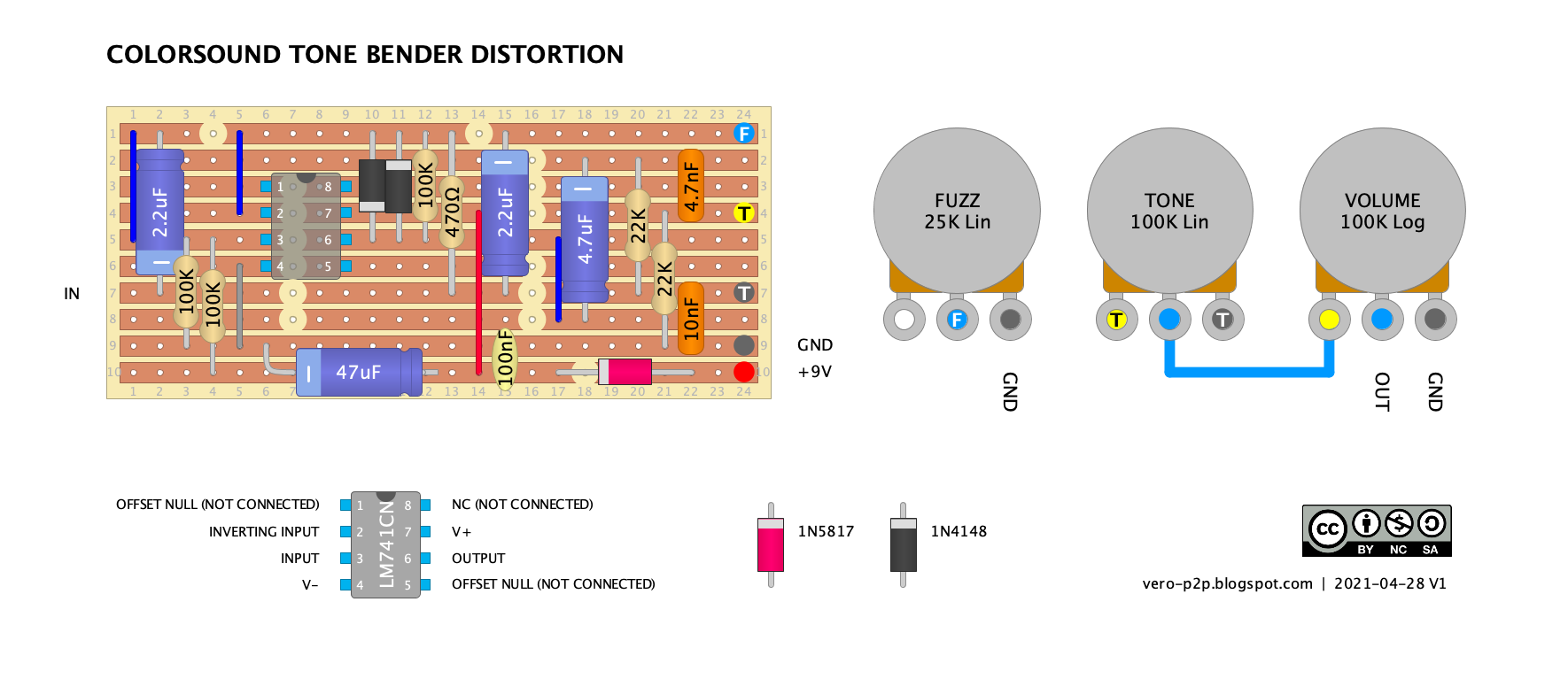
COLORSOUND: Tone Bender Distortion

I did a point to point layout for this some time ago, which was actually my first post for this blog.  Full description via the link above.   

The Colorsound Tone Bender Distortion is more distortion than bender - there are zero similarities between a MKI, MKII or MKIII bender and this circuit. 


COLORSOUND TONE BENDER DISTORTION - VERO LAYOUT

COLORSOUND TONE BENDER DISTORTION - GUITAR EFFECTVERO LAYOUT STRIPBOARD LAYOUT FOR DIY FX


COLORSOUND TONE BENDER DISTORTION SCHEMATIC


Sunday, March 7, 2021

COLORSOUND: The Yellow Hybrid OC140 Tone Bender by Jake Rothman

All the details are listed in the previous post - this is a 0.15" version of the yellow Colorsound Hybrid Tone Bender.  

I did the previous layout on standard size vero, and after using 0.15" vero and tag board on a lot of builds recently, it just seems very tiny now, so I did another layout on a larger scale.


YELLOW HYBRID COLORSOUND TONE BENDER - 0.15" VERO LAYOUT

YELLOW HYBRID COLORSOUND TONE BENDER - 0.15" GUITAR EFFECT VERO LAYOUT


note:  the exact value of the zener diode at the time of posting this unknown


On the bench, waiting for an OC140 to arrive in the mail.  I've built another on regular vero with an AC127 (which sounds great).

Not exactly as per the the layout above, as I moved a couple of things around a little to fit more comfortably.  I'm also going to try a 47n cap in the tone section instead of 33n - 47n is found in earlier versions.

Yellow hybrid tone bender build photo

  • 0.15" vero
  • 1W carbon film resistors
  • The orange caps are Philips
  • 500pf styroflex caps instead of 470pf ceramics
  • OA7 germanium diode
  • Standard MKT caps in grey and white
  • Q1, AT462 which is similar to a BC107
  • Q2, BC109C
  • Q3, will be an OC140 - once it arrives in the post
  • Added 100ohm resistor to combine with a 220uf for power filtering, and a diode for polarity protection


Friday, March 5, 2021

COLORSOUND: The Yellow Hybrid OC140 Tone Bender by Jake Rothman

Such a lengthy heading...   I've been waiting to find out what was going on with this one, and it has recently been traced on the Pedal PCB forum.  There's also a great back story here, with some info on the Zener diode.

The schematic can also be found via the Pedal PCB link above. 

There are other earlier versions, including a PNP version using an OC75.  The OC75 version is very close to the OC140 version - although there's no diode involved in biasing the collector, just a 4k7 resistor (and obviously some different transistors on Q1 / Q2).  A couple of odd value resistors, like a 10ohm on the emitter of Q2.  I'm pretty sure I'm reading it correctly, but...  

The PCB is a Jumbo Tone Bender board with modified parts/values.   


COLORSOUND HYBRID TONE BENDER (2018 EDITION) - STANDARD VERO LAYOUT

COLORSOUND HYBRID TONE BENDER (2018 EDITION) - GUITAR EFFECT VERO LAYOUT


note:  V3 germanium diode polarity reversed, fuzz pot changed to A100k

COLORSOUND HYBRID TONE BENDER (2018 EDITION) - STANDARD VERO LAYOUT


I'll get around to cleaning up the connections at some point, as they are a bit rough and will also add another diode for polarity protection - this was a quick solder job for testing.

It works....  sounds like a Tone Bender too.  Not a direct replication of the sound of a MKIII / MKIV, but the flavour is there.


I had to make a few substitutions as I did not have all the parts as per spec. 

  • 5.1V zener diode, instead of the 4.7V (bear in mind the actual value has yet to be confirmed)
  • AC127 instead of the OC140 - it's quite leaky, with a gain around 100
  • AT426 instead of the BC107
  • 100n instead of 10n, just because I wanted to, and it has been seen in earlier versions
  • B25k pot instead of W20k


TONE POT SWEEP


The PNP version uses tropical fish capacitors, using a 47n cap instead of 33n, resulting in a slightly different sweep, with less of a dip in the mids.


ON THE SCOPE / FFT

Input signal:  440hz sine wave, approx 130mv TRMS


Q1 Collector  (AT426)
Fuzz set to 100%
C 4.4V
B 0.6V 
E 0.04V


Q2 Collector (BC109C)
Fuzz set to 100%
C 4.35V
B 0.6V 
E 0.04V


Q3 Collector (AC127)
Fuzz set to 100%
C 1.7V    (Traced pedal read 2.5V with OC140)
B 0.1V 
E 0.0V


Bass


 Treble


 Tone 50 / 50 Mix


Monday, January 11, 2021

COLORSOUND: Bass Fuzz

The Colorsound Bass Fuzz is a Big Muff style circuit, missing a pair of diodes and the gain recovery stage, not unlike a Jumbo Tone Bender.  Caps have been enlarged to suit the bass guitar.


COLORSOUND BASS FUZZ - VERO LAYOUT

COLORSOUND BASS FUZZ GUITAR EFFECT VERO LAYOUT


Saturday, November 14, 2020

COLORSOUND: Fuzz Box

They don't come much more straightforward than this - said to be a Dick Denney design, the Colorsound Fuzz Box is a one-knob silicon fuzz face with a couple of value tweaks, but other than that, you know what you're getting here.   

This circuit is also found in the Vox V1141 Super Beatle solid state amplifier.

The layout below is the D*A*M / Macari's reissue, which is a great way to use up the little bit of vero left over from making other circuits.

COLORSOUND FUZZ BOX   -   0.15" VERO LAYOUT

COLORSOUND FUZZ BOX VERO LAYOUT

There's a few comments below regarding values - yes, they can vary a bit in the wild.   I think the different Macari's releases have slight tweaks to some resistor or transistor values.   From what I gather, this is normally the bias resistors on Q2 (2k2 and 82 ohm as shown above).  

There's also a bit of debate on the topic at FSB


The Colorsound Hammer House Fuzz Box uses what looks to be 5k6 and a 270 ohm resistor, so there is some room for movement or experimentation in this area.  I've certainly needed to change values occasionally to get the best results out of some vintage RCA silicon transistors that I was using.

Increasing the 82 ohm resistor lifts the output a bit.  With the 82 it's a bit above unity running full tilt.   


Same again but with a 120 ohm resistor - you can see it has a bit more beef now compared to the input signal, despite only having an extra 38 ohms of resistance.


Below is the Hammer House version - even hotter again


Saturday, July 11, 2020

COLORSOUND: Tone Bender Distortion, Point to Point Layout

The Colorsound Tone Bender Distortion, one of the lesser known Tone Benders - which also happens to be a recent D*A*M collaboration with Colorsound (Macari's Music), who released a faithful reproduction using original circuit boards after some were found in a basement.  

More information can be found on the D*A*M forum which is a very handy source of information for all things Tone Bender.   Just don't go asking for advice, it's not really a builders forum from what I can tell.

The Colorsound Tone Bender Distortion is more overdrive bordering on distortion than bender - there are zero similarities between a MKI, MKII or MKIII bender and this beast. 

COLORSOUND TONE BENDER DISTORTION - POINT TO POINT LAYOUT


SOLA SOUND TONE BENDER DISTORTION VERO POINT TO POINT P2P LAYOUT


SCHEMATIC


COLORSOUND TONE BENDER DISTORTION - SCHEMATIC


This is probably more like an overdrive than a distortion, as the diodes are soft clippers


Gain @ 100% - Tone pot sweep

COLORSOUND TONE BENDER DISTORTION - SCHEMATIC


Tone control is a variation on the classic big muff