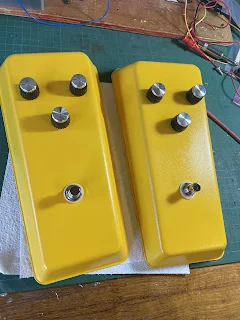
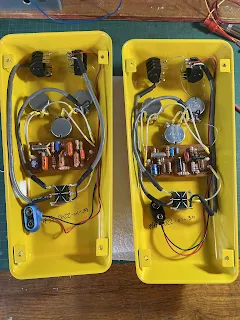
Showing posts with label ENCLOSURE. Show all posts

Monday, January 19, 2026

ENCLOSURE: Wiring rig

This was long overdue - I finally got around to making a half-decent wiring rig.  I’d been using cardboard from pizza boxes (yes really), which worked, but it was pretty ordinary to say the least.

Once the parts were laid out and the enclosure marked up, I drilled the pilot holes in the chassis, then cut and drilled a sheet of lightweight galvanised iron to match.  It turned out to be far easier than I expected, and I honestly can’t believe I waited so long to do something like this.


This one in particualr is for a Foxx Tone Machine, but as a generic layout for a 3 knob circuit in a 1590XX this will be fine.  


I quite often do most of my wiring in the enclosure, this makes things a little easier.  I'll have to make a few more, for different types of enclosures.


Sunday, October 13, 2024

ENCLOSURES: Cutting Holes for a Battery Draw

I know I could probably pay Tayda to do this, but they don't always have the enclosures that I want, and part of me likes going down the hillbilly route with a hand drill and a file.

Here's my process for cutting out holes for battery draws.  It's actually pretty easy to do.  

STEP ONE:  MARK OUT

So first things first - make sure that you know where you plan on putting the foot switch and other parts, to make sure there's room for the battery draw.  

Use the battery draw as a guide to trace out the length / width etc, using a square.   

STEP TWO: DRILL THE OUTLINE

I use a small drill bit to get as close to the inside edge of the line as I can, trying to keep the holes quite close together.  I don't have a fancy pedestal drill, so this is all done with a regular battery powered hand drill.

Pedal enclosure - battery cut-out

STEP THREE: REPEAT, BUT BIGGER

Then I use a larger bit to drill around the smaller holes, and in some cases this breaks through the edges of the smaller holes, creating a bigger gap.

Pedal enclosure - battery cut-out

Once this is done, metal shears finish the job - it's usually doesn't take much effort at all.

Pedal enclosure - battery cut-out

STEP FOUR: GET BUSY WITH THE FILE

As the title suggests, time to get busy with the file.  Check progress as you file, because aluminium is quite soft and the file will do its work quickly.  Check the hole with the battery case occasionally, just to make sure you are on track.  Watch the corners too - most of the hole can be the right size, but if the corners aren't, it will not fit, leading you to remove more material than required.

Pedal enclosure - battery cut-out

Pedal enclosure - battery cut-out


STEP FIVE: DRILL MOUNTING HOLES

I like to drill the holes for the battery holder at this stage, using the case itself as a guide.

Pedal enclosure - battery cut-out

Pedal enclosure - battery cut-out


NEARLY THERE

After drilling out small pilot holes for pots and jacks etc, it's time for the stepped bit.  Keep an eye on the stepped drill bit, as they tend to clog and this can cause issues.  I find slow and steady drill speed with a little pressure works for me.

I also like to double check the size while drilling, using the components that will go on the enclosure, to make sure that I don't accidentally overshoot it.  

Pedal enclosure - battery cut-out

Hopefully it looks something like this when you're done.  I've given it a light sand and a wash in warm soapy water by this stage.

Pedal enclosure - battery cut-out


Thursday, February 22, 2024

GAPCO: Vintage Pressed Steel Enclosure

I'm sure we're all familiar with these enclosures from GapCo, just jotting down some notes for myself, as I found a drawing with dimensions (sorry Reverb seller).   

GAPCO VINTAGE ENCLOSURE

  • Plain unfinished steel, arrives lightly oiled, may have light rust (will need a very good clean)
  • Holes for pots are 6mm, which suits 16mm pots
  • Note that these enclosures come without screws, and they are also untapped (the thread for the screws need to be cut in). 

Gapco tone bender enclosure


Gapco tone bender enclosure dimensions


HARDWARE REQUIRED

If ordering direct from Gapco, they are not supplied with screws - #8 x 1/2" Pan Head Phillips Sheet Metal Screws.  Alternatively, get the nearest size stainless steel metric self tappers from Bunnings.

Thursday, January 12, 2023

OFF-BOARD WIRING: Tone Bender MKI off-board wiring for vero layout

Just a reference for me - this is specifically for this layout mounted above the pots.


MKI TONE BENDER OFF-BOARD WIRING PLAN

Tone Bender MKI - Off-board wiring for vero layout

The final soldering of the board to the pots has not been done yet - that will be done when it is mounted on the actual enclosure lid, as opposed to the dodgy piece of cardboard that I'm using as a wiring template.   

MKI TONE BENDER OFF-BOARD WIRING PLAN PHOTOS

These little clips are handy for securing the reasonably heavy Belden shielded cable I'm using.  It has its own ideas about how it would like to bend.  I could probably warm it up and reshape it, but I don't mind.  It's normally a two-core cable with shield, but I remove one core and use it for other purposes.   

MKI TONE BENDER OFF-BOARD WIRING PLAN PHOTOS 2

If you're wondering, transistors: Q1, OC71.  Q2, OC44.  Q3 NEC ST303 (later removed and replaced with an OC71)


Sunday, January 30, 2022

BALMORAL ELECTRIC: MKIII / MKIV Tone Benders

Two new MKIII / MKIV Tone Benders finished over the weekend - the circuits have been finished for a while, just had not got around to boxing them up.  Hopefully off to new homes shortly.   Pity Gapco is now out of stock with these enclosures - I should have bought more when I had the chance…

One has a traditional MKIV spec, and the other is more like a D*A*M Fuzzsound / MKIII.  


MKIII / MKIV Tone Benders

MKIII / MKIV Tone Benders


As a comparison - the main difference between the two is that the D*A*M uses different filter values (tone stack).  A 220n and a 4n7 cap for D*A*M vs 100n and 2n2 in the stock Sola Sound (3.3khz vs 7.2khz).  Basically, the D*A*M has more prominent mids, as the high pass filter on the treble side has a lower cutoff.  Of course, there's a lot of talk about what transistors are used and the impact that has on sound - which I think is more of a textural thing, but I won't go down this road.


tone bender MKIV vs dam fuzz sound freq response


The difference with the bias resistors on the base of Q1 also makes a small difference in the frequency response, but nothing significant by the time they reach Q3. D*A*M uses 220k / 47k, which is used in the Sola Sound MKIII Tone Benders, whereas the MKIV uses 680k / 100k.  Check out the tone bender values tables post if you’re interested.

tone bender mkiv vs dam fuzz sound darlington pair freq response


Wednesday, November 24, 2021

VERO: How to Mount Vero in Pedal Enclosures

THE PROBLEM WITH VERO / STRIPBOARD LAYOUTS

As much as I like a bit of vero (clearly), vero is not meant for commercial-scale production, at least in the modern sense.  Unlike PCBs, where pots and switches can all be mounted on the board, thus providing a convenient way to hold the board in the enclosure, vero layouts are almost never designed this way.  This brings us to the issue at hand - I've built it, now how do I make it stay put in the box, or how do I know this thing will be reliable?

Vero, or stripboard layouts are often laid out by folks like me, with small size often being the main driver of the layout, without any consideration for anything else.  What is rarely seen on layouts is space for mounting points, or any indication of how it should be laid out in an enclosure with pots, jacks, switches etc.  Sure, we all like to do our own thing, but it's kind of hard to work out when you're just starting out.  I know when I was starting out, boards were jammed in enclosures in any way possible, usually with a lot of excess wire.  As long as it worked and I could close the lid, I was happy.


SO WHAT TO DO?

Well, kind of obvious - secure the vero board to the enclosure properly.  The board is literally full of things that you don’t want touching the enclosure, switches or any other conductors.


HOW TO MOUNT VERO IN A GUITAR PEDAL ENCLOSURE?

Standoffs

This is my preferred method.  Self-adhesive plastic standoffs are pretty handy - but you will need to check if there's space on the layout for a few holes and that there is enough room in the enclosure once the pots and switches are in (which should happen first, in my opinion).  If there isn't enough room, see if there's room to add a couple of rows or columns to the vero layout for mounting holes.

Standoffs come in many different shapes and sizes, usually with a plastic snap to lock them in place, or a small screw.  Naturally, if you are using the metal screw type, make sure that the screw isn't shorting the conductive strips on the vero board.   Of course, there is the bulletproof method, of screwing the standoff all the way through the enclosure, but this is a little harder to do and can limit space for graphics on the front.


circuit standoff - stomp box / vero board mounting


circuit standoff - stomp box / guitar fx / vero board mounting

This is a small point-to-point board - a single screw was enough to secure it.  In retrospect, I should have used two.  


circuit standoff - stomp box / guitar fx / vero board mounting


circuit standoff - stomp box / guitar fx / vero board mounting

Plastic standoffs on each end of a D*A*M Fuzzsound worked well


Glue

Quite a few people use hot glue guns to secure boards, and it works, but good luck if it ever needs repair.


Tape & Velcro

Thick double-sided tape and velcro also does the job.  At least with Velcro, you can remove it for repair, but something about velcro in a pedal bothers me.


Gum

No not that type of gum.  This is a suggestion from a comment left on the post (thanks Brain).   There's a sticky gum/gel specifically designed for sticking down boards, but you can still remove them later (with a bit of effort).

https://guitarpcb.com/product/gum-wadz-pcb-mount/   


LAYOUT PLANNING

I normally look at the vero layout, pots, switches and enclosure size before starting the build.  This way I can get a feeling for how I might finish, before I start.  Kind of frustrating to have something in mind, only to find that it was never going to fit after building the circuit.  I learnt this the hard way, maybe more times than I care to admit.

After I've built and tested the circuit (with ample wiring already on the board), I double-check that everything fits, by first adding the jacks, switches and pots to the finished enclosure.  Then drop the board in, to confirm the initial plans are still valid.  

I usually wire up the jacks, stomp switch and LED first - then I attach the circuit to the enclosure, and cut the cable to size, and solder connections as required.

Another method I sometimes use is to create a cardboard wiring jig, and do most of the work there, before transferring to the proper enclosure.   This just provides a bit more room to move, as some enclosures can be a little cramped to work in, and it works out about the same in terms of final product.


How bad does the cardboard jig look?   This is the Revox A77 preamp that I put in a wedge enclosure.


WHAT TO AVOID WHEN MOUNTING CIRCUITS IN PEDAL ENCLOSURES?

Now I think I've done nearly all of these things at one stage - so no judgement if you have too.

Try not to:

  • Wrap it in electrical tape, sure it works, but what a mess
  • Stick it in a plastic component bag
  • Do nothing and hope for the best / won't the wires just hold it where it should be?


Saturday, May 1, 2021

Tone Bender MKI Guitar Pedal Enclosure

So I finally got around to buying a Tone Bender MKI-style wedge enclosure.  I had been waiting for another seller, and they now have them in production.  I’ve just bought one on eBay, and I’ll update and compare it when it arrives.

Naturally, I'll be putting a Tone Bender MKI circuit in this enclosure and finishing it in traditional colours with a hammered finish.  I might document this in another post.

It feels pretty well built, quite heavy.  I was expecting mild steel instead of galvanised steel construction, but I'm fine with this.  It also came with a battery holder and a hole to mount it, which is a bonus.

The holes for pots look a little small for 25mm pots, so I'll be increasing the size, the foot switch and jacks are fine as is.


EBAY SELLER

Seller ID:  james1990.2012

They were prompt, communication was good, and shipping was fast via TNT.  About a week from the time of purchase to arrival, bearing in mind I bought it on a Friday night (China to Australia).   

The eBay seller is listed as being in Japan, however, the package was shipped from Changzhou Sun International Trade in China.

The packing was good - strangely, it came in a Colorsound box...   

The same seller also has Fuzz Face and Tone Bender MKII enclosures, but neither has holes for screws in the cast enclosure.  Not sure if I'm game to attempt drilling and tapping threads myself on relatively expensive and oddly shaped enclosures.  Tempting, maybe another day.  

PHOTOS OF THE TONE BENDER MKI ENCLOSURE

PHOTOS OF THE TONE BENDER MKI ENCLOSURE


PHOTOS OF THE TONE BENDER MKI ENCLOSURE

PHOTOS OF THE TONE BENDER MKI ENCLOSURE

PHOTOS OF THE TONE BENDER MKI ENCLOSURE


TONE BENDER MKI ENCLOSURE - DIMENSIONS

It has been built to the original imperial measurements - which matches plans I've found online elsewhere.

The steel is 1/16" thick or 16 gauge.


PHOTOS OF THE TONE BENDER MKI ENCLOSURE WITH DIMENSIONS


PHOTOS OF THE TONE BENDER MKI ENCLOSURE WITH DIMENSIONS


Friday, February 19, 2021

Tone Bender MKI Enclosure From Sunetec on eBay


These are now available from sunetec_au on ebay.  
I previously purchased a couple of wedge enclosures from them, and they are really well-made. 

It’s the right size, and it’s made from decent steel. Shipping was free and fast from Hong Kong.  It has rubber feet instead of pressed metal bumps - think I prefer rubber feet.  While not on the original, it’s more practical.   


Wednesday, January 20, 2021

ENCLOSURES: Maximum Vero and Tag Board Widths


HAMMOND ENCLOSURES - MAXIMUM VERO & TAG BOARD WIDTHS

Hammond 1590B

Standard vero board
Portrait:          21, possibly 22, with a bit of help from a file


Hammond 1590N1 (125B)

Standard vero board
Portrait:          23


Hammond 1590BB

Standard vero board
Portrait:        33
Landscape:  43

0.15 inch vero board
Portrait:        22
Landscape:  29

Tagboard
Portrait:        13, maybe 14 if you filed it tightly 
Landscape:  17


Hammond 1590XX

Standard veroboard
Portrait:         44
Landscape:   52 


WEDGE STYLE ENCLOSURE - MAXIMUM VERO & TAG BOARD WIDTHS

vintage wedge enclosure with dimensions

 
Standard vero board
Landscape:  30
 
0.15 inch vero board
Landscape:  19, 20 at a squeeze

Tagboard
Landscape:  12


TONE BENDER ENCLOSURE - MAX VERO & TAG BOARD WIDTHS


Standard vero board
Landscape:    28 flat
 
0.15 inch vero board
Landscape:  20 flat, up to 22 if on risers (walls slope outwards quite a bit)

Tagboard
Landscape:  12 flat, 13 on risers

Wednesday, December 23, 2020

WEDGE ENCLOSURE: Finishing Enclosure #1, Dark Grey Hammerite

I bought a couple of these enclosures on e-bay, not being completely sure what they would be like, but I'm pretty happy with them.  They feel solid, and the tolerances are good (no big gaps, and everything fits nicely).  The corners are a bit sharp, but nothing a file can't sort out before finishing.


VINTAGE-STYLE WEDGE ENCLOSURE DIMENSIONS


vintage wedge enclosure with dimensions


vintage wedge enclosure open


DRILLING THE ENCLOSURE

Drilled and ready to be prepped for painting.  Being steel, this is harder to work with than Hammond style aluminium enclosures - it takes a bit more effort to drill, and pilot holes are a must.  


PAINT - HAMMERED FINISH

Two light coats at the start and one a bit heavier at the end.  If you don't apply a decent coat at the end, the hammered finish doesn't appear.


The actual colour is slightly darker than the cap, but that's fine.


APPLYING GRAPHICS ON THE ENCLOSURE - WATERSLIDE DECAL

The decal application was more successful than my last attempt using a different product (that was on a Tone Bender enclosure).  I used an ultra-thin decal this time.  It's not perfect, but it's close enough for me. 


FINAL CLEARCOAT COVER

First coat of clear coat, and it's coming up well.  The edges of the decal are still slightly visible, but it's very hard to see.   Another coat will probably sort that out.


Second coat - it's hard to see the edge of the decal now.  Coming up well.


FINISHED ENCLOSURE WITH HARDWARE

As the name on the box suggests, it's a D*A*M Red Rooster that I made using a point-to-point layout.   I was considering not using the name on the box, but decided to run with it anyway.