I've had a couple of questions about these recently, and out of curiosity I decided to take a closer look. In 2024, Sola Sound released a few versions of a hybrid MKI, built by Dave Main of D*A*M.
So what is it? It’s essentially a standard MKI circuit, but with the first two germanium transistors replaced by silicon transistors. Because silicon devices don’t leak like germanium, a few extra resistors are needed to get things working properly.
As this is an incomplete trace and there are circuit variants - use the info below as a guide only.
That being said, I have breadboarded this with success - transistors matter.... It sounded a lot like the video demo below, and it was easy to tune playing with input and coupling capacitor values.
SOLA SOUND HYBRID MKI LAYOUT
There aren’t many photos available - I couldn't make out a few values, but I got most of it. You’ll want to experiment on a breadboard and dial things in before committing to solder.
I ended up making a slightly different layout, as I didn't like some of the placment on this one.
The two values that I just could not see anywhere: R3 & R7. For R7, start large and scale down, it seems to tame the gain somewhat - it can also assist with noise if this is a problem. For R3 I tried a couple of different values. I have 4k7 on the breadboard at the moment.
The cap values that I could not really see are C1 & C2 on the input & C3. C3 is just a suitable large electrolytic cap, normally a 22u.
I’m currently using 8k2 for R5 with a 50k pot. Could probably use a 25k pot and skip R6.
Groke
Note that R9 is actually 2 x 15k resistor in parallel, wich may as well be the stock value of 8k2.
The Griffin
Some difference with R5 & R6 are visible.
Brandy Snap
Looks like a 15n input cap with a 4n7 to ground. 1u coupling cap. Maybe a 1m5 resistor on the output.
Macari's often release pedals that are minor variations on the same circuit - in this case the "Sakata" Colorsound hybrid one knob fuzz has quite a few value changes compared to the previous hybrid they released, which was closer to a stock fuzz box. Macari's describe the Sakata as being tuned closer to a MK1.5
I was going to add this to my previous post about the Colorsound hybrid fuzz box, but I thought there are enough differences to deserve it's own post. For one, this is a positive ground effect, with the previous is a standard negative ground set-up.
Personally, I would not pick up the soldering iron until I'd tested this on a breadboard. Being a small circuit it will be quick and easy to do, and you can test a few values / transistors to see what you think.
COLORSOUND "SAKATA" ONE KNOB FUZZ
Transistors: BC179C for Q1 and an STC TK22C for Q2. Both PNP transistors. Like any fuzz face style circuit, transistor choices in this circuit will matter, as will the bias resistors.
Q1: The BC179C lists hfe in the 380-800 range - it's the PNP compliment to the BC109C if this helps you think of alternatives or as to how it might behave in the circuit.
Q2: If you can't access a TK22C, try an OC71. Without knowing the leakage and hfe range of the TK22C they selected, there will be some guess work here, even if you have some on hand (note my point above re breadboarding).
The bias resistors on Q2 look like 520 ohms and 5k6. The feedback resistor is 100k. These values are important.
The input cap is an electrolytic - I can't read the value, which isn't all that important, as once the input cap is over 1uf differences become minor (stock value on the fuzz box is 100n). A MK1.5 is 4u7 so I'd run with that. If you don't have a 4u7, 2u2 will be close enough.
Same with the bypass cap that's paired with a 1k resistor. I can't see the value, it's most likely 22u, which is what appears in a MK1.5, Fuzz Face etc.
The D*A*M Drag n Fly DF-05 is a hybrid fuzz pedal that combines silicon and germanium transistors, drawing inspiration from the classic Fuzz Face design.
What sets it apart is its unique filter control, located at the input of the circuit. This control blends the input signal between a 10uF and a 4n7 capacitor, offering a wider tonal range compared to the traditional 2u2 found in standard Fuzz Faces. Its brethren the Dragonfly DF-06 has the tone control at the end of the circuit, using something similar to a MKII.
While the overall circuit is straightforward, it incorporates some non-standard component values to fine-tune the sound, and there's a touch of the Vox Tone Bender in some circuit variations - and there were many variations on this circuit.
D*A*M DRAG N FLY DF-05 VERO LAYOUT
This is one of the layouts used by D*A*M - the 0 ohm resistors are often replaced by jumpers under the board.
Looking at the image below, it appears that they used velcro to mount the circuit to the back of the pots.
SCHEMATIC / LTSPICE
Component values have differed across various production runs over the years. The schematic serves primarily as a guide, illustrating the circuit's topology rather than providing definitive values.
Anyone familiar with D*A*M circuits will have seen the input capacitor blend on a few other designs.
This is what the signal looks like at the base of Q1. Basically it sweeps the bass response from thin to fat. The small bump in the middle is a result of the 47pf cap across the collector and base of Q1.
VARIATIONS
There are so many… check the D*A*M forum post hereThese are just some that I've seen; there are probably more. So if you don't have the "right" transistors, maybe don't stress about selection too much, as a lot were used over time.
10k instead of 18k resistor on Q1 collector (likely to be transistor selection related)
2 x trimmers for biasing on some layouts
56k resistor instead of 120k between the base of Q1 and the emitter of Q2
10uf and 3n3 on the input blend
R1 / 1 meg resistor on the input, not always used
Q1: BC108, BC107B and plenty more unidentified silicon transistors
Q2: AC176, AC187, OC76, OC82, AC128, CV7112, OC140 (note some are PNP)
note: this is a revised post from April 2022 with updated information, schematic and layout.
This the D*A*M Dragonfly DF-06, which is somewhat confusingly not the same circuit as the D*A*M Drag n Fly. They're both in the Fuzz Face family, but they each approach the tone control differently. The Drag n Fly does the tone shaping up front, while the Dragonfly does it at the end of the circuit, using a method similar to a MKIII.
Not having one available to trace, I’ve relied on photos available online. Unfortunately a few capacitor values can't be seen, however, on the upside, it's not hard to guess what they might be to get something very close to the mark.
For me, the key value is the capacitor forming a high-pass filter in the tone section. Breadboard it and see what you like, or be prepared for a bit of soldering on the vero board. The other caps certainly have a role to play, my feeling is that while they contribute to the overall bass response, the filter section is where the magic happens.
Possible high-pass filter values:
24k 4n7 1.3khz
24k 3n3 2khz
24k 2n2 3khz
D*A*M DRAGONFLY DF-06 0.15" VERO LAYOUT
DRAGONFLY TRANSISTORS
It's a hybrid silicon / germanium circuit. The DF-06 below uses a BC337 & an OC141. The BC337 is very similar to a 2N2222A which us a regular low gain NPN transistor. Just watch the transistor pinouts, as the BC will be the reverse of the 2N. i.e. Flipped 180 degrees.
If you don't have any decent NPN germanium transistors, drop in a silicon and I'm sure it will still work - but you may need to tweak some resistor values to get it to work well. This may even be the case with germanium transistors, as I’m sure Dave Main will have biased this to get what he wanted out of these particular transistors.
STYRO CAPS
As you can see, the styro cap (the silver one) on the input to ground is larger than the one in the high pass filter section, which leads me to believe that it's probably a 10n, similar to what might be found on a MKII Tone Bender.
D*A*M DRAGONFLY SCHEMATIC
As a few values are not known, this is really just a guide to what the circuit looks like and it's handy for me to test possible values in LTspice. Where values are unknown, I think a safe bet is running with component values used in fuzz faces and tone benders. Seems like an obvious choice. An AC127 was used in LTspice, as I didn't have access to the model for an OC141.
Like most things pedal-related, and I've mentioned this before - nothing beats building it and testing values on a breadboard.
INPUT CAP C2
I've shown a few values below, which as mentioned above, are probably common fuzz face or tone bender values.
TONE CONTROL - HPF CAP C4
C4 forms a high pass filter with R6, the 24k resistor to ground. The high pass filter is mixed in with a direct signal from Q2 via C3 (100n cap). This is quite similar to a MKIII Tone Bender arrangement.
Lower value = more mids. Higher values have a bit more sizzle.
Not much around in terms of video - this is all I could find
The Colorsound Fuzz Box has to be one of my favourite fuzz circuits, due to its simplicity and reliable results. It's very much a one trick pony, but if you just want a nice thick fuzz, this will to that trick quite well. The original silicon circuit is said to be a Dick Denny design, found in the Vox V1141 Super Beatle solid state amplifier.
The layout is the same as the traditional all silicon version, with some component values changed - most notably Q2 is now a germanium NPN transistor and the bypass cap has jumped up from 10u to 22u.
If you want a bit more than the Fuzz Box, check out the D*A*M Meathead series or Drag n Fly, as they appear to be a very close relative to the Fuzz Box. They're also a good reference to see the range of possible component values to play with.
COLORSOUND HYBRID FUZZ BOX - 0.15" VERO LAYOUT
If you don't have the CV7112, try any low leakage NPN germanium transistor that you can get your hands on, and see how it sounds. The CV7112 is a mil spec OC140.
Maybe you will need to tweak the resistor values a little (the 2k2 and 82 ohm in particular), hopefully you have a breadboard that you can experiment on, rather than unsoldering and soldering resistors on the board.
I was testing it on the breadboard with a 10k pot in place of the 2k2 and found that about 4K was the sweet spot for the AC127 I was using. I also increased the 82 ohm resistor to 120 for higher output.
I've not found reliable photos of the low value resistor paired with the 2k2 (the one on the far left). I've left what I consider the stock value of 82 ohms on the layout. It might be a little different to this - who knows... increasing the 82 ohm resistor increases output, which might be a good thing in some cases. It doesn't need a substantial increase to see higher output - even taking up to 120 is noticeable.
I'm sure you've seen other layouts with 820 ohm resistor instead of 82 - debate / clarification on FSB can be found here and on DIY Stompboxes. I mostly use values that I can see in photos or verified circuit traces. If you don't have an 82, I'm guessing you probably have a 100 ohm resistor - just use that, it will be fine.
LTSPICE RESULTS
Here's the difference between 10u and 22u on the bypass cap.
And for the diagram below, this is what happens when the input cap is changed (retaining the 22uf bypass cap).
In this circuit, the input cap, along with the 150k resistor and the bypass cap, mainly control the frequency response. If you want to tweak the response, the easiest way is to increase the input cap. The 220n cap on the output doesn't do much for the frequency response, so if you're looking for a bit more thickness, you could try swapping the input and output caps. For reference, a Fuzz Face uses a 10n cap on the output, so even dropping to a 100n cap still gives you plenty of room to play with.
No doubt there will be some colouration as a result of the germanium transistor, as it's not entirely unusual for some to sound tonally different to others. i.e. fatter or thinner at times, maybe more or less highs.
LTspice is a handy guide, but it by no means replaces real world testing with a breadboard and a guitar plugged into an amplifier running at an obnoxious level.
Changing the 82 ohm resistor has no effect on frequency response - the level increase is very obvious.
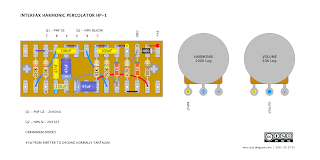
This is a slightly modded Interfax Harmonic Percolator that I made today. It's an odd little circuit - it can run from clean, a bit overdriven, then into distortion, and finally to overly compressed fuzz madness. The range of sounds are so broad, it's almost worth setting it up as a dual pedal (which I might do).
In terms of mods, it's kind of a mix of a couple of schematics, the Land Devices HP-2 and a bit of my own thing. It's still very much a Harmonic Percolator, that much is sure. If you want to use the layout for a stock Harmonic Percolator (whatever that may be), there's fairly extensive discussions on the usual forums, including schematics and of course many and varying opinions as to what it should be.
INTERFAX HARMONIC PERCOLATOR - MODDED VERO LAYOUT
When it was on the breadboard I tried a few different transistors. The differences were noticeable, and I'd recommend testing before soldering, to make sure that you have a combination that you're happy with.
If you have a breadboard, it's worth getting it on there to play with - there are so many variations on this circuit, and they do make a difference.
The silicon transistor had a hFE of around 240 and the germanium was about 70 with almost no leakage (like many soviet transistors). The type of germanium and silicon diode is not important.
ON THE SCOPE
With the input trimmer down, it's a pretty clean signal (called Harmonics on the pedal). I run a 200mv 440hz sine wave into my scope.
This is with harmonics on full, it's a fairly over the top and very compressed fuzz sound. Germanium diodes are on.
This is Harmonics on full, diode clipping bypassed - there's a huge jump in level and it's a lot more dynamic.
Similar to the previous Zonk Machine, this has a MKI switch for a larger input cap. Have had this on the breadboard recently, and decided to jump to a vintage-style veroboard.
There are of course more differences between a MKI Tone Bender and a Zonk than just an input cap, but for convenience's sake, the input capacitor gets you pretty close.
MODDED JHS ZONK / MK1 HYBRID - 0.15" VERO LAYOUT
HYBRID ZONK ON THE BENCH
Some minor changes to keep some mojo caps on the board. 12n instead of a 10n input cap, as I got a reasonable deal on 100x 12n caps. 10n tropical fish are sometimes expensive.... same for the 100n, went for something larger, which will have almost no impact on the sound, but not a common value, meaning substantially cheaper.
OC76 for Q1 and Q3. Q2 is an old silicon glob top from Fairchild.
Yet to build this myself, I quite like the idea behind this - I am partial to anything with bass / mid/high controls for guitar and a germanium transistor. Bonus points for also including a discrete op-amp, which I've been playing with lately.
Before I looked at the schematic for this, I was playing around with modding a Boss Blues Driver to make the tone stack a real tone stack with external pots and removing the last stage, just leaving the two discrete op-amps. This is a refined version of where I was heading, so I think I'll park that project for now.
BOOST STAGE
The boost stage uses a LND150 MOSFET which is common on several Spaceman Effects designs. It could just as easily have been a JFET-based boost - this is a clean boost to make up for the gain loss at the EQ stage. A little bit of high-end is also filtered off at this stage, but nothing substantial. You may not even hear it.
EQ
It's a fairly standard bass / mid/high tone stack with some tweaked values. This could be modded to typical values for Marshall or Fender, but there's a decent chance Spaceman went this way for a reason - it looks pretty balanced to me.
DISCRETE OP-AMP
It's a Boss-style discreet non-inverting op amp using two JFETS and a PNP transistor (as found in the Blues driver). There are a couple of resistor value changes, and the PNP transistor is, of course, germanium instead of silicon - hence the germanium preamp name. The GE transistor will add some extra flavour, but maybe not much more.
According to the Dead End FX build docs, a 1T308B transistor is used - it makes sense to use Soviets for a pedal with a large production run. If you don't have a 308 - try something around 70-80 hfe and low leakage (most Soviet-era transistors have low leakage) Japanese transistors might also be a good choice.
Potential mod: As this is just another type of op-amp - diodes can be added across the output of the op-amp and inverting input for some soft clipping. It works on LTspice, so it should work in practice. I'm definitely going to try this.
SPACEMAN REDSTONE GERMANIUM PREAMP - VERO LAYOUT
The layout below is missing the soft switching to save on size. If you don't have ferrite beads, jumper it on the input, or use a low-value resistor in the power section (100ohm). You could quite happily not use the MOSFET in the power supply section, but I had the room, so may as well keep it in.
The same layout as above, but this one is for a Soviet 1T308 transistor, which uses the less common BCE pinout, as many Soviet-era transistors do - you could always use the one above and bend the legs. Still, I find that annoying, so I made another layout to suit.
SCHEMATIC
I redrew part of the Deadend FZ schematic, as I found it difficult to picture the discreet op-amp. I have not included the soft switching or fancy power supply in the drawing below.
This is a slightly different hybrid MKII than I have previously seen - this is a Sola Sound MKII built by D*A*M, referred to as the Black Fish Skin version by Macari's Music. The PNP Silicon transistor is a PNP version of a BC109 / BC108.
I couldn't see the value of one resistor on the photos, so a safe bet would be to try something in the usual range for a MKII, and see how it goes - adjust to taste. The 10k on the base of Q1 might need to be 100k if you use a different transistor, which is normal for a MKII.
SOLA SOUND TONE BENDER MKII PROFESSIONAL - 0.15" VERO LAYOUT
This is the Peach Guitars version of the Hudson Broadcast, as traced by V1nce69 and posted on the Guitar FX layout forum. Others also did work on tracing in this thread, so sorry if I left anyone out. Lots of great gut shots and a bunch of measured voltages there too.
The layout is basically a redraw of the original, which used 0.15" vero - but without the charge pump daughter board (I'm not a big fan of using charge pumps, as most pedal power supplies have high voltage outputs these days).
You can't use these layouts on standard vero, or if you do, you'll have a hell of a time getting it all to fit.
HUDSON BROADCAST - 0.15" VERO LAYOUT
Note: The gain switch can be either ON-ON or ON-OFF-ON. Stock is ON-OFF-ON
HUDSON BROADCAST - LTSPICE
This is trickier than usual to model, as a germanium transistor and a transformer are involved. LTspice doesn't have a transformer model library (which is annoying), so you have to model your own using inductors. I measured the inductance and resistance of a TY-141-P transformer, so hopefully, the model is close. Same with germanium transistors - they can be different enough individually, let alone simulating one.
Anyways, here it is.
If you like more bass, decrease R13. I found changing the 330n capacitor moves the mid-range peak in conjunction with the lo-cut control. Increasing to 1u brings the peak lower, at the cost of some high frequencies elsewhere.
The overall response can be quite gain dependent, as it appears to have a bit of a mid hump at its highest gain setting (no bass cut)
Same again but with gain fixed at 100% and the locus sweeping a few values.
And again, but with a 330n and 1u cap to show the change in peak.
The output stage forms a high-pass filter with the transformer - I think this is mainly what the transformer is adding to the mix. I'm sure it does a little bit more, but perhaps not a lot.
The first time I built one, I didn't have the correct value transformer, and the difference in inductance changed the low-frequency response too much (not enough bass in my case). I had to remove resistors to make it sound close to the original.
Since I've been on a bit of a Harmonic Percolator thing lately, I thought I might do some 0.15" mojo layouts using Albini / Mad Bean Pepper Spray values.
Here's one built by Sean of Spiller Instruments. Looks great, as do his other builds.
INTERFAX HARMONIC PERCOLATOR, ALBINI VALUES - VERO LAYOUTS
A nice Harmonic Percolator variation from Catalinbread. They've kept the bones of the original, and have added an input capacitor blend, as well as a pot to dial in the diodes on the output.
Being tag board, I've used 1/2w resistors and axial caps. You could use something more practical (smaller), but if that's what you want to do, I would recommend using a different layout, as this is not the best use of space for regular-size parts.
The RCA BA-31C would have been found in broadcast consoles of the day (late sixties), as a microphone preamp module.
I think it may have been the starting point for the Hudson Broadcast, as they look quite similar and I've heard some references made to RCA. If it is what they used, I can see why they did - it's very tweakable, with some nice options for setting gain as well as high and low-end roll-off.
The original runs at +/-30V. I was aiming for a 9v single rail supply to keep it simple, and of course without expensive transformers.
RCA BA-31C MICROPHONE PREAMP - ORIGINAL SCHEMATIC
RCA BA-31C - MODDED FOR GUITAR
I tried to keep things simple, while still maintaining the structure of the circuit.
Note: This is still a work in progress, still some fine tuning and changes in progress.
GAIN
Like a Hudson Broadcast, it runs from clean boost to an overdriven fuzz. It's not super fuzzy like a fuzz face, but you can hear it.
After experimenting on the breadboard, I decided to use an A1K pot for R6, and set R10 to 22k - 68k (anything a bit bigger than the original 6.8k resistor is fine, so long as it still has some feedback). Decreasing R5 also provides a bit more dirt.
FREQUENCY RESPONSE
With a few capacitor value changes the frequency response is easily adjusted.
Increase C5 to roll-off high frequencies, although this is only needed at the highest gain settings, on lower gain settings, the tops are already reduced.
Decrease C3 to roll-off lows after Q1. 1u is pretty flat, can go down to relatively small values (22n as an example).
MODDED RCA BA-31C ON THE BREADBOARD / SCOPE
So it works.... this is using a B5k pot for R6, and I think a 100n on the output as it was sitting right in front of me at the time. Will change over to 1u.
PNP is a germanium 2SB457, NPN is a BC108. It really isn't at all fussy about what germanium is used for Q2.
caution: this starts at low volume and increases - watch your ears / speakers.
VERO LAYOUT - THE BALMORAL BROADCAST
Initially I thought I would end up with a few switches for bass and treble - but for now I decided to keep it simple. Think I will most likely land on gain, volume, and a fat switch (which will change the coupling cap value between Q1 and 2). For me it doesn't get bright enough to need control on the treble - if anything it's a bit low on treble on cleaner settings.
At low gain settings, it has a slightly rolled off high-end, with is nice and bluesy, maybe a bit of a jazz tone. I did try it with a boost in front, which works pretty well, although it can use a bright cap across the boost level control.
This layout is a little different to the schematic above, as I decided to change the output cap. I've called it the Balmoral Broadcast - due to some similarities to the Hudson, and I live in Balmoral.