Showing posts with label AWA. Show all posts

Wednesday, May 20, 2026

AWA: Model PA1005, 12w Valve PA Amplifier

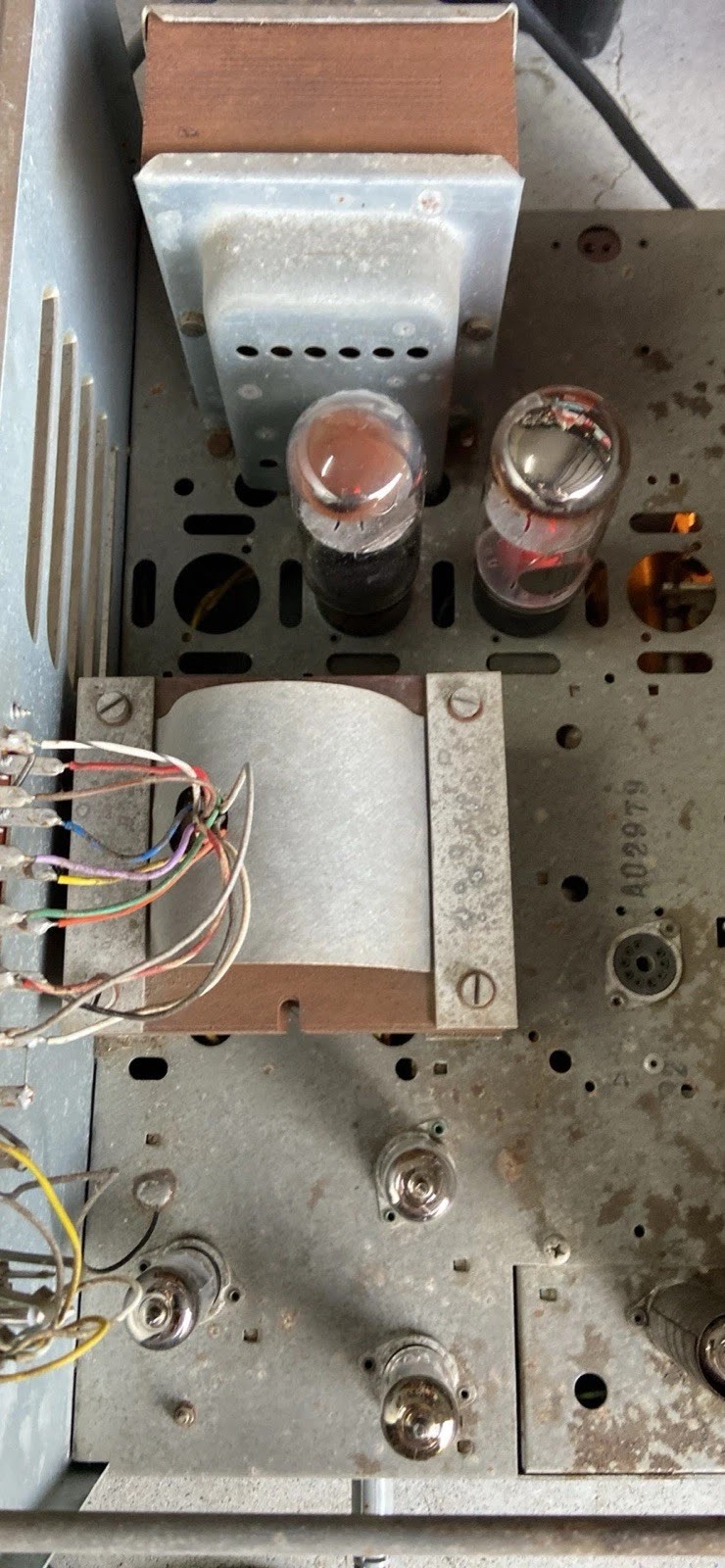
Another AWA valve PA amplifier from the PA100X series, from the late sixties.  Very utilitarian looking, and very sturdy.  It's a little bit tight in the chassis - not much room to work in there.

AWA PA1005 PA AMPLIFIER

Standard mic, PU (record player) and tone controls.  Bass cut control on the rear, which is part of the negative feedback network.  Designed as a 100v line system, perhaps intended as a portable system.

Slightly unusual in that this has a quad of 6AQ5 on the output stage.  They're described as a miniature 6V6 - they have the same specs at 250v, which is listed as the max voltage that these can handle.  12AX7s used for the preamp & phase inverter.  The valves all tested OK.

The quad of 6AQ5s is cathode biased, the preamp valve heater was used as part of the resistance to ground for the 6AQ5s - some amps do this to provide a DC heater voltage, with the hope of reducing hum. 

B+ is pretty low at around 250v 

Output transformer

Turns ratio of 25.5 to 1 on the output marked as 15 ohm (between the 40 - 60 secondaries).  Despite saying it's suited to 15ohms, the calculations seem to work out better at 8ohms.

A pair of 6AQ5s at 250v wants to see 10kp-p, therefore a quad wants about 5k.  25.5 squared, times 8 = 5,202   

Secondaries:  Common, 40, 60, 120, 200, 315 & 630 ohms


It has quite a chunky mic input transformer: AWA 7XD51768, intended to match low impedance microphones to high-impedance triode grids.


Components are the same as what's used in many other AWA amps - always good to see mustard caps.


GUITAR AMP CONVERSION

So far, I've done the usual maintenance, safety checks etc.  At the moment, it's a simple two knob volume and tone set-up.  

Work done so far
PU input and associated components removed 
Transformer on the low-impedance microphone input was removed
Input and output jacks added to existing holes
Cathode biasing on the output valves changed to a regular cathode resistor (12AX7 heater in series removed)
First preamp added to the normal heater chain
Decreased voltage droppers from 22k and 47k to 10k, to get more juice to the phase inverter and preamp
Reduced the 220k plate resistors on the preamp - the preamp is closer to a Benson Monarch now.
Replaced the 2m2 grid leak resistor on the phase invert input with a lower value   
Added a simple tone control
power switch.

6AQ5 Power Amp
150 ohm 10w bypass resistor, 47uf bypass cap
248v on the plates, 15.2v on the cathode 

It’s running pretty conservatively - could drop the cathode bias resistor back a bit, maybe a 135 ohm, but I think I’ll leave it for now.  

Saturday, May 16, 2026

AWA: Model PA-806, 5w Valve PA Amplifier

Such an awesome looking little amp from 1954.  Photos from an online listing, I am yet to track one down in person.

For a simple single-ended 6V6 based amp, it's an interesting circuit.

AWA MODEL PA-806 PA AMPLIFIER

Standard inputs and controls for a small Australian PA amp from AWA.  Inputs for a mic, turntable input (PU) with a simple tone control.  No power switch, or fuse.

6AV6 microphone input stage (single triode)
12AX7 mixing / gain stage.  Grid leak biased, negative feedback from OT.
6V6 single-ended output stage, 5 watt
6X4 full-wave valve rectifier

Power Transformer: TS2525823
Power for the rectifier and 6.3v heaters
B+ ~360v

Output Transformer:  1T357100
600, 300 and 150ohm windings on the secondary (plus winding for negative feedback)

This model has also been well documented here

AWA MODEL PA806 PA AMPLIFIER - Front panel

AWA MODEL PA806 PA AMPLIFIER - rear panel

AWA MODEL PA806 PA AMPLIFIER

AWA MODEL PA806 PA AMPLIFIER


AWA MODEL PA806 PA AMPLIFIER - internal photo of circuit

AWA MODEL PA806 PA AMPLIFIER - internal photo of valves

AWA MODEL PA-806 SCHEMATIC

AWA MODEL PA806 VALVE AMP - SCHEMATIC


Monday, April 6, 2026

AWA: Model PA872, 20w Valve PA Amplifier (Serial Number 94)

I posted another AWA PA872 a while back, but realised I never actually shared this one.  It had been sitting on the shelf for months - one of those projects that was nearly there, but never quite finished.  I finally got around to wrapping it up this weekend.

This looks to be an earlier unit, although schematically the same.  The serial number is much lower (#94), and the general aesthetic appears earlier.

Someone had already had a go at converting it - let’s just say what I found inside is a good reminder to be cautious with amps of unknown history.  I never even turned it on - deathtrap.

This one came to me as a friendly trade. The previous owner hadn’t worked on it themselves, and was unaware of the condition - they were just clearing out a few projects they knew they were never going to get around to.

With no real baseline to work from, I stripped it right back to the sockets and started again.  It’s now rebuilt as a 5E3-style Deluxe, with a few tweaks to taste.

The stock 5E3 uses 100n coupling caps on the preamp.  I dropped the bright channel right down to 22n, and trimmed the normal channel slightly to 82n.  For the tone control, I’ve gone with stock 5n on the bass side and increased treble from 500pf to 1n, for a slightly different response.  The results are good - two distinctly different, but useful channels.

I chased a pretty stubborn hum for a while - in the end, it came down to grounding.  Moving the power transformer ground to the same point as the filter caps fixed it immediately.  We're only talking a distance of about 80mm.

There was a previous attempt to “fix” the hum, which involved adding 2 x 220uf filter caps to the power supply - so it’s no surprise the valve rectifier was dead on arrival.  Yes - 220uf, not 22uf...  

AWA MODEL PA 872 - 20 WATT PA AMPLIFIER

I really like the blue hammered finish - someone in the design team really nailed the look of this one.  

AWA MODEL PA 872 - 20 WATT PA AMPLIFIER

Schematic screened onto the back of the amp - a nice touch for serviceability.  Serial number 94.

AWA MODEL PA 872 - 20 WATT PA AMPLIFIER - REAR PANEL

The amp can run a 15 ohm speaker without any dodgy rewiring of the output transformer, so that's always handy.


I patched over some holes for a couple of can capacitors, as they were dead, and not conveniently placed for what I wanted to achieve.

Not my most amazing work to date, but it is solid, and it sounds great.


FURTHER READING


My previous post for the 872, which has full tech details 


Sunday, November 2, 2025

Thursday, May 8, 2025

AWA: Model PA1002B, 50W Valve PA Amplifier

Another addition to my AWA valve PA family.  I hesitated on this one at first—mainly because the power stage is a bit of a beast, and I’ve already got two from the same line.  But the price was right, and apparently, I have no resistance when it comes to valve PA heads.

This one’s a 50-watter from the mid-sixties, with a particularly complex output stage—rumoured to resemble a McIntosh hi-fi design. I’ve no idea how it actually works yet, so there’s some learning ahead… or I might just leave it alone and enjoy the mystery.

  • 2 x mic inputs, 1 x phono / radio input with tone control
  • 12AX7 preamps, EF86 mixer, 12AX7 phase inverter, with a 12AU7 driving the 7027A in the power stage
  • Solid state rectifier / voltage doubler ~500V B+
  • Fixed bias, with rear panel access to bias controls
  • Optical compressor / output limiter driven from an OT wind, applied to the EF86 mixer across all input channels
  • Bass cut switch
  • Power transformer marked 52481A
  • Output transformer:  unknown.  

AWA MODEL PA1002B, 50W VALVE AMPLIFIER

These photos are from the eBay listing 


The output transformer in this amp is a bit different from the usual guitar amp arrangement. Rather than having simple 4, 8 and 16 ohm speaker taps, it uses a sectional secondary made up of multiple windings and taps that can be linked in different ways. 

With 10.37VAC applied to the primary, the measured secondary voltages were 1-3 = 0.945VAC, 4-6 = 0.946VAC, 7-9 = 0.943VAC, and 10-12 = 0.942VAC. That tells us each full secondary section is essentially identical, with a turns ratio of about 10.37 / 0.945 = 10.97:1. Because transformer voltage ratio follows turns ratio, and impedance reflects by the square of that ratio, each section reflects its load back to the primary by roughly 121:1

That matters because a push-pull pair of 7027A valves usually wants to see a plate-to-plate load in roughly the 6k to 6.6k region under common Class AB conditions. RCA’s data shows typical plate-to-plate loads of 6600 ohms, 6000 ohms and 6500 ohms for several fixed-bias examples, with cathode-biased examples also shown at 6600 ohms.

So from the valve side of things, the transformer makes good sense. The unusual part is the secondary. This was not designed as a normal guitar amp speaker secondary, but as a higher-impedance PA/distribution type output with multiple linking options. In practical terms, to get anything even vaguely close to a regular speaker impedance, all of the secondary windings need to be paralleled.


I should have looked more carefully at the photos.  That's red plate on one 7027 and the other doesn't have much getter left.


Strangely, someone has added a really small spring reverb...   


Some sizeable old filter caps in here.


AWA PA1002 SCHEMATIC

AWA PA1002 VALVE AMPLIFIER SCHEMATIC

ACCESSORIES & ADVERTISING

As these were primarily intended for commercial use, a number of configurations are accessories were available - including preamps removed, so the amplifier could be used in a large distributed system.

AWA PA amplifier accessories


FURTHER READING

Manual and installation instructions     

Article in Silicon Chip  

Aussie Guitar Gear Heads. (does not like Safari security settings by the way, Chrome works)

Monday, April 7, 2025

AWA: Model PA872, 20w Valve PA Amplifier

AWA Model PA872 is a 20-watt Australian valve PA amplifier from the early-to-mid sixties, originally running KT66 output valves and designed for 600-ohm PA speaker lines. I already own its little brother, the AWA PA774, so I had to grab this one.


  • Inputs / Controls:    Mic level (250k), phono level  (250k) and tone (1meg).  There's a bass cut switch on the back.  Phono is the old-school high-output type, so it skips a gain stage.   
  • Valves:  5V4G rectifier, 2 x 12AX7 for preamp and phase inverter, 2 x KT66 for the power amp. 
  • Output transformer:  5k P-P.  Various outputs for 600 ohm speakers (details below)
  • Power transformer:  Marked 50483
  • Voltage:  B+ is about 320v.  
  • Power amp: Push-pull, cathode-biased power amp stage.  20 watts
  • Phase inverter:  paraphase inverter of some type.
  • NFB:  Negative feedback from the 50Ω transformer winding.  Bass cut incorporated into the network.
  • Preamp heater voltage:  The preamp and phase inverter valve’s filaments are wired in series, and then in parallel with the cathode resistor in the power amp stage - meaning they’re running on a DC supply to keep hum down.

Much more detailed technical information on the AWA PA872 is available in Tim Robbins’ article which can be found here

AWA PA872, 20W VALVE AMP

AWA PA872 20W valve PA amplifier front panel with mic and phono controls

Schematic screen printed on the back, just like its little brother.  Terminals from the various secondary winds on the output transformer, bass cut and the fuse.  

AWA PA872 rear panel with schematic and output transformer terminal strip

OUTPUT TRANSFORMER

Number of 600 ohm speakers, or one 15 ohm between 6-10 and 3-5 

Grey:        Common
Yellow:    11-20 speakers / 40 ohm
Green:      6-10 speakers / 75 ohm
Black:      3-5 speakers / 150 ohm
Orange:    2 speakers / 300 ohm
Purple:    100V

Turns ratio results:
purple - orange, 15:1  
black - green, 20:1 (the connection recommended for 1 x 15 ohm speaker).   With a 16ohm load, 6k6 p-p (which is what I ran with)
green - yellow, 30:1

5k P-P on schematic.  
NFB wind is 50 ohms

AWA: Model PA872 vintage Australian Valve PA Amplifier rear panel

Ducon filter cap:  One of the caps needs to be reformed, one seems to be just fine.  

All of the coupling caps are really leaking a lot & show too much resistance to remain - apart from that, most of the values are larger than anyone wants in a guitar amp these days.  If you ever see a white UCC cap - test it.  Every single one that I have ever seen has been bad.
 
AWA: Model PA872 vintage Australian Valve PA Amplifier rear panel

The large filter caps don’t belong.  The 100uf cap is about double what the rectifier can handle.   It’s a bit cramped and messy in there, so I’m going to have to really think about how to approach this.  

AWA: Model PA872 vintage Australian Valve PA Amplifier rear panel


The 1A fuse had been replaced with a 50A automotive fuse.  That’s a good way to smoke an amp or burn down the house.   The mains electrical cable also has to go too - the insulation feels stiff and perhaps a bit fragile.  Of course, it needs an on/off power switch installed.

AWA: Model PA872 vintage Australian Valve PA Amplifier rear panel


AWA PA872 ADVERTISING & SPECS

AWA PA872 advertising


AWA PA872 CONVERSION NOTES

Given it only has three front-panel controls, I went with a Deluxe Reverb-style preamp - just volume, bass and treble.  I left the phase inverter largely untouched (other than removing the negative feedback), and converted it from KT66 to 6V6 (a cheaper, lower power and more accessible valve).  I also replaced the unusual cathode bias/heater setup with a standard heater arrangement.  Given this was designed for a KT66, it could also easily handle a pair of 6L6 for more output.  

I couldn’t hear any noise advantage with the original heater configuration, and basically, it left almost no control over biasing, and the preamp and phase inverter valves couldn't be hot swapped.  

Overall, it sounds good and I’m pretty happy with the result.


Thursday, February 20, 2025

AWA: Fox Sound Systems, PA1003 Valve Amplifier

Branded as Fox Sound Systems, this is really an AWA PA1003.   I couldn't find any information on Fox Sound Systems, Sydney. My guess is that they were an installer who ordered unbranded amps directly from AWA for their installation work—possibly for schools or government buildings. But who knows?

I already own one of these, so when I saw this and the seller dropped the price to a reasonable amount, I snapped it up. I suppose I'll have to sell one later.

The differences between this one and my other unit are minimal. The main ones are that this amp has the optional low-impedance mic transformer on the input, and the phase inverter uses a 12AU7 instead of a 12AX7.

I recently started work on this by pulling out the microphone transformer and giving it a run with a guitar - it ripped.  

Fox Sounds Systems AWA PA1003 vintage valve amplifier

B+ ~380v

In addition to the weird impedances for 100v line systems, this output transformer can handle a regular 16ohm speaker (12 - 15 according to their published specs).

Fox Sounds Systems AWA PA1003 vintage valve PA amplifier

Same transformers as my other PA1003.  Which I think are Ferguson.

Fox Sounds Systems AWA PA1003 vintage valve PA amplifier

Model 2426 


Some nice RCA 7027A output pentodes - basically a fancy 6L6GC.  The 12X7 preamp valve and 12AU7 phase inverters are both AWA branded.  These are likely all original.


Plenty of space to work in - which is part of the reason why I like these.


It's a little grubby, and it looks like there may have been a couple of resistors replaced, but otherwise appears OK.  


7027A CLASS AB, CATHODE BIAS