Showing posts with label TRANSISTORS. Show all posts

Saturday, February 7, 2026

GEC: Germanium Signal Transistors (1971 Semicondcutor Handbook)

From the General Electric semiconductor handbook, 1971


Sunday, January 21, 2024

TRANSISTORS: Germanium Transistor Leakage

I saw a post today about leakage and temperature, so I thought I'd do a quick test myself to see how close it came.  The test distinctly lacked scientific conditions - for starters I wasn't even wearing a white coat at the time, but the results seem to match the theory.

For germanium transistors, leakage current mainly depends on temperature and doubles for every 10°C rise in temperature.

Measurement #1:  taken in my garage / workshop after it had been closed up all day - it's not very well insulated, so it gets really hot.  The temperature was probably about 40 degrees (ambient temperature outside was high thirties).

79hfe, 0.32mA leakage


Measurement #2:  Same transistor about an hour later after sitting in very cool air conditioning, I'm guessing, but it's probably about 20 degrees in the house, so I'd say close to a 20 degree difference to the first reading.

hfe 69, leakage 75ua (or 0.075mA).  

Given the first reading was 320mA and the second was 0.075mA, doubling every 10 degrees seems to hold true.


WHAT'S THE POINT?

If you're working with germanium transistors, try and work in normal conditions (a reasonable room temperature).  If you have a circuit sitting just on the edge of gating at 35 degrees, it may not work at 15 degrees.  Likewise if noise is a concern at a low temperature due to leakage, it's going to get way worse when it heats up.


Thursday, October 26, 2023

TRANSISTOR, VALVO: OC76 Germanium Transistor Datasheet


VALVO OC76 GERMANIUM TRANSISTOR DATASHEET

VALVO OC76 GERMANIUM TRANSISTOR DATASHEET

VALVO OC76 GERMANIUM TRANSISTOR DATASHEET


TRANSISTOR, VALVO: OC45 / OC44 Germanium Transistor Datasheets

Valvo transistors were produced in Germany, as a subsidiary of Philips (not unlike Mullard in England).   More information on Valvo can be found here.  My experience with Valvo, is that they are pretty much identical to their English counterparts.

The OC45 is a PNP germanium alloy transistor intended as IF amplifier in AM broadcast receivers.

VALVO OC45 / OC44  GERMANIUM TRANSISTOR DATASHEET


VALVO OC45 / OC44 GERMANIUM TRANSISTOR DATASHEET


Sunday, August 27, 2023

TRANSISTOR, GEC: GET Germanium Transistors

GEC is the General Electric Company of England, not the one from the U.S.A.   These are occasionally branded as Mullard.  Full write-up on GEC / GET transistors can be found here


GEC GET 102 - 114 GERMANIUM TRANSISTOR DATA

Type V Max Hfe     P Max (mW) I Max f (Mhz)

GET102     30        100         200                 1000 1.5

GET103     30        55         200                 1000 1

GET104     30        55         200                 1000 1

GET105     40        30         800                 1000 0.9

GET106     15        55         200                 1000 1

GET110     40        20         800                 1000 1

GET111     60        55         200                 1000 1

GET113     15        100         200                 1000 1.5

GET114     15        55         200                 1000 1


TRANSISTOR EQUIVALENTS

Anything from the red colour range from GEC is an audio amplifier; they're listed as being similar to a number of common transistors, such as the AC128.


TRANSISTOR, BRIMAR: AC113 Germanium Transistors

Brimar transistors were made by Thorn and were also commonly branded as Mazda.  A full write-up can be found here

The AC113 is an audio frequency amplifier or driver type germanium transistor.

AC113  GERMANIUM TRANSISTOR DATASHEET

AC113  GERMANIUM TRANSISTOR DATASHEET


TRANSISTOR EQUIVALENTS

Being a fairly generic audio amplifier, they're listed as being similar to a number of common amplifier transistors, such as the AC125.


WHAT ARE THEY REALLY LIKE?

Testing results from a lot of 10:  The range of gain and leakage is huge - from 45hfe with very little leakage, right up to 330hfe with a lot of leakage.  Several were a bit over a 100hfe with moderate leakage.  One was dead, only useful as a diode.

So if you see some going cheap and are tempted to grab a few, buy more than you think you will need, as there will most likely be wastage.

AC113  GERMANIUM TRANSISTOR


Saturday, January 7, 2023

TRANSISTORS: Soviet Germanium Transistor Data

Germanium transistors from the former USSR are cheap, generally high quality, available in large quantities and very cheap compared to their European counterparts.   

They are their own thing and are not direct copies of European transistors - you can find similar transistors, but they are never like-for-like replacements.  They nearly always sound different and have their own character.  So when sellers on eBay compare the Soviet version to a western one, just use this as a rough guide.   

Note:

  • Check pinouts, as B, C, E is common
  • The emitter is often marked with a dot on the case
  • The case is sometimes connected to the base
  • hfe on most datasheets will be on the high side, due to high test currents.  Look at the minimum gain as a more likely average than the maximum
  • They tend to be low leakage compared to European transistors, which means that many will not work in circuits that require high leakage to self-bias 

SOVIET-ERA GERMANIUM TRANSISTOR DATASHEET

Link to the spreadsheet


SUPPORTING INFORMATION ON SOVIET TRANSISTORS


Friday, January 6, 2023

TRANSISTOR / DIODE: Soviet Semiconductor Device Designations

This has been transcribed from the U.S. Joint Publications Research Service No. 569 from 1978.  Translations of Eastern European Scientific Affairs.   Among other things, it contains a guide to Soviet semiconductors.  The publication can be found in this folder.   

It's a handy guide to Soviet transistor and diode numbering, as well as their intended purpose.  If you are looking for datasheets, jump to this post.

SOVIET SEMICONDUCTOR DEVICE DESIGNATIONS

Soviet semiconductor devices are designated in conformity with the following: 
                devices made before 1963 according to State Standard 5461-59 (for example F403)
                  devices made after 1963 according to State Standard 10862- 64 (for example GT308)
                    and after 1973 according to State Standard 10862- 74

        SOVIET STATE STANDARD 5461-59 (PRE-1963)

        The designation of semiconductor devices according to State Standard 5461-59 consists of two or three elements. 

        FIRST ELEMENT: 

        D                 diodes 
        P (MP)        transistors 

        SECOND ELEMENT:  a number that characterises the purpose of the device. 

        FOR DIODES: 

        point-contact germanium               001-100
        point-contact silicon                          101-200
        junction silicon         201-300
        junction germanium 301-400
        mixer microwave 401-500
        multiplier         501-600
        video detector         601-700
        parametric germanium 701-749
        parametric silicon 750-800
        stabilitrons         801-900
        varicaps 901-950
        tunnel diodes 951-1000 
        rectifier columns 1001-1100 


        FOR TRANSISTORS: 

        low-power germanium low-frequency         001-100
        low-power silicon low-frequency                 
        101-200
        power germanium low-frequency         201-300
        power silicon low-frequency                 301-400
        low-power germanium high-frequency         401-500
        low-power silicon high-frequency         501-600
        power germanium high-frequency         601-700
        power silicon high-frequency         701-800


        THIRD ELEMENT:  a letter showing the modification of the device. In the absence of a modification no letter is placed. 

        Example of designation: 

        P15A transistor, low-power, germanium, low-frequency, modification A

        P701 transistor, power, silicon, high-frequency


        SOVIET STANDARD 10862-64 (1963-1973)

        The designation of semiconductor devices according to State Standard 10862-64 is done with four elements. 

        FIRST ELEMENT: a letter or digit indicating the semiconductor material: 

        G (1) germanium
        K (2) silicon
        A (3) gallium arsenide 

        The designation beginning with the letter G is for germanium semiconductor devices operating at a temperature below +60° C. 

        The designation beginning with the letter K is for silicon semiconductor devices operating at temperatures below +85° C. 

        Designations beginning with the digits 1, 2 or 3 are intended for semi-conductor devices operating at higher temperatures: 

        germanium up to +70° C
        silicon up to +125° C

        SECOND ELEMENT:   a letter designating the type of device. 

        D,  diodes
        T,  transistors
        V,  varicaps
        A,  microwave diodes
        F,   photo- devices
        N,  uncontrolled multilayer switching devices (dynistors)
        U,  controlled multilayer switching devices (thyristors)
        I,  tunne
        3,  stabilitrons
        Ts, rectifier columns and units
         
        THIRD ELEMENT:  a number designating the purpose or electrical of the semiconductor device: 

        TRANSISTORS LOW POWER  (T) 

        for low frequencies                101-199

        for medium frequencies     201-299
        for high frequencies              301-399


        TRANSISTORS, MEDIUM POWER (T) 

        for low frequencies            401-499
        for medium frequencies     501-599
        for high-frequencies           600-699


        POWER TRANSISTORS  (T) 

        for low frequencies            701-799
        for medium frequencies     801-899
        or high frequencies            910-999


        DIODES  (D) 

        rectifier, low-power            101-199
        rectifier, medium-power     201-299
        rectifier, power                    301-399

        general-purpose                  401-499
        pulse                                   501-999
                     
              
        PULSE VARICAPS  (V) 

        tunable                                101-199

        multiplier                            201-299


        MICROWAVE DIODES  (A) 

        mixer                                 101-199

        detector                              201-299
        modulator                          301-399
        parametric                         401-499
        switching                           501-599


        PHOTODEVICES  (F) 

        diodes                                101-199

        transistors                           201-299


        FOURTH ELEMENT:  a letter designating the division of the technological type of groups. 

        For example: 

        GT105A: germanium transistor, low-power, low-frequency of group A, operating at temperature up to +60° C. 

        2T105A: silicon transistor, low-power, low-frequency of group A, operating at temperature up to +120° C. 

        The designations of selenium rectifiers consist of letters and digits. For example, AVS-I5-60. The letters designate aluminium rectifier; selenium, and as for the digits: 

                    the first group gives the length of the side of the square washer or the diameter in mm; 

                    the second group gives the number corresponding to this rectifier. 

        For low-power rectifiers a designation is used in which the average value of the rectified current (mA) and the supplied variable voltage (V) are placed after the letters. For example: AV3-6-270M. The letter M signifies miniature. 


        Thursday, March 18, 2021

        TRANSISTORS: Soviet Transistor Pinouts

         Just a little reference to Soviet-era transistor pinouts.   

        SOVIET TRANSISTOR PINOUTS

        Soviet Transistor pinouts


        Soviet-era Transistor pinouts


        note:  in addition to potentially different pinouts, some Soviet-era transistors can have the case connected to the base - which is not good if it touches anything else.  The dot on the case usually marks the emitter, not the collector as often found on European transistors 


        Monday, March 8, 2021

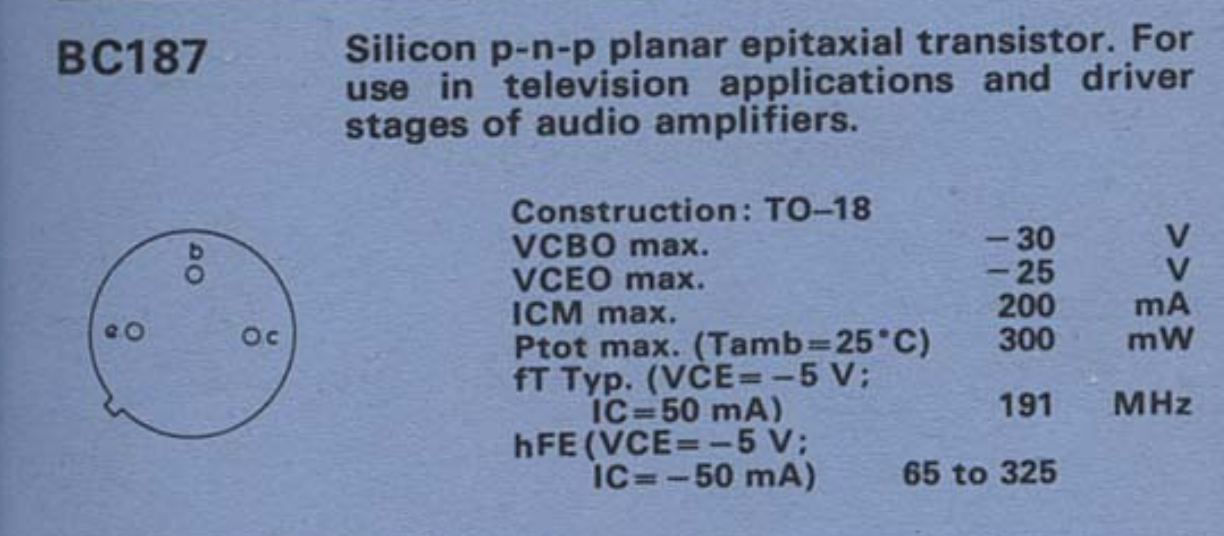
        TRANSISTORS: Mullard Data Book 1965 - 66 & 1974 - 75 Excerpts

        Transistor datasheets from Mullard for;

        Germanium:    OC44, OC45, OC70, OC71, OC72, OC74, OC75, OC78, OC81 and OC81D

        Germanium:    AC126, AC127, AC128, AC176, AC187, AC188

        Silicon:            BC107, BC108, BC109, BC186, BC187


        MULLARD DATA BOOK 1965 - 66

        MULLARD OC44 DATASHEET / PINOUT

        MULLARD OC45 DATASHEET / PINOUT

        MULLARD OC70 DATASHEET / PINOUT

        MULLARD OC71 DATASHEET / PINOUT

        MULLARD OC72 DATASHEET / PINOUT

        MULLARD OC74

        MULLARD OC75

        MULLARD OC78

        MULLARD OC81

        MULLARD OC81D

        MULLARD OC82


        MULLARD DATA BOOK 1974 - 75


        Tuesday, March 2, 2021

        Tone Bender MKIII, Q3 Transistor Comparison (OC71, OC75, OC81)

        Now I didn't go as far as measuring and matching gain and leakage (as much as possible), but here's a comparison of a few Q3 transistors for a Tone Bender MKIII - all the same setting, just swapping Q3 on the breadboard.

        Why?   I saw someone on Facebook poking fun at an eBay seller in Thailand over what they thought were fake OC71.  I bought some as the seller looked legit to me, as did the transistors -  so I tested them yesterday, and it turns out they are real, so I promptly ordered more.

        Lines on a screen don't replace ears, but as you can see, they are quite similar.  There are definite differences in harmonic content, with the 2nd and 4th being the most obvious.  On the scope, the waveforms are very similar, with hard-to-pick differences.

        I could talk about the sound, but it's very subjective... 


        Unbranded OC71


        Valvo OC75


        Mullard OC81


        Sunday, February 21, 2021

        TRANSISTORS: Germanium Transistor Equivalents or Comparable Tables

        It's worth noting that none of the source material claims that equivalent equates to identical - there will be differences, it will largely come down to what you are trying to build in a lot of cases.

        I've only listed transistors commonly sought after for guitar pedals, as this is what I'm usually trying to find equivalents of - usually at a better price than the 'right' transistors.

        TRANSISTOR EQUIVALENTS OR COMPARABLE TABLES


        Saturday, February 20, 2021

        TRANSISTORS, CV Designations - UK Military Specification for Germanium Transistors

        CV Transistors are UK military spec valves, transistors and diodes (CV stands for common valve, as it predates semiconductors).  CV transistors were made by several different manufacturers on contract and produced to the UK military's specifications.  These can be, and quite often are, common commercial transistors made to military specification and renumbered.

        Here are a few pedal-friendly transistors with well-known counterparts.

        Like most things, I am by no means an expert - this is primarily for my own purposes, so please don't get too mad at me if you're a CV transistor expert and I have somehow misinterpreted something or made a mistake.  That being said, do feel free to leave me a comment.  This guy is an expert if you are interested in more information.

        CV TRANSISTOR CODES

        The codes can vary, and this is not a definitive collection of every possible code and variation - but here's a very loose and abridged guide.  

        Usually, there will be three parts.  Specification, designation, date.

        Hypothetical example:  A Mullard OC45 made to the K1001 specification for the UK in the first week of 1969 might have a code that looks something like this.

        KB/D 6901
        CV5105

        CV TRANSISTOR SPECIFICATION CODE

        There are two parts, the first for the specification, the second being the manufacturer (see the next heading re factory codes).

        KB/XX

        First letter

        K    Specification K1001 or K1006

        J    JAN or MIL-spec

        Second letter

        B    UK authority

        U    US qualification

        D    Australian

        X    Director of Electronics Research and Development


        FACTORY CODES

        Mullard          D, DA, DB, DC, DE, DF 

        Valvo             DP

        Newmarket    CO

        STC                F, FB, FC, FD, FDA, FE, FF


        DATE CODE

        Usually made up of four numbers, the first two being the year, the second two being the week of manufacture.   example:  6901 is the first week of 1969.


        GERMANIUM CV TRANSISTOR EQUIVALENTS

        Link to the full CV register from 1963.  Note that a few CV numbers can refer to the same transistor.  Especially when it's a generic AF type - OC71 as an example.  

        MULLARD

        CV2389    OC71

        CV2400    OC71

        CV5105    OC45

        CV5337    OC73

        CV5416    OC84

        CV5439    OC75

        CV5457    OC70

        CV5710    OC44

        CV5711    OC77

        CV5712    OC71

        CV5713    OC72

        CV5813    OC123

        CV7002    OC72

        CV7003    OC44

        CV7004    OC45

        CV7005    OC71 (tin cans sound the same as NKT275, analogman)

        CV7006    OC72

        CV7007    OC77 

        CV7111    OC139

        CV7112    OC140

        CV8314    OC76

        CV8315    OC44

        CV8316    OC45

        CV8344    OC71

        CV8435    OC140

        CV8346    OC77

        CV8389    OC71

        CV8440    OC72

        CV8724    OC83

        CV8756    OC122

        CV8966    OC139

        CV9259    OC83

        CV9447    OC77

        CV9778    AC127

        CV9779    AC128

        CV9927    OC71 (advanced spec)

        CV9928    OC44 (advanced spec)

        CV9797    OC83 m.pr

        CV10061    OC141

        CV10675    AC176

        CV10809  OC71


        NEWMARKET

        CV5445     NKT203

        CV8559      NKT223

        CV8765      NKT213

        CV8794      NTK226

        CV9190     NKT271

        CV9372      NTK218

        CV10855    NKT228

        CV11170    NKT216

        CV11175    NKT210


        TEXAS INSTRUMENTS

        CV7007      2G377

        CV7376      ACY17

        CV7002      2G382  (also equivalent to OC72)

        CV10164    2G387

        CV10394    2G382


        GEC / MULLARD

        CV2339    GET114 (OC71)

        CV2400    GET106 (OC71)

        CV5459    GET104

        CV5833    GET875

        CV5856    GET110

        CV5902    GET104

        CV7001    GET103

        CV7002    GET116 (heatsink)

        CV7007    GET111 (GEC version)

        CV7008    GET106

        CV7009    GET110

        CV7074    GET103

        CV7080    GET571

        CV7081    GET572

        CV7082    GET573

        CV7087    GET875 (2G306)

        CV7326    GET111

        CV7327    GET102

        CV7392    GET116 (heatsink)

        CV8150    GET880

        CV8362    GET103

        CV8363    GET102

        CV8642    GET887

        CV8607    GET113

        CV8618    GET885

        CV8641    GET890

        CV9069    GET881

        CV9070    GET889

        CV9071    GET892

        CV9039    GET882

        CV9258    2-GET103

        CV9267    GET888

        Sunday, January 24, 2021

        Common Transistor Pinouts & Numbering Systems

        COMMON SILICON TRANSISTOR PINOUTS

        common transistor pinouts


        TRANSISTOR NUMBERING SYSTEMS

        JEDEC (JOINT ELECTRON DEVICE ENGINEERING COUNCIL)

        example:  2N2222


        First Number


        1 = Diode

        2 = Bipolar transistor or single gate field effect transistor

        3 = Dual gate field effect transistor


        Second Letter


        = N 


        Subsequent numerals


        = Serial number


        Important to note that there is no correlation between the number assigned and the type or properties of a transistor.  Numbers are assigned in order of registration.


        ----------------------------------------------------------


        JIS (JAPANESE INDUSTRIAL STANDARD)

        example:  2SC828

        First Number

        1 = Diode
        2 = Bipolar transistor or single gate field effect transistor
        3 = Dual gate field effect transistor


        Second and Third Letters

        SA:    PNP HF transistor
        SB:    PNP AF transistor
        SC:    NPN HF transistor 
        
SD:    NPN AF transistor
        SE:    Diodes
        SF:    Thyristors
        SG:    Gunn devices
        SH:    UJT
        SJ:    P-channel FET/MOSFET 
        SK:    N-channel FET/MOSFET
        SM:    Triac
        SQ:    LED
        SR:    Rectifier 
        SS:    Signal diodes
        ST:    Avalanche diodes 
        SV:    Varicaps
        SZ:    Zener diodes
         

        Subsequent Numerals

        The serial number follows the first digit and the two semiconductor device type letters. The numbers run between 10 and 9999.


        ------------------------------------------------------

        PRO-ELECTRON / EECA (EUROPEAN ELECTRONIC COMPONENT MANUFACTURERS ASSOCIATION)

        example:  BC549C

        First Letter

        The first letter indicates the material.

        A = Germanium
        B = Silicon
        C = GaAs
        R = Compound materials


        Second Letter

        The second letter indicates the device application.

        A:    Diode RF 
        B:    Variac
        C:    Transistor, AF, small signal
        D:    Transistor, AF, power
        E:    Tunnel diode
        F:    Transistor, HF, small signal
        K:    Hall effect device
        L:    Transistor, HF, power
        N:    Optocoupler
        P:    Radiation sensitive device
        Q:    Radiation producing device
        R:    Thyristor, Low power
        T:     Thyristor, Power
        U:    Transistor, power, switching
        Y:    Rectifier


        Subsequent Characters

        The serial number of the device. 
        • domestic use has three numbers
        • commercial or industrial use has a letter followed by two numbers, i.e. A10 - Z99.


        Suffix


        A = low gain
        B = medium gain
        C = high gain


        ---------------------------------------------------

        MANUFACTURERS OWN SCHEME

        NOTE:  Some manufacturers will follow their own numbering schemes


        example:  MPSA by Motorola, and a lot of old germaniums, NKT etc, but that's another topic entirely 


        ------------------------------------------------------

        MILITARY SPEC

        There are several different codes between the UK, NATO, the US, and of course, the Soviet Union.  I will not attempt to list them all here. 

        CV:      UK
        Usually CV followed by 4 numbers - no relation to the original part number.

        JAN:    USA
        JAN is a prefix ahead of normal JEDEC code