Showing posts with label Mu-Tron. Show all posts

Saturday, April 10, 2021

MUSITRONICS: Mu-Tron Phasor II

A classic phaser from the mid-seventies - the Musitronics Mu-Tron Phasor II.  It has the same six-stage phaser as the Bi-Phase, with less happening in the oscillator section.  

This is the hardest layout I have ever done and took some time to finish and check...  including some time wasted after I started using a layout with errors in the oscillator section, which was very annoying.   

Being a six-stage phaser using DIY vactrols - what could possibly go wrong?  Unverified at present / build at your peril.

This should just fit in a Hammond 1590BB enclosure (landscape),  The dual rail power supply will need to be done on a separate board.  

I have not wired as per the original, as it was not true-bypass, and it has a relatively low input impedance of 390k.  If you really want to wire it up as the original, just check an old schematic, and you should be able to modify a layout to accomplish this.  


MU-TRON PHASOR II - VERO LAYOUT
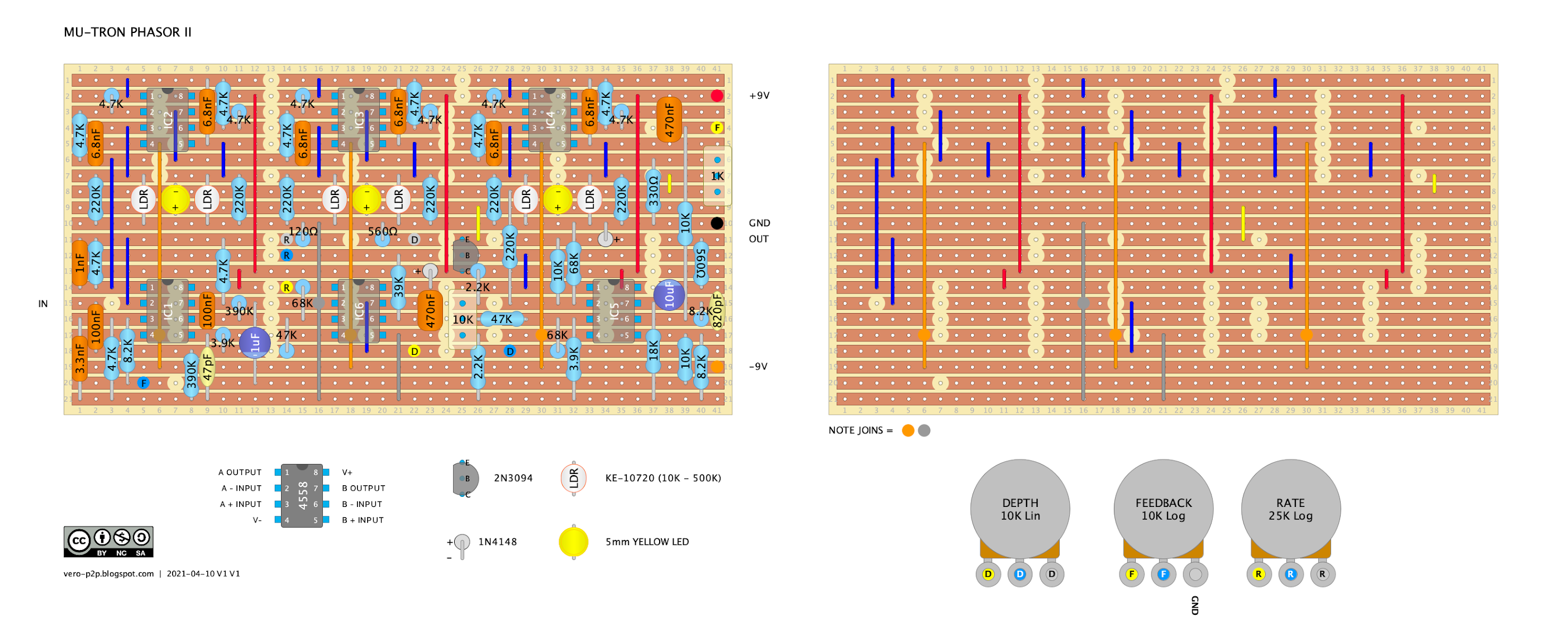
MU-TRON PHASOR II - GUITAR EFFECT VERO LAYOUT


Pedal PCB values/schematic were used for the layout above, which is slightly different to one of the original schematics that I've seen.  This is running at +/- 9v.


MU-TRON PHASOR II - VERO LAYOUT - LFO WAVE SHAPE MOD

After looking in awe at the Mu-Tron Bi-Phase schematic, I realised that most of it are actually the same, or at least quite similar to the Phase II.

The mod below adds a sone / square wave selector.  I'm surprised they never included this on the original, as it's pretty easy to add (bearing in mind that this is currently an unverified layout).


MU-TRON PHASOR II - VERO LAYOUT V2


This layout is based on an original schematic, it's running at +/-12v, and it has very minor differences here and there - mainly in the LFO.  

MU-TRON PHASOR II - CALIBRATION

Note this refers to the older AC-powered unit, which is the layout directly above - please don't connect anything to mains power, or you may die in the process.  

In the instructions, it mentions changing R37 from 68k to 82k if there are flat spots on the waveform.  R37 is the resistor from Depth 2, connecting to pin 3 of IC5.  


MU-TRON PHASOR II VS BI-PHASE

A quick note on the main differences between the Bi-Phase and the Phasor II, as they are actually very closely related.  For starters, there are two phasers in the Bi-Phase - obviously.

Common
  • The six-stage phaser
  • The input section is basically the same, along with the feedback control
  • LFO oscillators have the same basic topology in terms of waveform generation
  • Sweep, Rate and Depth controls

Bi-Phase, Main Differences
  • LFOs have sine and square waves
  • LFO A rate can be controlled by an expression pedal
  • LFO B can be inverted or synced to LFO A
  • Additional routing controls, cause there are two phasers to play with - as an example, route Phaser A into Phaser B, giving a 12-stage phaser... 
  • Switching between Phaser A & B is controlled by a vactrol in the signal path of the output stage (audio section).  i.e. an optical switch.  When engaged, the switches increase resistance in the signal path to the point where audio does not pass.  

Wednesday, April 7, 2021

MUSITRONICS: Mu-Tron III

I've already built the Micro V, and it's a really cool-sounding envelope filter, so I thought I might try the Musitronics Mu-Tron III.  It's generally regarded as THE envelope filter of its day.  As much as I love a bit of fuzz, I really do enjoy sitting in a groove with an envelope filter running....  

Note read comments below - currently unverified. 

MUSITRONICS MU-TRON III - VERO LAYOUT

MUSITRONICS MU-TRON III - GUITAR EFFECT VERO LAYOUT


Same again, but bigger...   bit more room on the board.


Recommend that you check it against the schematic below if you plan to build this before I do.  I'll post photos etc once I have it made, or at least a progress report from the bench.   

The placement of the trimmer is a bit clumsy, but I think I will test some values and hopefully replace it with a standard resistor.  The trimmer is R23 on the schematic - see note re value.

Once (if ever) working, I'll need a suitable funky enclosure to fully release the seventies vibe.

ON THE BENCH

Seems to be partially working, but it's not fully wired up with all the switches etc yet.  I used the larger layout for this.

The homemade vactrol is working, although white heatshrink still lets light through.   Needs to be blacked out more - the case should take care of that, but it's not helpful trying test it like this.

It’s being very tricky to dial in, which may be the homemade vactrol, and/or the size of the trimmer on the LED.   Seems to have a very small spot where it works, but even then, the sweep is not great.    

Apparently, these are notoriously difficult to get going properly - maybe a Micro V is a better idea if you consider trying this.  


Suggested mods/notes to self to address issues 

1) bigger trim pot.  220k
2) change 180k resistor to 500k trimmer 

So still a work in progress - UNVERIFIED.


MUSITRONICS MU-TRON III - SCHEMATIC

MUSITRONICS MU-TRON III - SCHEMATIC
Note that the schematic above shows where to place an external control input for the envelope filter.


MUSITRONICS MU-TRON III - SCHEMATIC


The strange part labeled O805 is a single LED with dual LDRs.  It is not available to buy, so your options are make your own with LDRs and an LED, or try a couple of single optoisolators and see how that works.  

Google "R.G. Keen Neutron Filter" for more details on options.  

MUSITRONICS MU-TRON III vs EHX Q-TRON

As it happens the EHX Q-Tron is a direct progression of the Mutron III, albeit appearing over twenty years later.  They share a lot in common in terms of topology - perhaps due to the fact that they were both designed by Mike Beigel of Musitronics fame.

Wednesday, September 23, 2020

MUSITRONICS: Mu-Tron Micro V

The Musitronics Mu-Tron Micro V is a cool old auto-wah / envelope filter from the seventies - I feel I need to be wearing a valour tracksuit, possibly with a half-unzipped jacket exposing generous chest hair with a gold dangler to really play this properly.  Maybe a moustache too...   

I've used a LM13700 instead of the near impossible to find CA3080 (real ones that is).  In the thread on DIY Stompboxes there's a reference to changing the 1M resistor on the collector of Q2 to 470k / 500k for a better sweep (I have not tested this yet).

If you're interested in how envelope filters work and have some spare time to read and wrap your head around this, here's an excellent reference by Mark Hammer.

MU-TRON MICRO V  - VERO LAYOUT

MU-TRON MICRO V  - VERO LAYOUT

This one is verified.  Note the two sides of the LM13700 are tied together.  I'm yet to test them being split.  In the thread, they say that it just sounds a bit sweeter with both sides running together, so I'll probably leave it that way.


It did take some filing to make it fit, but I did manage to fit it in a smaller than planned enclosure.


ORIGINAL SCHEMATIC 


VIDEO DEMO