Showing posts with label Vintage Australian. Show all posts

Wednesday, April 29, 2026

VASE: Trendsetter 60, Vintage Australian Guitar Amplifier

This amp is a bit of a classic from my hometown, Brisbane.  Vase Trendsetters were very common back in the day, and many are still floating around.  If you couldn't afford a Marshall, there was a good chance that you had a Vase.

They were mostly fairly simple amps, and pretty well made - I'd say they were all designed for working musicians, as I'm not aware of any budget low-wattage combos being produced.  I've only ever seen Vase heads and cabs.

VASE TRENDSETTER 60

This amp has already been very well docuemented here on on Aussie Guitar Gear Heads (thanks Mike), but as a recent acquisition, I thought I should add it to my blog anyway. 

It’s working well and sounds great, but it needs a bit of attention to the wiring where the old spaghetti insulation has crumbled away.

Photos to be added as I commence work.


SCHEMATIC

Excellent trace by Mike - so good to have all of the voltages etc on hand like this.  Vase are also known for a lot of minor variations on their amps - so if you have a Trendsetter, this is probably a really useful guide, but don't be too concerned about little differences, as it may have left the workshop that way.


FURTHER READING

https://ozvalveamps.org/vase.htm

https://guitarnerd.com.au/2010/10/vase-amplifiers/

https://reverb.com/news/a-history-of-brisbanes-vase-amplifiers


Monday, April 27, 2026

GOLDENTONE: Model 1755 Slimline

I saw this one pop up recently and decided to take a punt on it (thanks Damian).  For the money, I figured it was worth a look even if it only ended up being a decent chassis and set of transformers.

Turns out that this amp is a testament to the quality work that Goldetone produced - despite what has clearly been a very hard life, she works just fine (apart from the heavily corroded reverb tank). 

image from the eBay listing

Cosmetically, it has had a bit of a rough life (perhaps an understatement).  Where to begin? The original combo was cut down to a head, tolex removed, it was painted yellow, then black, and at some point it was covered in 1970s or 80s woodgrain vinyl.  The head still feels solid, so there’s something to work with.

I didn’t think the original faceplate was on the amp, so I was pleasantly surprised when the silver paint started wiping away with isopropyl alcohol, revealing the original panel underneath.  It's still in good shape too - maybe the dodgy paint work protected it?  

The reverb tank, on the other hand, was absolutely covered in heavy corrosion- no chance of salvage.

Inside the chassis was a much nicer.  It looks to be all original, with no obvious signs of previous work or failed parts.  It was dusty as hell, but I’ll take dust over a butchered circuit any day.

GOLDENTONE - 1755 SLIMLINE

I believe this is a Goldentone Model 1755 Slimline, based on the schematics I've seen.  Circa 1965, serial number 3967.  

The 1755 is regarded as one of the classic Goldentones - after a bit of time playing it, I can understand why.

FEATURES
Two channels, both have bass and treble controls.  One channel has reverb and trem.  
40watts
The original open back cab would have had 2 x 12" alnico speakers.

PREAMPS
Miniwatt 12AX7s.  

Tone controls
James style, bass and treble

Reverb / trem channel
First gain stage
Ra 220k
Rk 3k3, 25u bypass

Second gain stage
Ra 220k
Rk 1k8, 25u bypass

Normal Channel
First gain stage
Ra 100k
Rk 3k3, 25u bypass

Second gain stage
Ra 100k
Rk 3k3, 25u bypass

All pots 1MC (Volume, bass and treble)


REVERB
Valve driven, Miniwatt 6GW8
Pioneer EAV-201 reverb tank fitted (very small, 2 spring)
Rola LRH3 transformer

Transformer bench measurements
10.4v, 440Hz sine wave applied to primary:  result, 3.3v on secondary

That gives a turns ratio of:  10.4 / 3.3 = 3.15:1

Because impedance ratio is the square of turns ratio:  3.15² ≈ 9.9:1

So the transformer reflects about 10 times the tank/input impedance back to the 6GW8 pentode.

As a replacement, I'm using an old reverb tank from a Peavy.  Part number 710-1111.  DC resistance measures:  input ~50 ohms, output ~250 ohms.  It's probably an Accutronics 4EB2C1B, 600ohm input impedance, which will reflect 6k to the 6GW8.  That’s a very reasonable load, and it sounds great.   

Reverb level is completely independent from the preamp volume control.  i.e. the channel volume can be all the way down, but you can still hear the reverb.  The reverb send is post tone controls - before the volume control (attached to pin 3 of the volume pot).   

Reverb can be turned off via a foot switch.

TREM
12AX7 oscillator, modulating the cathode of a preamp triode.  
No depth control, just speed.

The trem pot is also the power on / off switch for the amp.  The trem is turned on / off by a foot switch.

PHASE INVERTER
12AX7, longtail pair
100n coupling caps
22k negative feedback from OT secondaries

POWER AMP
2 x Hitachi 6DQ6-B fitted - although schematics show 6DQ6-A (6GW6)
47 ohm resistor to screen
10k grid stopper resistors
470k grid leak resistors
Fixed bias -30  Bias not adjustable - no pot

OUTPUT TRANSFORMER SPECS (OT)
A&R 2700
Primary 3k3
Secondaries 16, 8 & 4 ohms

Output transformer bench measurements
84 ohms DCR primary

Test conditions:
10.5v, 440Hz sine wave applied to primary:   result, 0.58v on secondary
Turns ratio 18.1:1  

Primary
2.6kΩ at 8 ohms
5.2kΩ at 16 ohms

This is different to the specs above - possibly the result of construction variations and a low-voltage test.

POWER SUPPLY
A&R 5892 (which is different to schematics)
Silicon bridge rectifier
Rola choke TV301, May 1965
B+ about 360v

Goldentone Reverbmaster 40 / slimeline vintage guitar amp

My little moment of joy, finding the original faceplate under the silver paint.  They may be original knobs, but I'm not sure. 

Goldentone Reverbmaster 40 / slimeline vintage guitar amp


Chassis - Goldentone Reverbmaster 40 / slimeline vintage guitar amp

The 6DQ6 valves have their anode on a top cap - hence the warnings. 

Circuit - Goldentone Reverbmaster 40 / slimeline vintage guitar amp

A&R 5892 power transformer &  a big Ducon filter cap for the power supply.

Transformer - Goldentone Reverbmaster 40 / slimeline vintage guitar amp

Choke & reverb transformer& 6GW8 valve for the reverb


Prior to dust removal - all the mustard caps look fine, no cracks.  Can't see any resistors that have been heat-stressed.

circuit - Goldentone Reverbmaster 40 / slimeline vintage guitar amp

They used an interesting method to mount components on the preamp and phase inverter.  There's a thread through the valve base, with another valve base on the other end of it.  It kind of makes a little tree for components to be vertically mounted.  

It is kind of difficult to get to the valve socket end, so maybe not the most practical method when compared to the tag stip mounted components.


This was a reverb tank at some stage in life.  


This is after most of the horrific vinyl has been removed, showing the remnants of various paint jobs underneath.


SCHEMATIC, GOLDENTONE MODEL 1755

Compared to some schematics floating around, mine has a few differences.   Worth noting that there are some major changes between the 1755 and some later Reverbmasters.  
  • Some preamp plate and cathode resistor values differ   
  • Reverb send and return paths are different   
  • 47Ω screen resistors, not 47kΩ as shown on the schematic
  • 10k instead of 180ohm resistor used for screen power filtering
  • 4n7 capacitor across the reverb level control
  • different power transformer is used
The measured voltages in my amp are very close to the schematic values overall, although the screen voltages are slightly lower, possibly due to the larger resistor in the filter section.

I liked the look of this schematic, so I made a few rough and ready modifications to match the values in my amp.


GOLDENTONE CATALOG IMAGES


Vintage Goldetone amp advertising


FURTHER READING


Monday, April 6, 2026

AWA: Model PA872, 20w Valve PA Amplifier (Serial Number 94)

I posted another AWA PA872 a while back, but realised I never actually shared this one.  It had been sitting on the shelf for months - one of those projects that was nearly there, but never quite finished.  I finally got around to wrapping it up this weekend.

This looks to be an earlier unit, although schematically the same.  The serial number is much lower (#94), and the general aesthetic appears earlier.

Someone had already had a go at converting it—let’s just say what I found inside is a good reminder to be cautious with amps of unknown history.  I never even turned it on - deathtrap.

This one came to me as a friendly trade. The previous owner hadn’t worked on it themselves, and was unaware of the condition—they were just clearing out a few projects they knew they were never going to get around to.

With no real baseline to work from, I stripped it right back to the sockets and started again.  It’s now rebuilt as a 5E3-style Deluxe, with a few tweaks to taste.

The stock 5E3 uses 100n coupling caps on the preamp.  I dropped the bright channel right down to 22n, and trimmed the normal channel slightly to 82n.  For the tone control, I’ve gone with stock 5n on the bass side and increased treble from 500pf to 1n, for a slightly different response.  The results are good - two distinctly different, but useful channels.

I chased a pretty stubborn hum for a while - in the end, it came down to grounding.  Moving the power transformer ground to the same point as the filter caps fixed it immediately.  We're only talking a distance of about 80mm.

There was a previous attempt to “fix” the hum, which involved adding 2 x 220uf filter caps to the power supply—so it’s no surprise the valve rectifier was dead on arrival.  Yes - 220uf, not 22...  

AWA MODEL PA 872 - 20 WATT PA AMPLIFIER

I really like the blue hammered finish, and someone in the design team really nailed the look.  

AWA MODEL PA 872 - 20 WATT PA AMPLIFIER

Schematic screened onto the back of the amp - a nice touch for serviceability.  Serial number 94.

AWA MODEL PA 872 - 20 WATT PA AMPLIFIER - REAR PANEL

The amp can run a 15 ohm speaker without any dodgy rewiring of the output transformer, so that's always handy.


I patched over some holes for a couple of can capacitors, as they were dead, and not conveniently placed for what I wanted to achieve.

Not my most amazing work to date, but it is solid, and it sounds great.


FURTHER READING


My previous post for the 872, which has full tech details 


Monday, December 8, 2025

PHILIPS: Model 976B PA Amplifier

Philips 976B - I have had one previously that I documented here.   

PHILIPS MODEL 976B VALVE PA AMPLIFIER 

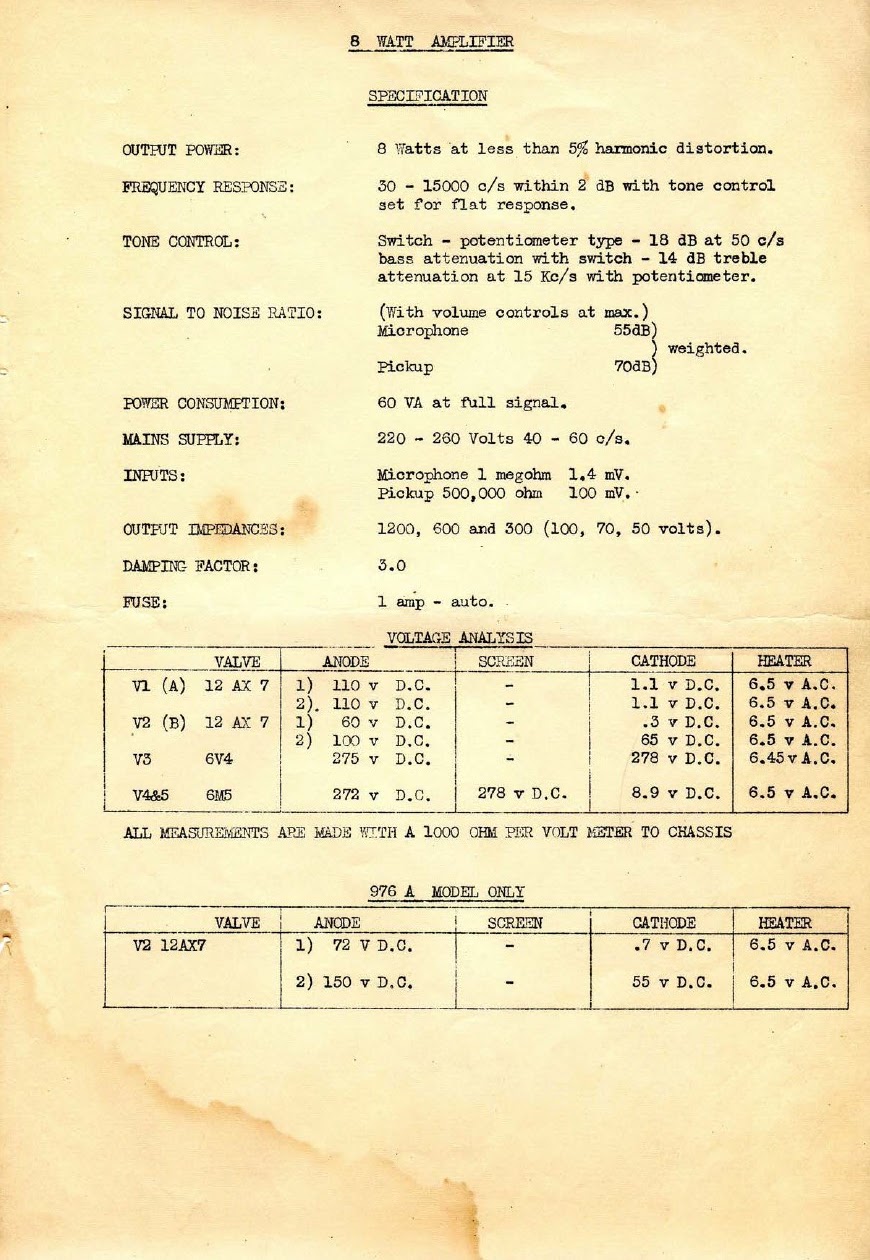
This is a small Australian-made valve PA amplifier from the mid to late fifties - about 8 watts, intended for 100v line systems running multiple speakers.  These were also sold as Steanes Sounds Systems using the same model number, marketed as a compact portable PA system, often with a couple of speakers and a mic on a stand. 

It's mostly original; it has had the filter caps bypassed replaced and a repaint at some stage. 


I had to add a power switch, and input and output jacks.  The original power cord was really short and not in the best shape, so that went as well.   


2 x 6M5 in the power stage, for about 8watts.

I replaced the original output transformer, as I was not keen on the configuration options.  It's sounding great with a M1120.  


The original filter caps have been left in place, with new ones added in the chassis.  I don't love the mounting method (or lack of), but at least the caps they used look the part.


PHILIPS 976B SCHEMATIC & TECHNICAL MANUAL


PHILIPS 976B AMPLIFIER SCHEMATIC

PHILIPS 976B SCHEMATIC & TECHNICAL MANUAL

PHILIPS 976B SCHEMATIC & TECHNICAL MANUAL

PHILIPS 976B SCHEMATIC & TECHNICAL MANUAL

PHILIPS 976B SCHEMATIC & TECHNICAL MANUAL


MODS / CHANGES

I've left it close to stock in terms of the circuit, as I thought it sounded pretty good. 
  • Added input & output jacks
  • Replaced the dodgy power lead and added a power switch & a jewel light 
  • Unused PU level pot now a Vox style cut control 
  • Swapped the output transformer due to limitations with secondary impedances 
  • Rebuilt the preamp and phase inverter, as the carbon comp hiss and crackle was just too much
  • Moved the filter caps to some tag stips 
Interestingly, there’s a small amount of bleed around the volume pot. It’s not a major issue—more of a curiosity. The two 12AX7 triodes share a cathode resistor, and there’s plate-to-grid negative feedback on the second stage, which creates an AC path around the pot. That allows a small amount of signal to reach the phase inverter even with the volume turned down.

6V4 RECTIFIER


6M5 POWER PENTODE

6M5 (EL80) pentodes appear to be unique to Australia - they're similar to an EL84, but with a slightly different pinout and a little less power.  It's often referred to as the noval version of the EL41.  Either way, I quite like the sound of these being driven.


Thursday, November 27, 2025

GOLDENTONE: Model 1776 Guitar Amplifier

This is a Goldentone 1776, which is essentially a Goldentone 1774 with trem.   It had been reshoused in a 2 x 10 cab with Oxford speakers (one ceramic, one alnico), with the amp chassis mounted on the bottom, with the control panel up the top.  The amp would have been mounted the same way in its original 1 x 12" cab.

Based on the fact that it's made by Rose Morris, this would have been made before 1965.  Serial number 1375.  The 1776 models are listed as being made in 1961 - 1962

Apart from a DIY cab, I think it has had a little bit of work done on it.  There appeared to be an extra resistor in the power section - the rest looks stock, and I'd say there's a good chance that these are the original valves.  

Like its sibling, this amp has volume and tone controls before the first triode - which is kind of pointless.  It's low impedance, and it only really sounds good turned all the way up.  It basically puts another set of volume and tone controls before the amp, which you already have on your guitar.


GOLDENTONE MODEL 1776 GUITAR AMPLIFIER

  • Single-ended 10w valve amp
  • Volume 250k, Tone 250k, Depth 250k, Speed 2meg
  • Silicon rectifier - looks like a voltage doubler
  • 1 x 12AX7 preamp
  • NFB to the first triode
  • 1 x 6AU6 pentode driven tre, with Bakelite trem foot switch
  • 1 x EL34 for the output
  • Ducon caps
  • OT  A&R 2584.  2k5 @ 16ohm
  • PT A&R type 1971


Goldentone 1776 guitar amplifier showing rear panel serial number made by Rose Morris


Goldentone 1776 vintage guitar amplifier circuit gut shot

Goldentone 1776 vintage guitar amplifier circuit gut shot showing under the tag strip board


Trem oscillator

Goldentone 1776 vintage guitar amplifier circuit gut shot showing the tremolo section


POWER SUPPLY

  • A&R type 1971 power transformer.
  • Silicon rectifier, voltage doubler. 
  • B+ 285v

Goldentone 1776 vintage guitar amplifier circuit gut shot showing the power section


SINGLE-ENDED OUTPUT TRANSFORMER

  • A&R Type 2584
  • Turns ratio 12.4
  • 16 Ω speaker reflects 2.5 kΩ to the primary


COUPLING CAPS

These wax coupling caps had to come out - they didn't measure well at all - they never do.  When I tested the amp, it was sounding weak and thin.  Caps have been replaced.


GOLDENTONE 1776 - DRAFT SCHEMATIC

I've roughed out the main amplifier stage, and I'm nearly finished with the tremolo circuit. 

GOLDENTONE 1776 - DRAFT SCHEMATIC


TREMOLO CIRCUIT

The 1776 uses a small 6AU6 pentode for the tremolo - the circuit is similar to the Silvertone 1482. 
I had to replace all of the caps, as they were well out of spec and a little leaky.


MODS

Modding a vintage amp is a little controversial, but this one was barely working when I got it, and it can easily be changed back. 

  • Volume and tone moved to after the first triode
  • Leaky wax paper coupling caps were replaced with slightly larger values, as while the amp sounded great when cranked with the smaller caps, they didn't do it any favours running clean.
  • The tremolo had to be rebuilt to get it working, and as I had changed the volume and tone controls, I had to move the point where it was inserted into amp.  The trem still isn't perfect, slight tick when the amp is cranked.
  • A couple of filter caps were replaced.

Sunday, November 2, 2025