Showing posts with label PA Head. Show all posts

Wednesday, May 20, 2026

AWA: Model PA1005, 12w Valve PA Amplifier

Another AWA valve PA amplifier from the PA100X series, from the late sixties.  Very utilitarian looking, and very sturdy.  It's a little bit tight in the chassis - not much room to work in there.

AWA PA1005 PA AMPLIFIER

Standard mic, PU (record player) and tone controls.  Bass cut control on the rear, which is part of the negative feedback network.  Designed as a 100v line system, perhaps intended as a portable system.

Slightly unusual in that this has a quad of 6AQ5 on the output stage.  They're described as a miniature 6V6 - they have the same specs at 250v, which is listed as the max voltage that these can handle.  12AX7s used for the preamp & phase inverter.  The valves all tested OK.

The quad of 6AQ5s is cathode biased, the preamp valve heater was used as part of the resistance to ground for the 6AQ5s - some amps do this to provide a DC heater voltage, with the hope of reducing hum. 

B+ is pretty low at around 250v 

Output transformer

Turns ratio of 25.5 to 1 on the output marked as 15 ohm (between the 40 - 60 secondaries).  Despite saying it's suited to 15ohms, the calculations seem to work out better at 8ohms.

A pair of 6AQ5s at 250v wants to see 10kp-p, therefore a quad wants about 5k.  25.5 squared, times 8 = 5,202   

Secondaries:  Common, 40, 60, 120, 200, 315 & 630 ohms


It has quite a chunky mic input transformer: AWA 7XD51768, intended to match low impedance microphones to high-impedance triode grids.


Components are the same as what's used in many other AWA amps - always good to see mustard caps.


GUITAR AMP CONVERSION

So far, I've done the usual maintenance, safety checks etc.  At the moment, it's a simple two knob volume and tone set-up.  

Work done so far
PU input and associated components removed 
Transformer on the low-impedance microphone input was removed
Input and output jacks added to existing holes
Cathode biasing on the output valves changed to a regular cathode resistor (12AX7 heater in series removed)
First preamp added to the normal heater chain
Decreased voltage droppers from 22k and 47k to 10k, to get more juice to the phase inverter and preamp
Reduced the 220k plate resistors on the preamp - the preamp is closer to a Benson Monarch now.
Replaced the 2m2 grid leak resistor on the phase invert input with a lower value   
Added a simple tone control
power switch.

6AQ5 Power Amp
150 ohm 10w bypass resistor, 47uf bypass cap
248v on the plates, 15.2v on the cathode 

It’s running pretty conservatively - could drop the cathode bias resistor back a bit, maybe a 135 ohm, but I think I’ll leave it for now.  

Saturday, May 16, 2026

AWA: Model PA-806, 5w Valve PA Amplifier

Such an awesome looking little amp from 1954.  Photos from an online listing, I am yet to track one down in person.

For a simple single-ended 6V6 based amp, it's an interesting circuit.

AWA MODEL PA-806 PA AMPLIFIER

Standard inputs and controls for a small Australian PA amp from AWA.  Inputs for a mic, turntable input (PU) with a simple tone control.  No power switch, or fuse.

6AV6 microphone input stage (single triode)
12AX7 mixing / gain stage.  Grid leak biased, negative feedback from OT.
6V6 single-ended output stage, 5 watt
6X4 full-wave valve rectifier

Power Transformer: TS2525823
Power for the rectifier and 6.3v heaters
B+ ~360v

Output Transformer:  1T357100
600, 300 and 150ohm windings on the secondary (plus winding for negative feedback)

This model has also been well documented here

AWA MODEL PA806 PA AMPLIFIER - Front panel

AWA MODEL PA806 PA AMPLIFIER - rear panel

AWA MODEL PA806 PA AMPLIFIER

AWA MODEL PA806 PA AMPLIFIER


AWA MODEL PA806 PA AMPLIFIER - internal photo of circuit

AWA MODEL PA806 PA AMPLIFIER - internal photo of valves

AWA MODEL PA-806 SCHEMATIC

AWA MODEL PA806 VALVE AMP - SCHEMATIC


Monday, April 6, 2026

AWA: Model PA872, 20w Valve PA Amplifier (Serial Number 94)

I posted another AWA PA872 a while back, but realised I never actually shared this one.  It had been sitting on the shelf for months - one of those projects that was nearly there, but never quite finished.  I finally got around to wrapping it up this weekend.

This looks to be an earlier unit, although schematically the same.  The serial number is much lower (#94), and the general aesthetic appears earlier.

Someone had already had a go at converting it - let’s just say what I found inside is a good reminder to be cautious with amps of unknown history.  I never even turned it on - deathtrap.

This one came to me as a friendly trade. The previous owner hadn’t worked on it themselves, and was unaware of the condition - they were just clearing out a few projects they knew they were never going to get around to.

With no real baseline to work from, I stripped it right back to the sockets and started again.  It’s now rebuilt as a 5E3-style Deluxe, with a few tweaks to taste.

The stock 5E3 uses 100n coupling caps on the preamp.  I dropped the bright channel right down to 22n, and trimmed the normal channel slightly to 82n.  For the tone control, I’ve gone with stock 5n on the bass side and increased treble from 500pf to 1n, for a slightly different response.  The results are good - two distinctly different, but useful channels.

I chased a pretty stubborn hum for a while - in the end, it came down to grounding.  Moving the power transformer ground to the same point as the filter caps fixed it immediately.  We're only talking a distance of about 80mm.

There was a previous attempt to “fix” the hum, which involved adding 2 x 220uf filter caps to the power supply - so it’s no surprise the valve rectifier was dead on arrival.  Yes - 220uf, not 22uf...  

AWA MODEL PA 872 - 20 WATT PA AMPLIFIER

I really like the blue hammered finish - someone in the design team really nailed the look of this one.  

AWA MODEL PA 872 - 20 WATT PA AMPLIFIER

Schematic screened onto the back of the amp - a nice touch for serviceability.  Serial number 94.

AWA MODEL PA 872 - 20 WATT PA AMPLIFIER - REAR PANEL

The amp can run a 15 ohm speaker without any dodgy rewiring of the output transformer, so that's always handy.


I patched over some holes for a couple of can capacitors, as they were dead, and not conveniently placed for what I wanted to achieve.

Not my most amazing work to date, but it is solid, and it sounds great.


FURTHER READING


My previous post for the 872, which has full tech details 


Monday, December 8, 2025

PHILIPS: Model 976B PA Amplifier

Philips 976B - I have had one previously that I documented here.   

PHILIPS MODEL 976B VALVE PA AMPLIFIER 

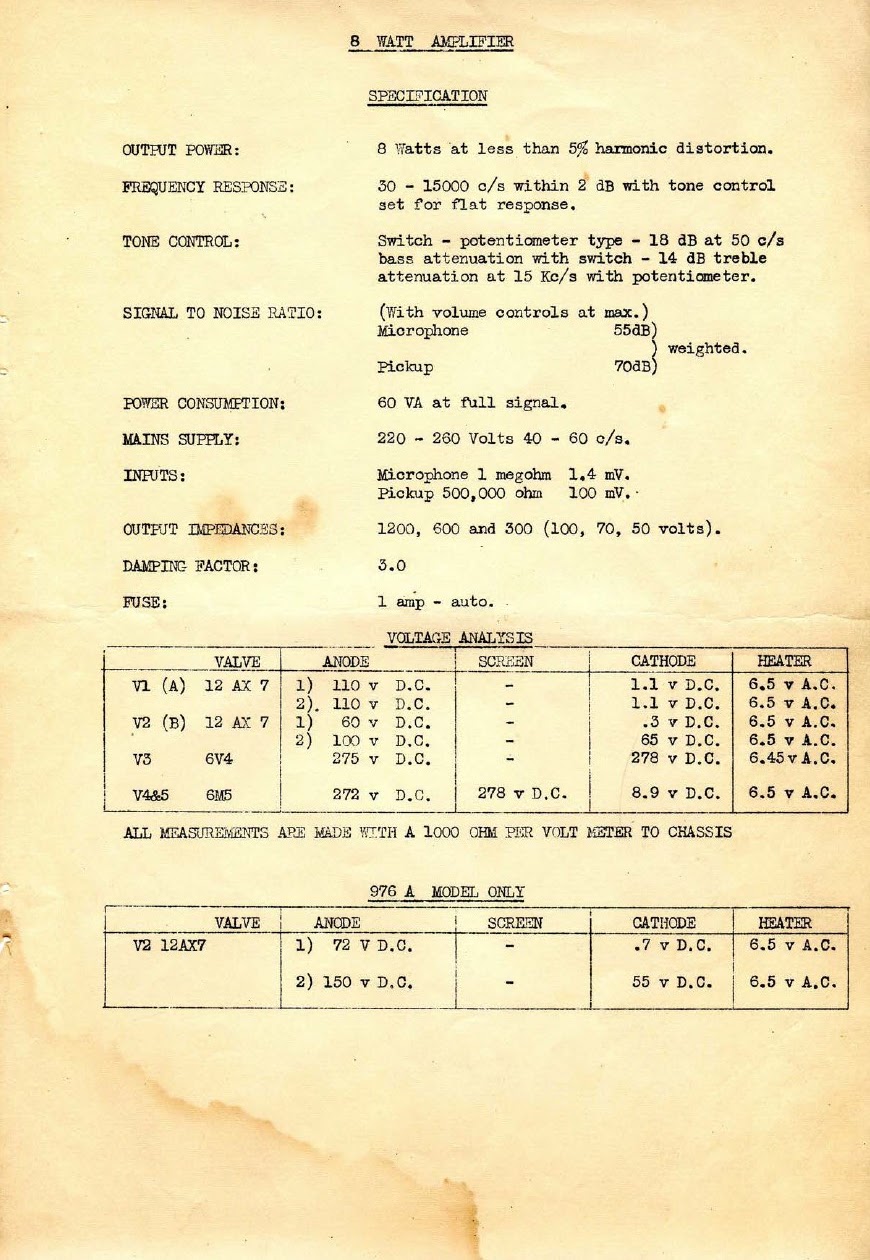
This is a small Australian-made valve PA amplifier from the mid to late fifties - about 8 watts, intended for 100v line systems running multiple speakers.  These were also sold as Steanes Sounds Systems using the same model number, marketed as a compact portable PA system, often with a couple of speakers and a mic on a stand. 

It's mostly original; it has had the filter caps bypassed replaced and a repaint at some stage. 


I had to add a power switch, and input and output jacks.  The original power cord was really short and not in the best shape, so that went as well.   


2 x 6M5 in the power stage, for about 8watts.

I replaced the original output transformer, as I was not keen on the configuration options.  It's sounding great with a M1120.  


The original filter caps have been left in place, with new ones added in the chassis.  I don't love the mounting method (or lack of), but at least the caps they used look the part.


PHILIPS 976B SCHEMATIC & TECHNICAL MANUAL


PHILIPS 976B AMPLIFIER SCHEMATIC

PHILIPS 976B SCHEMATIC & TECHNICAL MANUAL

PHILIPS 976B SCHEMATIC & TECHNICAL MANUAL

PHILIPS 976B SCHEMATIC & TECHNICAL MANUAL

PHILIPS 976B SCHEMATIC & TECHNICAL MANUAL


MODS / CHANGES

I've left it close to stock in terms of the circuit, as I thought it sounded pretty good. 
  • Added input & output jacks
  • Replaced the dodgy power lead and added a power switch & a jewel light 
  • Unused PU level pot now a Vox style cut control 
  • Swapped the output transformer due to limitations with secondary impedances 
  • Rebuilt the preamp and phase inverter, as the carbon comp hiss and crackle was just too much
  • Moved the filter caps to some tag stips 
Interestingly, there’s a small amount of bleed around the volume pot. It’s not a major issue—more of a curiosity. The two 12AX7 triodes share a cathode resistor, and there’s plate-to-grid negative feedback on the second stage, which creates an AC path around the pot. That allows a small amount of signal to reach the phase inverter even with the volume turned down.

6V4 RECTIFIER


6M5 POWER PENTODE

6M5 (EL80) pentodes appear to be unique to Australia - they're similar to an EL84, but with a slightly different pinout and a little less power.  It's often referred to as the noval version of the EL41.  Either way, I quite like the sound of these being driven.


Sunday, November 2, 2025

Thursday, October 2, 2025

ROSE MUSIC: CSA. Model 35 PA Amplifier (Goldentone).

This one’s a rare find – a Communication Systems of Australia valve PA head, ~35 watts from around 1967 / 68.  It's super clean, fully functional, with all parts within spec.

Anyone familiar with vintage Australian guitar amps will recognise the front panel straight away: it looks just like a Goldentone.  That’s no accident.  These were built by Goldentone’s parent company, Rose Music in Melbourne, and were sold under the CSA, Goldentone and Zephyr badges.

The layout is typical for the period, with mic and pickup (turntable) volume controls and a single tone control. Like a number of Australian amps of the era, the power section uses TV valves – a quirk that seems to be unique to local designs.

  • A pair of 6CM5 in the power stage 
  • 12AX7s for the preamp and phase inverter.
  • A&R power transformer
  • A&R type 2766 Output transformer, marked 100v, 70v and 50v.
  • Silicon bridge rectifier - ITT MB4 
  • Mic input is grid leak biased, low impedance.
  • Cathodyne phase inverter, with NFB from transformer winding
  • Additional input straight into the phase inverter so the amp can be used as a slave (octal plug)
  • Simple treble roll-off tone control
  • Pots 500k volume, 250k tone

COMMUNICATION SYSTEMS OF AUSTRALIA, MODEL 35

COMMUNICATIONS SYSTEMS AUSTRALIA 35 vintage valve PA amplifier goldentone


COMMUNICATIONS SYSTEMS AUSTRALIA 35 vintage valve PA amplifier goldentone

COMMUNICATIONS SYSTEMS AUSTRALIA 35 vintage valve PA amplifier goldentone

COMMUNICATIONS SYSTEMS AUSTRALIA 35 vintage valve PA amplifier goldentone

CSA 35 OUTPUT TRANSFORMER

A&R Type 2766 output transformer with a constant-voltage secondary (50/70/100 V taps). I ran basic DC resistance and low-voltage AC ratio checks to fingerprint the winding and estimate the primary load seen by the output valves (2× 6CM5).  Note that I have not included the negative feedback winding yet.

16 Ω on 50 – 70 is about 3.8 kΩ p-p reflected.   Datasheet spec is 3.5 kΩ for 2 × 6CM5 at ~300 V B+

Winding / Tap DC Resistance (Ω) Measured VAC
Turns Ratio
Primary (p-p) 85 14.49 
COM – 50 7.1 2.355 6.15 : 1
COM – 70 9.7 3.265 4.44 : 1
COM – 100 14.5 4.816 3.01 : 1
50 – 70 0.900 16.1 : 1


COMMUNICATIONS SYSTEMS AUSTRALIA 35 vintage valve PA amplifier goldentone

COMMUNICATIONS SYSTEMS AUSTRALIA 35 vintage valve PA amplifier goldentone

There's a spare noval socket on the far right, and the octal behind it is used as an input for the phase inverter.  I have seen another of these that had 2 x Mic inputs, using the additional socket for another preamp.

COMMUNICATIONS SYSTEMS AUSTRALIA 35 vintage valve PA amplifier goldentone

SOLID STATE RECTIFIER

The black square is the solid-state bridge rectifier marked as MB4 ITT - nice and compact.  The network sitting next to it is the negative bias voltage supply.

COMMUNICATIONS SYSTEMS AUSTRALIA 35 vintage valve PA amplifier goldentone

COMMUNICATIONS SYSTEMS AUSTRALIA 35 vintage valve PA amplifier goldentone

Preamp and phase inverter:  Blue, yellow and white hookup wires are colour-coded for plate, grid and cathode.  Green for ground.


COMMUNICATIONS SYSTEMS AUSTRALIA 35 vintage valve PA amplifier goldentone

COMMUNICATIONS SYSTEMS AUSTRALIA 35 vintage valve PA amplifier goldentone

COMMUNICATIONS SYSTEMS AUSTRALIA 35 vintage valve PA amplifier goldentone

CSA 35 VALVE AMPLIFIER SCHEMATIC

CSA 35 SCHEMATIC

C8 is unusual in that it seems to be on a separate winding, compared to the rest of the output transformer.  It may be some form of shield.  Looking at the phase inverter and negative feedback network, they seem to have gone to some effort to reduce high-frequency oscillations / interference.  R12 / C9 is another example.

Voltages

B+ 380
Screens 188
Plates 375
Bias -32.5

CSA 35 CONVERSION NOTES

Despite being a little reluctant to touch the beautiful work done by the person who built it - it needs to function as a guitar amp.   

First things first - at 100k, the input impedance was too low.  Swapped the 100k for a 1meg resistor to bring it up a bit.   An input jack was added.

While the tone control was OK, a simple low-pass filter is a bit boring, and there was a spare knob...   Goldentones often have a James tone controls for bass and treble (sometimes called passive Baxandall), so I installed one to keep to the theme.  I used mustard caps and a low-value tropical fish capacitor to be consistent with the parts used in the amp.  

A bypass cap was added to the gain stage of the cathodyne phase inverter to make up for the loss of gain introduced by the tone controls, and a grid leak resistor was added to where the old tone control was in the circuit.

It sounds great - it's a solid little amp.


FURTHER READING

Oz Valve Amps

Aussie Guitar Gear Heads

The Trainspotter's Guide to Goldentone Amplifiers  (page 58)