Showing posts with label TAG BOARD. Show all posts

Saturday, June 29, 2024

VOX: Modded Vintage AC-4 schematic and tagboard layout

While I'm in the process of modding / rebuilding some Vox amps, I thought I might try the original Vox AC-4 from 1962, or at least a simplified version of it.  

Here's a link to the full vintage Vox AC-4 schematic and amp details.

Apart from the simplicity, I want to try something with an EF86 pentode valve as the preamp.  These were in a lot of early Vox amps, but they were more difficult to manage than an ECC83 as they are a bit microphonic, and this became a problem as wattages increased.  Less of a problem in a small amp like this - but still needs to be managed.

I have not detailed the wiring of valves, resistor wattages, cap voltages and transformers etc on my layout, as you can work this out from the schematic - and if you can't work it out, you should not be playing inside amps.


VOX AC-4 SCHEMATIC - TREMOLO CIRCUIT REMOVED

Vox Ac-4 guitar amp schematic - no trem


ORIGINAL VINTAGE VOX AC-4 SCHEMATIC


MODDED AC-4 LAYOUT

Vox AC-4 tag layout, modded


Thursday, August 3, 2023

PARK: Fuzz Sound, Two Knob Version, tag board layout

Request for Phil - one tag board layout for the Park 2 knob fuzz sound.   I generally prefer to keep the links below the board, as it looks neater.  I don't mind linking two adjacent lugs on top, as you hardly notice it.

One suggestion for this.   The D*A*M Colosround Fuzz Sound has a few different values and an internal trimmer to fine-tune the fuzz.   They say that it's set at about 90% - so given that the pot is normally 100k, you could use a 10k resistor instead of a link under the board, or any value resistor of your choice. 

Check the MKIII component values table as a reference.  Stock values are listed below.

PARK TWO KNOB FUZZ - TAGBOARD LAYOUT

PARK TWO KNOB FUZZZ TAGBOARD LAYOUT


Tuesday, April 25, 2023

VOX: Tone Bender, Tag Board Layout

While I was working on another fuzz face layout (the Sonus Jimi Mod 1968),  I thought I might do a quick adaptation for the Vox Tone Bender, as there was room for the additional resistor.

Quite fond of the Vox, so I'll probably build this once I've finished my current project.  Usually I like to increase the size of the output cap, as these can be a little on this this side / harsh on the ears.  A small cap across the collector and base of Q1 can also help with this.


VOX TONE BENDER - TAG BOARD LAYOUT

VOX TONE BENDER - TAG BOARD LAYOUT


SONUS: Jimi Mod 1968

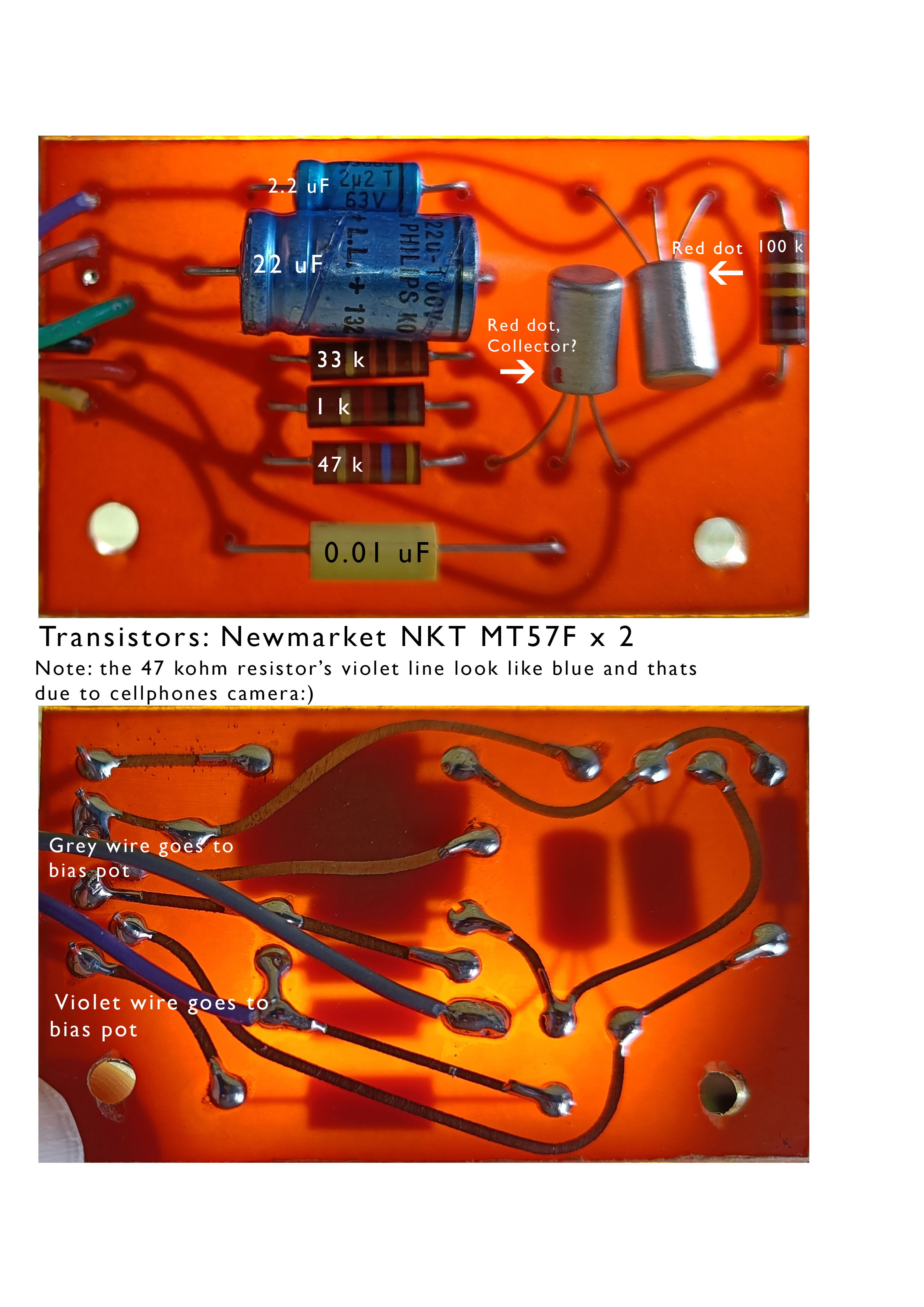
A request from Mikko, who had very kindly done all of the tracing work - very nice job by the way, and photos below.  

It's a Fuzz Face from Sonus using NKT MT57 germanium transistors, with an external bias pot and a couple of different component values (Jimi mods) - 2k fuzz pot and a 1k resistor instead of 470ohm.  

As you can see I did two versions on tag board, one a bit smaller and one with a bit more room.  Both have enough space for a mounting screw.

In addition to the battery, the Sonus pedal does have a DC input - I can see electrolytic poking out from shrink wrap, I'm guessing there may also be a diode hidden in there for polarity protection as well, but who knows.  Not hard to add this off board or just go without if you plan on battery only - this a positive ground effect, so for some people DC is not an option.


SONUS JIMI MOD 1968 - TAG BOARD LAYOUT


SONUS JIMI MOD 1968 - WIDER TAG BOARD LAYOUT


SONUS JIMI MOD 1968 - TAG BOARD LAYOUT


TRACING & PHOTOS SUPPLIED BY MIKKO


Tuesday, December 13, 2022

GHOST EFECTS: Sounds of Today

The Sounds of Today is Ian Sherwood from Ghost Effects adaptation of the MKI Tone Bender.  It's all explained by Ian here, with photos.  There are also plenty of photos of these in various stages of construction Instagram too, so you can see a few variations along the way.

Short story: The attack has been replaced with a fixed resistor.  The resistor in Q2 collector is now a bias pot, and the drive pot restricts the level into Q3.

GHOST EFFECTS SOUNDS OF TODAY - TAGBOARD LAYOUT

As you can see, there are a few unknown values - and if you build this kind of thing, I'm sure you will be confident enough to try a few things and work out what you prefer.  It is an MKI after all, and these often take some tweaking/transistor tests to get sounding good.

GHOST EFFECTS SOUNDS OF TODAY - TAGBOARD GUITAR EFFECT LAYOUT


Saturday, October 15, 2022

MOSRITE: Fuzzrite

I think you can see where I was going with this Fuzzrite layout - visually satisfying on top, quite the mess underneath, but who's going to see it once it's in a box?  It is a good looking board when finished.


MOSRITE FUZZRITE - TAG BOARD LAYOUT

MOSRITE FUZZRITE - TAG BOARD LAYOUT


Saturday, September 10, 2022

CHRISTIAN HOLMBERG (HEMMO): Bazz Fuss, Tag Board & Vero Layouts

This is a nice easy one for tag board off-cuts.  The Christian Holmberg (AKA Hemmo) Bazz Fuss.   

A simple one transistor monster of a fuzz.  Kind of surprised that I had not done a layout or actually built one of these...  how did this not happen earlier?  I was prompted to do this after browsing on Ditrbox Layouts and saw the Walrus Audio Contraband fuzz - link here which is a Bazz Fuss with an input cap switch. 

So here it is.  Will probably post a couple of other versions for 0.15" and the standard vero later.  Being such a simple circuit, it's ripe for modding and component value tweaks.  

Mods (Which are almost every part on the board):

  • size of the input and output caps (input cap most critical)
  • type of diode used between the bass and collector of the transistor
  • the transistor itself (NPN silicon)


CHRISTIAN HOLMBERG (HEMMO) BAZZ FUSS - TAG BOARD LAYOUT 

CHRISTIAN HOLMBERG (HEMMO) BAZZ FUSS - TAG BOARD LAYOUT


0.15" VERO LAYOUT 

CHRISTIAN HOLMBERG (HEMMO) BAZZ FUSS - 0.15" VERO LAYOUT

STANDARD VERO LAYOUT 

CHRISTIAN HOLMBERG (HEMMO) BAZZ FUSS - VERO LAYOUT GUITAR EFFECT


BAZZ FUSS ON LTSPICE

I haven't shown changes in diodes and transistors below, as while they might sound different (I'm yet to test this myself), they don't appear all that different on LTspice.  The waveforms are quite similar, with variations in level and minor variations in shape.

For me, the key driver of changes in this circuit appears to be the input cap.


Volume on 50% - not quite a square wave, but most of the way there.


With a 4.7u input cap and a 100n output cap the frequency response is almost flat - note the db scale (volume at 50%). 


Change the input cap value, and things start to happen with the response 


BAZZ FUSS - VIDEO DEMO

I've used the Walrus Audio Contraband Fuzz as a demo, as it's the best demo I could find of a Bazz Fuss circuit, even though it isn't strictly a stock circuit.   

The only significant difference is the input cap switch, which handily demonstrates the differences when changing C1.   220n and 33n are the values used on the Contraband. 


Saturday, May 21, 2022

D*A*M: Grand Magnus Orbiter (incomplete trace), Tag Board Layout

It's a Tone Machine / Arbiter Doubler - let's get that out of the way up front. Here's the thread on the D*A*M forum for the Grand Magnus Orbiter

Rainy day project for me, as I already have a Tone Machine that I'm happy with.  Not sure I'd ever be up for a two-layer tagboard layout… The D*A*M Grand Magnus Orbiter is something special in that regard.

This is also an incomplete trace as the second tag board is not visible - which also happens to include the tone control. I'd be surprised if Dave Main didn't tweak it somehow.  Personally, I think a larger cap in the tone stack to increase mid-range might be a distinct possibility - not unlike tweaks made to his Fuzz Sounds for a beefier sound.

The only significant change I noticed on the top board is the 10u cap on the emitter of Q, so it's a bit hotter at the start.  Silicon diodes are used on the top board in the octave section, which usually provides better (or at least different) results to germanium.

I'm assuming that if anyone builds this, they'll be an experienced builder, so I've left a few things that I might normally include off the layout.

D*A*M GRAND MAGNUS ORBITER - TAG BOARD LAYOUT

D*A*M GRAND MAGNUS ORBITER - TAG BOARD LAYOUT


Photo care of Reverb.  


Looks like 100k sustain pot


LTSPICE 

This is the difference with the 10uf cap on the emitter of Q1 - basically, things get square right from the start, and there's an increase in level and a slight change in the frequency response.

D*A*M vs Stock Tone Machine LTspice

D*A*M vs Stock Tone Machine LTspice


Now we see the response at the output - assuming stock values were used on the Grand Magnus Orbiter.  As mentioned earlier, I'd be surprised if this was left stock, and like the Big Muff, the Tone Machine tone control is easy to mod and shape to your taste.  A standard mod is to increase the size of the 3n3 capacitor to lift the mid scoop.  Even a small increase to 4n7 makes a difference.   Another mod is adding a 22k resistor after the 3n3 capacitor, which makes it much more like a BMP tone control and dramatically increases the scoop.

D*A*M vs Stock Tone Machine LTspice

This is the bass and treble sides of the tone control.
 
D*A*M vs Stock Tone Machine LTspice

And finally, an output trace.


.  

Thursday, May 12, 2022

JOHN HORNBY SKEWES: Selectatone TB2 Treble and Bass Booster, Tag Board Layout

While on the JHS thing, I noticed this booster and thought it looked interesting.  The output switches between filters to allow for treble and bass boost, unlike most other boosters where it all happens at the input.

Very few seem to be around, as I could only find one photo of the internals and one video demo.  The schematic still has a couple of assumed (but working) values, which are explained below and marked on the layout.

There's a bit of off-board wiring, which is how the original was built - and no volume control.  

JOHN HORNBY SKEWES SELECTATONE TB2 - TAG BOARD LAYOUT

JOHN HORNBY SKEWES SELECTATONE TB2 - TAG BAORD LAYOUT


Image credit: Effects Database https://www.effectsdatabase.com/model/jhs/selectatone#


LTSPICE RESULTS

Both with 100n for the input cap (C1), and the cap linking the treble bass switch (C2).


Changes to the 100n caps (C1, C2) mentioned above have almost no impact on the frequency response of the treble boost (right down to 22n), so tweaking these caps is more around tweaking the bass boost to your liking, and there will be some changes to how it distorts as well.


I split the circuit into two for bass and treble boost, as switches are painful in LTspice - simple SPDT / DPDT switches don't exist.  

For nerdy folks familiar with spice, here's what I was doing (schematic below).   

Short story for lesser nerds, a smaller C5 cap in the bass boost section raises the boost level and shifts it towards the mid-range.  C2 tunes how much low-end roll-off there is.  i.e. you might want a low-mid boost without the flabbiness of too much low-frequency content.

C1 impacts the response, affecting how the transistor distorts, so it's worth trying a 47n in there and a 100n.

Basically, breadboard it and play with C1, C2, and C5. 


Treble boost vs Bass Boost


Input cap variations effect on the Treble Boost output


VIDEO DEMO


OC71 vs 1T308 TRANSISTORS

Spot the difference?  Someone had a question in the comments, so I thought I'd quickly breadboard it for a look - note that this is from the 100n cap on the output, not after the high pass filter.

So turns out they look almost identical, and voltages also measured about the same.   


Wednesday, May 4, 2022

ANALOG MAN: Beano Boost

The Analog Man Beano Boost takes the classic Rangemaster treble booster and adds a very useful function — a switched input capacitor that widens the tonal range beyond the original’s treble boost.

Because it’s a single-transistor germanium circuit, the choice of transistor does shape the tone and clipping character, especially at higher gain settings.  That said, you don’t need to hunt down an expensive vintage OC44 to get great results.  Many germanium transistors will work really well in this circuit — just be mindful of noise, as a bit of hiss is common with older germanium devices.

Quite a bit of info here on Analog Man's website 


ANALOG MAN BEANO BOOST - TAG BOARD LAYOUTS

ANALOG MAN BEANO BOOST - TAG BOARD LAYOUTS


Same again, but with a pot to control the gain - with the 5k pot at around 50% the series resistance is about 3.5k depending on component tolerances.  I think this is close enough to the stock 3.9k - you could use something a bit larger than 1k to get it closer, but it really doesn't make a massive difference.

This is handy for finding the sweet spot for just the right amount of grit in the boost.  Another useful option is to replace the 68k resistor with a pot (100k as an example).  One of the Steve Williams boosters has this addition - minor downside, the pot has DC on it, so it will sound scratchy / crackly.


ORIGINAL BEANO BOOST LAYOUT

This is one of the layouts used by Analog Man.  Note that I've done it in two layers, as it's hard to show parts directly underneath each other in this format.  


IMPORTANT: the mounting points on the strip must be isolated from the enclosure 

VIDEO DEMO


Wednesday, October 27, 2021

INTERFAX: Harmonic Percolator HP-1, Tag Board Layout

Haven't done a tag board build for a while - so here's a classic.  

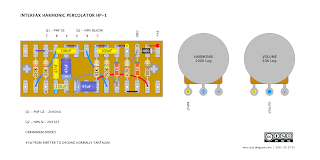
INTERFAX HARMONIC PERCOLATOR HP-1 - TAGBOARD LAYOUT

INTERFAX HARMONIC PERCOLATOR HP-1 - GUITAR FX TAG BOARD LAYOUT


Being tag board, I've used 1/2w resistors and axial caps.  You could use something more practical (smaller), but if that's what you want to do, I would recommend using a different layout, as this is not the best use of space for regular-size parts.  


Sunday, March 28, 2021

MATSUMIN: Valvecaster, Tag Board Layout

Full details available here, which is my point-to-point layout for the Matsumin Valvecaster.  Original values are used below.   


MATSUMIN VALVECASTER - TAG BOARD LAYOUT

MATSUMIN VALVECASTER - GUITAR EFFECT TAG BOARD LAYOUT 12AU7 TUBE OVERDRIVE


Wednesday, February 17, 2021

MARSHALL: SupaFuzz Prototype, Tag Board Layout

And more Tone Bending...   just make sure you add a decent size capacitor to decouple the output, I doubt anyone wants / needs stray DC escaping your fuzz.

MARSHALL SUPAFUZZ PROTOTYPE - TAG BOARD LAYOUT

MARSHALL SUPA FUZZ PROTOTYPE GUITAR EFFECT TAG BOARD LAYOUT

MARSHALL SUPAFUZZ PROTOTYPE - VIDEO


MARSHALL: SupaFuzz, Tag Board Layout

Just to continue on Tone Benders for a little longer...    Marshall SupaFuzz on tag board.


MARSHALL SUPAFUZZ - TAG BOARD LAYOUT

Marshall Supa Fuzz Guitar Effect Tag Board Layout


Wednesday, January 27, 2021

DALLAS: Rangemaster, Tag Board Layout

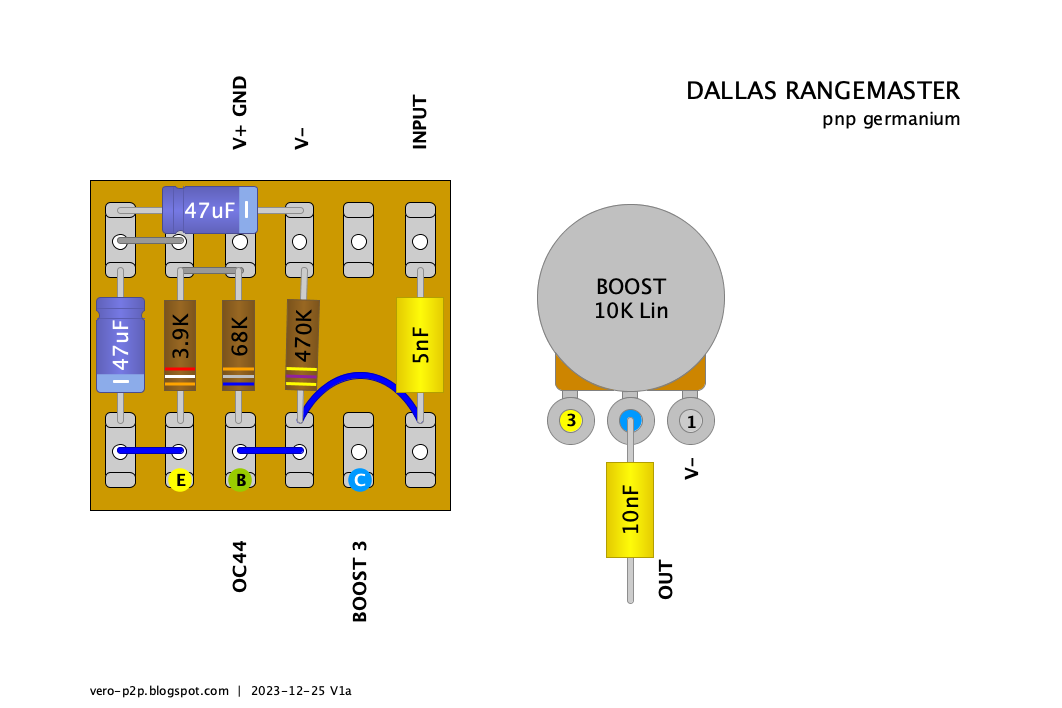
A bit of a classic - well one of the first guitar effects really, the Dallas Rangemaster.  A nice simple one for a quick build using leftover tag board.   

In theory there is room to fit the output cap on the board too, but I liked the straight lines of the components.  


DALLAS RANGEMASTER TREBLE BOOSTER - TAG BOARD LAYOUT

DALLAS RANGEMASTER TREBLE BOOSTER - TAG BOARD LAYOUT