Showing posts with label FUZZRITE FAMILY. Show all posts

Saturday, November 2, 2024

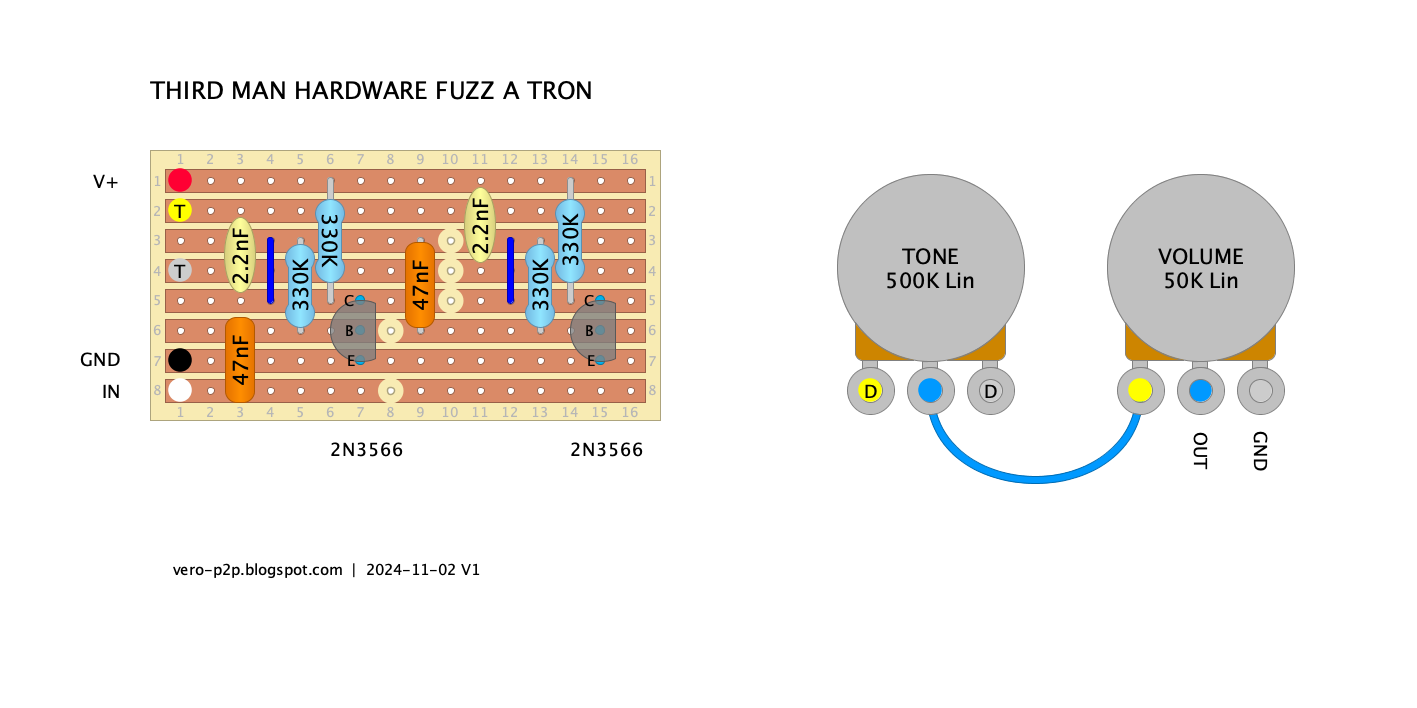
THIRD MAN: Fuzz A Tron

If you're in the USA, for $75 you may as well buy the kit.  otherwise, this should be a really simple build.  

THIRD MAN FUZZ A TRON VERO LAYOUT

THIRD MAN FUZZ A TRON VERO LAYOUT

Spoiler alert - it's a modded Fuzzrite.  330k resistors instead of 470k, and it's missing a resistor that formed a high-pass filter on the output of Q2.


Monday, October 2, 2023

EARTHQUAKER DEVICES: Spires Green Channel

The Earthquaker Devices Spires green channel is a variation of one of my favourite fuzz circuits - the Rosac Nufuzz.   It's a progression of a fuzzrite from the original designer, but it has a tone control on the output sweeping between a small and large cap to provide a thin to thick fuzz sound.  There's no fuzz control, it's set to full all the time.

I used an old layout from the D*A*M FR-70 to adapt for this, as it's almost the same.   I skipped the 10k resistor on the input for this reason.  Could always squeeze one in if you wanted it.

Schematic located here on Pedal PCB  and if you're wondering about the other channel on Spires (the red one), it's a silicon fuzz face.  It probably has some tweaks, but you get the idea.  


EARTHQUAKER DEVICES SPIRES GREEN CHANNEL - 0.15" VERO LAYOUT

EARTHQUAKER DEVICES SPIRES GREEN CHANNEL - 0.15" VERO LAYOUT


EARTHQUAKER DEVICES SPIRES DEMO


Sunday, October 23, 2022

SHIN-EI: Companion Fuzz FY-2

A classic Japanese guitar effect - the Shin-Ei Companion Fuzz - it has its roots in the Fuzzrite, with a notch filter at the output.  


SHIN-EI COMPANION FUZZ FY-2 - VERO LAYOUT

SHIN-EI COMPANION FUZZ FY-2 - VERO LAYOUT


FY-2 SCHEMATIC

SHIN-EI COMPANION FUZZ FY-2 - SCHEMATIC

Usual notch filter response.


It's a fairly broken-looking wave - not the infamous volume drop compared to the input level, which is normally fixed by adding a gain recovery stage.


FY-2 VIDEO DEMO


Saturday, October 15, 2022

MOSRITE: Fuzzrite, Silicon Version

After spending some time on the germanium Fuzzrite, time for a bit of silicon action.  It's a bit less interesting, as there seems to be less variance to the circuit - or none?  

Some differences in construction methods occurred, but that's about it as far as I can tell.   Although I need to do a bit more research on this, as I'd like to see some pot values on an original to confirm what the internet has been saying.


POTS

It seems that most people have settled on 350k for Depth, with was a common value used in Mosrite guitars at the time and also used in the germanium version, so this seems likely.

I've seen a few different values for the Volume pot floating around - anywhere from 33k to 500k.  The value of the Volume pot has a direct effect on the frequency response of the pedal.

The differences in values show up the most when the Depth pot is set to Q1 (Depth blends between Q1 & Q2).   A smaller volume pot reduces bass in this setting.


Even changing from 33k to 50k for volume affects the frequency response


THE 22K RESISTOR

There's still conflicting information floating around about the inclusion of the 22k resistor that forms the 3.3khz high-pass filter with the 2n2 capacitor on Q2.  Some people like to have it on a switch or change the value to 47k

The chart below used identical settings to the one above - except that the 22k resistor was removed.  As you can see, it significantly changes the frequency response and output level.


TRANSISTORS

The original used TZ82, which if you find any will probably cost a lot.  The general consensus is that almost any low-gain silicon transistor will provide good results (about 200 hfe and under).  

Usually, people report good results with Q1 having a higher hfe than Q2.  

Modern subs PN2222A, 2N3903


MOSRITE: Fuzzrite

I think you can see where I was going with this Fuzzrite layout - visually satisfying on top, quite the mess underneath, but who's going to see it once it's in a box?  It is a good looking board when finished.


MOSRITE FUZZRITE - TAG BOARD LAYOUT

MOSRITE FUZZRITE - TAG BOARD LAYOUT


Wednesday, October 12, 2022

MOSRITE: Fuzzrite, Germanium Version

There are more than a few versions of the germanium Mosrite Fuzzrite out there - seems like they went through a few different construction technics and capacitor combinations along the way.  The details mostly seem to be lost to time (and rust).

Here's a bit of info that I've pulled together from various sources while I was trying to work out what was going on with all the variations.  


STANDARD MOSRITE FUZZRITE SCHEMATIC - GERMANIUM VERSION

The basic structure of any Fuzzrite is a transistor (Q1) smashing another transistor (Q2) with a lot of level.  The signal from each collector, which is out of phase with the other, is mixed together at the depth pot.  Q2 passes by a high-pass filter before the mixing occurs.  

There's phase cancellation happening, volume loss around the middle of the depth control (phase and additional resistance), one transistor is more distorted than the other, and of course, Q2 is really bright due to the high pass filter.  This is the signature sound of the Fuzzrite, and why it doesn't quite sound like anything else.


FREQUENCY RESPONSE

There's a pretty clear difference between the two - the most obvious being the huge dip in the response with the 47n caps.  It's like a notch filter is at work.  The 100n caps have a bit more low-end, and less of a notch.  On both, the notch disappears pretty quickly as soon as the pot started to turn towards Q2.


The value of the Depth pot does make a difference - a 500k pot reduces the notch.  Changes to the volume pot don't seem to make a huge difference, although I would not recommend attempting to recreate a 33k pot, which I think is probably an incorrect value.


CAP VALUES

100n caps were used on early versions, later changing to 50n ceramics.  Some good references and photos on the Fuzz Boxes website.   

2n caps seem to be the most common, with the one coming off Q2 paired with a 22k resistor to form a high-pass filter.

There does seem to be some evidence of other cap values being used for the depth control - I recently saw a post on Instagram with 7.5n tropical fish caps in this position.  They seemed to be original.  I've also seen photos of a 1n cap on Q1 and a 2n on Q2.  Maybe this is the classic vintage construction technique, of use what we have available today or was cheap at the time it was needed.  Close enough right?

I was surprised to see the 7.5n caps were not radically different - noticeably so I'm sure.


POT VALUES

The most likely scenarios for pots are either 350k or 500k pots.  Despite 350k being an odd value, it is what was used in a lot of Mosrite guitars.   I have seen the code BA8-11-3901 on a volume pot, which is a Mosrite part number for a 500k pot.

On Guitar FX Layouts, Travis pulled his vintage GE Fuzzrite apart and listed 470k and C350k as the values for the pots.  Probably a safe bet that these are correct values.

A 1.2meg resistor across pins 1 & 3 of a 500k pot with give you a 352k pot, so close enough, especially considering the 20% variance on most pots.


TRANSISTORS - FROM THE RCA HANDBOOK

It's generally agreed to run something a little hotter for Q1 (2N2613), and something lower hfe for Q2 (2N408).  

But like most things, don't take the internet as gospel, you might prefer the sound of something different.  Apart from that "correct" transistors for the Fuzzrite are crazy expensive on eBay.


FUZZRITE VERO LAYOUT

Here's a simple layout intended for battery operation, with stock values.  Change caps to the nearest modern value, as it really makes no difference (well very little anyway).

MOSRITE GE FUZZRITE VERO LAYOUT


Sunday, October 9, 2022

ROSAC: Nu-Fuzz

The Rosac Nu-Fuzz is an Ed Sanner design, of Mosrite Fuzzrite fame - the Nu-Fuzz is an evolution of the Fuzzrite.  

Key differences to a Fuzzrite:  both sides of the tone (or depth on a fuzzrite) pot are taken from the same transistor, and are subsequently in phase, with the same amount of fuzz on each.

A Fuzzrite mixes signal from each transistor together at the depth pot - so one is cleaner than the other signal, and they're out of phase.


ROSAC NU-FUZZ - VERO LAYOUT

Nearest regular resistor values are used for the layout.

ROSAC NU-FUZZ - VERO LAYOUT GUITAR EFFECT


SCHEMATIC & LTSPICE ANALYSIS


ROSACE NU-FUZZ - SCHEMATIC & LTSPICE


ROSACE NU-FUZZ - SCHEMATIC & LTSPICE

ROSACE NU-FUZZ - SCHEMATIC & LTSPICE


Tuesday, October 4, 2022

D*A*M: Fuzzrong 69, 0.15” Vero Layout

This is a standard germanium Fuzzrite with a 250k depth pot instead of a 350k.  I found the old layout while doing a clean-out and a correction and realised that I had not posted the 0.15” version.   

The layout is a copy of the D*A*M design - mind you, I’ve never actually seen the value of the blue caps, so there’s an assumption that these are 2n2 caps.  Like anything produced by D*A*M - expect a solid guitar effect at the end of the build.


D*A*M FUZZRONG 69 - 0.15” VERO LAYOUT

D*A*M FUZZRONG 69 - 0.15” VERO LAYOUT


Tuesday, February 15, 2022

GHOST EFFECTS: Lunar Incantation, 0.15" Vero Layout

Just putting together some options for some leftover 0.15" vero - and I was going to do a standard Fuzzrite, but I ended up doing this instead - which is of course the Ghost Effects Lunar Incantation.


GHOST EFFECTS LUNAR INCANTATION - 0.15" VERO LAYOUT

GHOST EFFECTS LUNAR INCANTATION - 0.15" VERO LAYOUT


GHOST EFFECTS LUNAR INCANTATION VIDEO DEMO


Wednesday, January 13, 2021

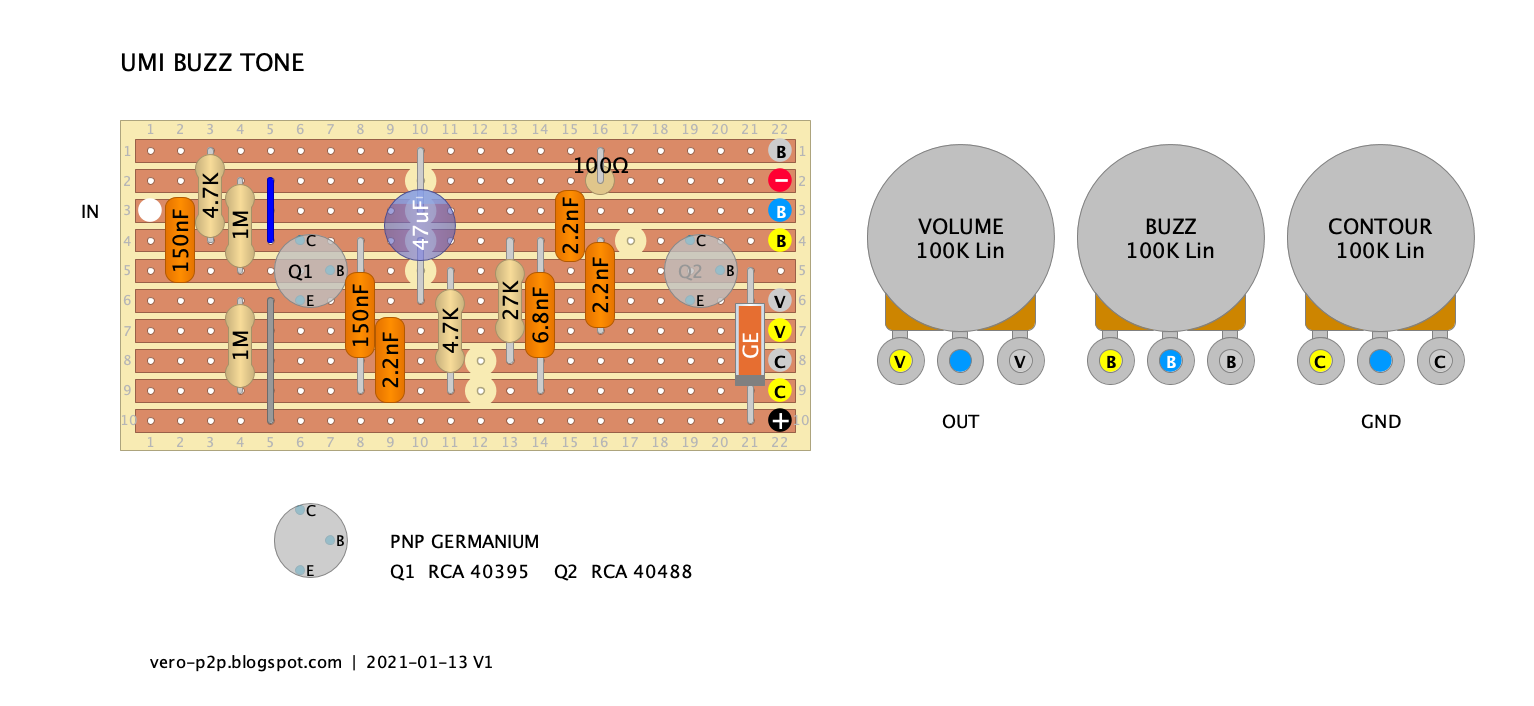
UMI: Buzz Tone

A very close relative of the Conrad Buzz Box, the UMI Buzz Tone.  Same same but with a contour control on the output.


UMI BUZZ TONE - VERO LAYOUT

UMI BUZZ TONE - GUITAR EFFECT VERO LAYOUT


CONRAD: Buzz Box

Another simple one - the Conrad Buzz Box and Volume Expander - there is no volume expansion happening; this is just fuzz. 

This is an easy one to convert to NPN, and there's quite a bit of discussion on the usual forums re transistors.  Good results have been seen with low-gain silicon in Q1, and germanium on Q2.   

There are also a few different schematics out there with varying pot values.  example:  100k for buzz; one even has 150k for both pots, which will be a little hard to find.


CONRAD BUZZ BOX - VERO LAYOUT

CONRAD BUZZ BOX - VERO LAYOUT


Saturday, December 12, 2020

D*A*M: Fuzzrong FR-70, Schematic


D*A*M Fuzzrong FR-70 schematic


D*A*M: Fuzzrong FR-70, 0.15" Vero Layout

Unlike the D*A*M Fuzzrong FR-69, which is very much a straight germanium Fuzzrite, the D*A*M Fuzzrong FR-70 is a little different.  

It's a version of the Rosac Nu-Fuzz, which was designed by Ed Sanner, the designer of the Fuzzrite.  There are a some changes with component values, but you are basically looking at the bones of Nu-Fuzz.

It uses very common transistors - so there is no hunting for expensive/rare germanium only to find out they sound 95% like the ones you already have...  


D*A*M FUZZRONG FR-70 - VERO LAYOUT (ORIGINAL D*A*M LAYOUT)

D*A*M FUZZRONG FR-70 - GUITAR EFFECT VERO LAYOUT


I altered the layout a little to add a cap for the power supply - also changed the small cap across Q1 to 1n to help reduce noise, and it was a tad bit bright for my liking.   It’s a really solid sounding circuit.  


NU-FUZZ vs FR-70


ROSAC NU-FUZZ vs D*A*M FR-70


This is swapping the tone/depth pots - similar, but the FR-70 has less bottom end.  

ROSAC NU-FUZZ vs D*A*M FR-70

AND HERE'S A CLIP FROM ONE OF MY YOUTUBE FUZZ FAVES


Thursday, December 10, 2020

D*A*M: FUZZrong FR-69

This is the layout that D*A*M used for the Fuzzrong FZ-69, which is essentially a germanium Fuzzrite.

I couldn't make out the pot values or the 2n2 cap values on the photos I could find, so will have to take this at face value.  

D*A*M FUZZRONG FR-69 - VERO LAYOUT

D*A*M FUZZRONG FR-69 - VERO LAYOUT


Friday, September 25, 2020

EARTHQUAKER DEVICES: Terminal Fuzz

The Earthquaker Devices Terminal Fuzz is based on the Shin-Ei Companion Fuzz, with a few tweaks to improve performance and versatility.  The first section is actually a lot like a silicon Fuzzrite.  Q1 feeds directly into Q2 - they feed into either side of the treble control with quite small capacitors.

The treble pot is followed by a notch filter, found on many fuzz circuits of the day, but the EQD Terminal Fuzz has included a voice control, to adjust the filter.  The notch filter is followed by a gain recovery section, as a notch usually drops a bit of level from the signal chain - a common issue in many old fuzzes with notch filters.

 EARTHQUAKER DEVICES TERMINAL FUZZ - VERO LAYOUT


EARTHQUAKER DEVICES TERMINAL FUZZ - VERO LAYOUT


Read the comments below, as there has been a bit of disappointment with this one.    A good suggestion was made by Tom, the 4n7 capacitor should be increased to 47n, which is the same as the Shin-ei.


Thursday, September 3, 2020

GHOST EFFECTS: Lunar Incantation, Point to Point Layout

The Ghost Effects Lunar Incantation is part Mosrite Fuzzrite and part Rosac Nu-Fuzz - what a combination...   time to break out some NOS low-gain silicon transistors? Maybe not.  BC108s will be fine; probably anything with lowish gain that's NPN silicon will do.  Ghost Effects recommend 150 to 300hfe, with the second transistor having a higher gain.

I've left enough room for power filtering/diodes / 1M input resistor etc, if you want to add that.


GHOST EFFECTS LUNAR INCANTATION - POINT-TO-POINT LAYOUT

GHOST EFFECTS LUNAR INCANTATION GUITAR EFFECT P2P POINT TO POINT LAYOUT


Wednesday, September 2, 2020

GUILD: Foxey Lady, Point to Point and Vero Layouts (two knob version)

This is an early two knob Guild Foxey Lady, which is very similar to a silicon Mosrite Fuzzrite.  However it’s different to other schematics I have seen online -  

I traced this from the circuit shown below - it's easy to make out part values, excluding the pots and transistors.  I left some room for power filtering too, should be able to fit an extra cap / resistor / diode on there without any trouble.

GUILD FOXEY LADY - POINT TO POINT LAYOUT

GUILD FOXEY LADY - POINT TO POINT LAYOUT


GUILD FOXEY LADY - VERO LAYOUT

As you can see I converted the P2P layout to vero - could have been smaller, but no matter - it's still on small side of things anyway.


GUILD FOXEY LADY - VERO LAYOUT


GUILD FOXEY LADY SCHEMATIC


I traced the circuit from the photos below, taken from David Morrin's website (hope you don't mind me using them Dave).  

 I don't know what the actual pot values are - the usual suspects for a Guild Foxey Lady would be a good starting point (100k).  Dave mentions that they are dated 1968.  Not sure about the transistors either, 2N5133 or similar is a distinct possibility. 


The traced circuit is a lot brighter than the standard schematic - no surprise given the 1n cap on Q2 instead of the 3n3