Showing posts with label CLASSIC FX. Show all posts

Saturday, December 2, 2023

INTERFAX: Harmonic Percolator (modded)

This is a slightly modded Interfax Harmonic Percolator that I made today.  It's an odd little circuit - it can run from clean, a bit overdriven, then into distortion, and finally to overly compressed fuzz madness.  The range of sounds are so broad, it's almost worth setting it up as a dual pedal (which I might do). 

In terms of mods, it's kind of a mix of a couple of schematics, the Land Devices HP-2 and a bit of my own thing.   It's still very much a Harmonic Percolator, that much is sure.  If you want to use the layout for a stock Harmonic Percolator (whatever that may be), there's fairly extensive discussions on the usual forums, including schematics and of course many and varying opinions as to what it should be.


INTERFAX HARMONIC PERCOLATOR - MODDED VERO LAYOUT

INTERFAX HARMONIC PERCOLATOR - MODDED VERO LAYOUT


When it was on the breadboard I tried a few different transistors.  The differences were noticeable, and I'd recommend testing before soldering, to make sure that you have a combination that you're happy with.  

If you have a breadboard, it's worth getting it on there to play with - there are so many variations on this circuit, and they do make a difference.

The silicon transistor had a hFE of around 240 and the germanium was about 70 with almost no leakage (like many soviet transistors).  The type of germanium and silicon diode is not important.   


ON THE SCOPE

With the input trimmer down, it's a pretty clean signal (called Harmonics on the pedal).  I run a 200mv 440hz sine wave into my scope.


This is with harmonics on full, it's a fairly over the top and very compressed fuzz sound.  Germanium diodes are on.


This is Harmonics on full, diode clipping bypassed - there's a huge jump in level and it's a lot more dynamic.  


Friday, November 10, 2023

Monday, October 2, 2023

RANGEMASTER BOOSTER

Just a Rangemaster with a rotary switch for selecting input capacitors - it uses some odd parts, as this is what was available in my local electronics store - the 5 lug tag strip in particular, a regular Rangemaster is on 6.  It's also a slightly odd rotary, but it was all that was left in the draw.

RANGEMASTER BASED GERMANIUM BOOSTER - VARIABLE FREQUENCY

RANGEMASTER BASED GERMANIUM BOOSTER - VARIABLE FREQUENCY

You may also want to add a small cap ( 470p / 1n) across the input to the base of the transistor, so there’s always a capacitor in the circuit - this reduces switch noise on the rotary.  I don’t think it’s massively important,  as I’m a set and forget kind of guy.  

Do check the numbering on the rotary, as the ones that Ive been using are in reverse, compared to the layout.  i.e.  start with small cap values on the left.


RANGEMASTER BASED GERMANIUM BOOSTER - VARIABLE FREQUENCY - BUILD PHOTO


Expect some hiss - this circuit is infamous for it, but it does sound good so most people overlook this.  Having a rotary with a few capacitor options is so much better than the stock Rangemaster treble booster - the additional range of sounds is well worth it.  The full range boost can get a little fuzzy, which is something that I was not expecting. 


While it was pretty quick to put the Rangemaster board together, it wasn't fast to wire up the rest.  There was a bit of fiddling with lining up the capacitors on the rotary, and the general position of the tag strip didn't help matters.   

Same again, but this time with a pot to help set the gain, instead of a 3.9k resistor.  This is hand to dial in (or out) the grit that can really make treble boosters shine. 


Thursday, July 6, 2023

PROCO: Rat, 0.15" vero layout

Now this is mainly for my own purposes, as I doubt anyone else will want to build a Rat this way & I only plan on making one.  

Just a standard Rat, built on 0.15" vero and I've prioritised looks of build practicality (or at least what I think looks good anyway).  I have built this, and can confirm that it works   


PROCO RAT - 0.15" VERO LAYOUT


PROCO RAT - 0.15" VERO LAYOUT

The layout probably makes more sense with a photo as a reference


Saturday, April 8, 2023

MKI TONE BENDER: Phenolic Board Template

I purchased a sheet of phenolic board locally to make some MKI boards, as I didn't want to pay $25 postage on a $3 board from the USA (postage to Australia is often a killer).  I couldn't find a template anywhere, so I reversed one from a product image online - I did make one slight change to the online product, as I didn't like the alignment of the resistors and capacitor on the righthand side.   

I think it's pretty close as a MKI template, even if it's a metric approximation.   I've built a few boards using this, and the spacing does work with 1/2 watt carbon composite resistors.


MKI TONE BENDER - PHENOLIC BOARD DIMENSIONS / TEMPLATE


MKI TONE BENDER - PHENOLIC BOARD DIMENSIONS / TEMPLATE


safety message:  wear breathing protection when cutting board, even if it's just a medical mask.

Link to MKI component table for variants


Wednesday, January 18, 2023

SOLA SOUND: Tone Bender MK1.5 - Original 0.15" Vero Layout

A bit of a classic - the MK1.5 Tone Bender.  Some great phots and background information here on Fuzzboxes.org and some great video demos below - who better than Ant Macari to talk Tone Benders.

Note that some earlier versions carried a 500k volume pot, instead of 100k resulting in more bass - ultimately bringing it closer to a Fuzz Face.  

One of the main differences to a Fuzz Face is the use of OC75 transistors.  The key to this is that they are very leaky, and will not bias the same way as a regular fuzz face.  Do not try and bias it like a fuzz face with 4.5v on the collector of Q2 - it will be around 7 or 8 volts.   


SOLA SOUND MK1.5 TONE BENDER - ORIGINAL VERO LAYOUT (0.15" / 3.8MM)


SOLA SOUND MK1.5 TONE BENDER ORIGINAL VERO LAYOUT (0.15" / 3.8MM) FOR DIY GUITAR EFFECT BUILDERS


Saturday, October 29, 2022

Tone Bender MKII - Component Values Table

Nice bit of MKII history on fuzzboxes.org   The MKII might be the most popular of the Tone Benders, although personally I'm split between the MKI & MKIII.

There's also this interesting timeline on the D*AM forum.  Not sure who made it, but it's a handy reference (thanks ClassicFuzz).  


TONE BENDER MKII SCHEMATIC & VALUES

Tone bender MK II component table schematic

TONE BENDER MKII COMPONENT VALUES TABLE


R7

Apparently, this resistor was used to shave a bit of gain off circuits that were prone to making unpleasant noises when Attack was set to full.   It's said that this was only on some short board Solas, and some Marshall Suapfuzzes.

C6

My experience with this circuit is that if you don't have a cap on the power, it can oscillate/make terrible noises.  

TONE BENDER MKII LEAKAGE & HFE

A lot of talk about this - I'm not going to get into absolutes, but keep in mind that these originally used quite leaky transistors, and there are reports of nice sounding ones with very high hfe. 
  

APPROXIMATE VOLTAGE RANGE

As the heading suggests - these are approximate voltages only.  Results will vary from unit to unit, and if it sounds good to you, then don't stress about some numbers.  

-4.5 to -5 volts is not what you're after on Q3 collector - that's fuzz face territory.

All voltages shown below are negative

Q1
C   8.5
B   0.3 to 0.06
E   0.0

Q2
C   0.13 to 0.32
B   0.07
E   0.0

Q3
C   7.5 to 8.5 
B   0.13 to 0.22
E   0.1


Battery: -9.67V

Q1 
C -9.02 
B -0.03 
E 0

Q2 
C -0.17 
B -0.08 
E 0

Q3 
C -8.44 
B -0.17 
E -0.11


MKII TONE BENDER TUNING TIP

Tuning tips by Dave Main - if you're using a trimmer in place of the 8k2 resistor.  

You can also do it by ear, which is much more fun. Get the MKII running into a clean amp at a reasonable volume. Set the Level full and the Attack totally off. Roll your guitar's volume control back a wee bit, about 7-8 if you have a Strat. The tone here should be pretty clear and clean, if you can hear some fuzzy artefacts then inch the trimmer over to the left until they disperse. If you then crank the Attack and pull up your guitars volume you'll also have maximum sustain from the unit, that too should give a little play on any temperature fluctuations.


Friday, September 23, 2022

MXR: Phase 90

Bit of a classic guitar effect - the MXR Phase 90.

Electrosmash has an excellent reference that covers all things Phase 90, including the schematic  https://www.electrosmash.com/mxr-phase90.

JFETS can be pesky, so make sure you match them as best as possible and buy from reputable suppliers.

The script switch is strictly optional.   It's one of those things that if you like a setting, you probably won't ever change.  


MXR PHASE 90 - VERO LAYOUT

MXR PHASE 90 - VERO LAYOUT

Correction 25 Jan 2026:  Fixed resistors across JFETS.  Thanks Merlin


Tuesday, September 13, 2022

KLON: Centaur

The Klon Centaur - no introduction required really.  Arguably the most mythical of all overdrives?  Likely the most expensive of all overdrives...  

This layout took a lot longer than I thought it would.  In the end, I also realised that I could have shaved a row off, but hey...   maybe I'll come back to it another time.

I used the schematic from Aion FX, minus the pulldown resistor on the input, as this layout does not have the input buffer switch, so it's not really needed (be sure to use a switching scheme with grounded circuit input).   There's room on the board if you want to add it, just remember to increase the value of the other 1 meg resistor to 2meg.

The layout works, read past the first comment, and you will see the importance of buying ICs from reputable suppliers.

KLON CENTAUR - VERO LAYOUT

KLON CENTAUR - VERO LAYOUT GUITAR EFFECT

KLON DIODES

CAUTION: nerd alert on the diode videos.  Thought it was pointless to post a demo video, so here's a deep dive down the rabbit hole of the mystical Klon Centaur diodes.


Saturday, August 20, 2022

AMPEG: Scrambler

I haven't looked at an Ampeg Scrambler in a long time - in fact, my first attempt a few years ago went nowhere and ended up in the bin.  

It's a pretty wild octave fuzz from the late sixties; not a huge number were produced so the originals are expensive now.  

Scramblers were designed for bass guitar, which is why there's a clean blend.  Another thing to note is that they have a pretty low output level compared to a regular fuzz, sometimes below unity, so a boost is often added or used in conjunction with an electric guitar.


AMPEG SCRAMBLER - VERO LAYOUT

I didn't include the diodes marked as 'not on units' on the original schematic, as after playing with the circuit on LTspice they seemed to make no difference at all.
 
IMPORTANT: If you use 2N5306 for this, check your pinouts, as they can vary.

AMPEG SCRAMBLER - VERO LAYOUT STRIPBOARD


ORIGINAL SCRAMBLER SCHEMATIC

AMPEG SCRAMBLER - ORIGINAL SCHEMATIC


VIDEO DEMO


LTSPICE ANALYSIS

Schematic

I used DIY Darlington transistors in spice, as it doesn't actually come with Darlington transistors as a standard component (LTspice has some quirks), and I could not get the version I tried to download as a model to work.  Anyway - seems to have worked here...

As mentioned above, I did not include the redundant diodes, but I did compare them side by side and found almost no difference at all - if there was, it was extremely minor, not enough for me to spot on my laptop screen.  


Frequency Response

I included comparisons of different values for the emitter capacitor on the boost stage (Q3 on my schematic).  The original has a 120u capacitor, which will be hard to find now.  There's not a huge amount of difference between 100u and 120u.  You could probably move the 47k resistor to the left, and add another capacitor in parallel if you want to get closer to the original value, or just go a bit larger and use a 220u.


Traces


Below is the output of boost stage after the rectifier diodes, which, as you can see separates the positive and negative sides of the wave, and sends them to the differential amplifier.  Differential amplifiers as the name suggests, amplify the difference between the two inputs, which basically doubles the frequency, as you can see below.


Wednesday, August 3, 2022

BOSS: OD-1 Overdrive

A classic Boss overdrive - the one that started it all for Boss guitar effects, originally sold from 1977 to 1985.   This is one of the later designs that does not use the quad opamp.

Kind of curious that after this, many designs used the Boss version of a discrete opamp that can be seen in several different designs.  

BOSS OD-1 OVERDRIVE - VERO LAYOUT

BOSS OD-1 OVERDRIVE - VERO LAYOUT GUITAR EFFECT

BOSS OD-1 OVERDRIVE  SCHEMATIC


BOSS OD-1 OVERDRIVE - VIDEO DEMO

Not strictly speaking a straight demo of the OD-1, but I like Wampler's videos, and this does have a good comparison of the SD-1 and OD-3. 


Monday, July 25, 2022

DAN ARMSTRONG: Orange Squeezer

A classic - the Dan Armstrong Orange Squeezer.  It's a very simple feedback-based compressor using JFETS as variable resistors, driven by a single diode acting as a half-wave rectifier.  

This makes it pretty snappy to play, unlike an optical compressor which is traditionally a bit slower and smoother - not that there's anything wrong with optical, just a different feel.

I decided to use a single opamp for this layout.  I also started down the rabbit hole of replacing the opamp with a transistor-based amplifier, but more on that in another post.


DAN ARMSTRONG ORANGE SQUEEZER - VERO LAYOUT

DAN ARMSTRONG ORANGE SQUEEZER COMPRESSOR VERO LAYOUT FOR DIY STOMPBOXES


DAN ARMSTRONG ORANGE SQUEEZER - VIDEO DEMO


Sunday, July 10, 2022

DOD: 250 Overdrive Pre-amp

A nice simple one - the DOD 250, which is a Distortion + variant.  Or is it the other way around?  Either way, it's a classic.

DOD 250 OVERDRIVE PREAMP - VERO LAYOUT

DOD 250 OVERDRIVE PREAMP - GUITAR EFFECT VERO LAYOUT


DOD 250 OVERDRIVE PREAMP - SCHEMATIC

DOD 250 OVERDRIVE PREAMP - SCHEMATIC


DOD 250 OVERDRIVE PREAMP - VIDEO DEMO


Sunday, May 1, 2022

COMPONENT TABLE: Fuzz Face Variants

FUZZ FACE VARIANT SCHEMATIC, INCLUDING MK1.5 & VOX TONE BENDERS

The schematic includes room for components not present on a standard fuzz face, as some variants have additions.  

I thought I'd keep it relatively simple and not venture into circuits with input blends or the various trimmers substituted for resistors (at least for now anyway).  R1 & R3 are where trimmers are often placed - usually more frequently as R3, sometimes in combination with a low-value resistor.  R4 can also be fun to play with, to help fine-tune the circuit.  

No attempt has been made to list every transistor ever used in a fuzz face.


fuzz face variant schematic


FUZZ FACE VARIANT COMPONENT TABLE


FUZZ FACE TRANSISTORS

Of course, you can't mention fuzz face without talking about transistors.  It's definitely a matter of taste - some folks like high-gain silicon, others will settle for nothing but NKT275.

A lot of info out there on forums etc talks about the "best" hfe combination - just ignore that and trust your ears.  Lower hFE for Q1 and higher for Q2 is valid advice.  Some say keep the hFE about 20 to 40 apart

Very low leakage germanium transistors have given me good results, especially for Q1.  In my experience, very low leakage on Q1 gives the best clean tones.  


The Mythical NKT275

Good luck finding real ones.  Interesting quote from Analog Man here re the NKTs.  The man knows his transistors and fuzz faces.  

"The sound of these original NKT275 transistors was quite similar to the other types of germanium transistors that we use. But the NKT275s have less fuzz, and less high end fizziness. They have a deeper tone and clean up better than most transistors. If you turn down the volume on your guitar, the NKT275 sound will be totally, sparkly clean without any fuzz remnants. Normally, NKT275 transistors are not high gain, that is why they clean up so well and are so smooth sounding."


AC128

They did appear in some reissued fuzz faces at one stage, but most experts out there are yet to see one in a proper vintage fuzz face.   The general advice is to avoid the AC128.  

VOLATGE

As for the magic Fuzz Face number of -4.5v on the collector of Q2 - it's a good start, but don't stress about it.  I tested a really nice Fuzz Face from the first year of production measuring -5v (NKT275 transistors).  It sounded great.  

If you're making a MK1.5 using OC75s - it's going to be a much higher voltage, due to leakage.  Don't bother trying to get it to -4.5v.  It's not going to happen.  

VOLUME MOD

A common complaint is that the volume too low.  

R2 & R3, usually 470 and 8k2, form a voltage divider from the collector of Q2 to DC supply.  AC isn't fussy about where ground is - this means that you have a hardwired volume control before the actual volume pot, which is reducing the output level by a massive amount.   

8,200 + 470 = 8,670.   So just adjust the resistor values to add up to around the same amount.   The most common thing to do is change the 470 to a 1k resistor.   


Replacing the 8k2 with a trimmer is also another solution - this often changes the bias.  You might like the output level, but then find you prefer the fuzz sound when the level is lower.   Anyways, whatever works right...  


 THE ANALYSIS OF, AND THE DARK ARTS OF THE FUZZ FACE


Thursday, April 28, 2022

VOX: Tone Bender, 0.15" Vero Layout

After realising I had the "right" transistors for this, I thought I should have a crack at a Vox Tone Bender.  

I've done a generic vero layout with room for mods, with some common values listed - I guess the most obvious is the external bias pot, which could be replaced with a standard 8k2 resistor.

The D*A*M 1966 Italian Tone Bender has a Super Bee vs '66 mod, which is just a switch with a 47k resistor to ground from volume 3 (using a 470k pot) - reducing bass.  It's an easy way to capture the sound of some of the common variants out there.    


VOX TONE BENDER - 0.15" VERO LAYOUT

VOX TONE BENDER - 0.15" VERO LAYOUT FUZZ


VOX TONE BENDER CIRCUIT PHOTO


VOX TONE BENDER VS FUZZ FACE VS TONE BENDER MK1.5

And if you're thinking, what's the point, it's just a Fuzz Face - well, that's true to some extent, but sonically there are some differences, as you can see from the plots below.  

This of course, doesn't consider the differences in character provided by different transistor combinations - LTspice doesn't have a huge range of vintage transistors to choose from, and unlike real germanium transistors, everyone has identical hfe and leakage.


VOX TONE BENDER VS FUZZ FACE VS TONE BENDER MK1.5


VOX TONE BENDER VS FUZZ FACE VS TONE BENDER MK1.5


Some Vox Tone Benders have a 47k resistor across the 500k volume pot, which reduces the volume pot to 43K.  I used 50k, as that’s what some versions of the Vox Tone Bender use (there are a few circuit variations)

Vox Tone Bender vs fuzz face


Wednesday, October 27, 2021

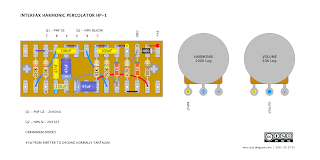
INTERFAX: Harmonic Percolator HP-1, Tag Board Layout

Haven't done a tag board build for a while - so here's a classic.  

INTERFAX HARMONIC PERCOLATOR HP-1 - TAGBOARD LAYOUT

INTERFAX HARMONIC PERCOLATOR HP-1 - GUITAR FX TAG BOARD LAYOUT


Being tag board, I've used 1/2w resistors and axial caps.  You could use something more practical (smaller), but if that's what you want to do, I would recommend using a different layout, as this is not the best use of space for regular-size parts.  


Tuesday, October 26, 2021

NOBELS: ODR-1 Overdrive, Nordland Updates

After doing a layout for the Nordland Overdrive, I thought I would compare the differences to the designers original Nobels version.   Apart from some insane power filtering / protection and LED circuitry, there's a couple of small changes.

Traced schematic for the Nordland is here, on Aion FX


  • Hard clipping diodes to ground, instead of to bias voltage 
  • Resistor to ground instead for bias voltage
  • Some coupling capacitor value changes
  • I omitted a few small details, like 10 ohm resistors providing some additional separation between components 
  • 50k tone pot instead of 20k


NOBELS ODR-1 OVERDRIVE - VERO LAYOUT

NOBELS ODR-1 OVERDRIVE - GUITAR FX VERO LAYOUT

NOBELS ODR-1 OVERDRIVE x NORDLAND OVERDRIVE - VIDEO DEMO


Saturday, August 21, 2021

FOXX: Tone Machine, BE Mods 2026

Updated Foxx Tone Machine layout on 0.15" vero.  This was inspired by the Aion mods - if you are unfamiliar with the Aion Vulcan, it's a Tone Machine with a modded EQ section (which is great) and an additional bypass option on one of the diodes - also a cool addition. 

I've tweaked a few values to suit my taste - this is not a stock Tone Machine.  

FOXX TONE MACHINE - BE 2026 V1


ADDITIONAL FOXX TONE MACHINE INFORMATION

Credit where credit is due - most of this information is from Aion build documents, which are excellent (go buy a kit, it will be easier than this...)

Transistors

The earlier Blue FTM used 2N3565 transistors with a hFE of around 230 to 245.   

The Red FTM used 2N3565 transistors with a hFE of around 450 - 550 

*I've also seen BC237B listed on the JD Sleep schematic from 2002.  

Treble Capacitor 

The earlier Blue used 3n3.   The Red used 2n7

Tone Control

Yes, it looks a bit like a Big Muff.   Can add a resistor after the treble cap to ground for BMP-like results.

The 4k7 resistor on the bass side of the treble control limits the range of the pot - jumper or remove for a tiny bit more range on the bass side.  

And of course, there is the mid-switch - basically adding more capacitance to the 3n3 treble cap, to boost mids.  I like a little bit of this action, but not too much.  15n is too much for me...  

Q3 bypass cap

Noted as 10uf on the schematic, measured at 22u, which does make a small difference to the bass response (more).  Basically, a 10u cap that is out of spec.

Additional Resistor

Red version had an extra 12k series resistor before the sustan pot, shaving a bit of level off.

Diodes

Use matched diodes in the octave section - originals used generic 1N34A diodes.  Matching just gives a better octave.   

Coupling Caps

Apart fromthe 100n on the input, the original used 10uf coupling caps.  They can be trimmed down to 1uf with no discernible difference.  

Optional Extras

The CBS Arbitier Doubler has a 10uf bypass cap on the emitter of Q1 - but is more gain here really needed?

Can add a 22u cap on the emitter of Q4 to bring the level up, as it can be a bit low.  


Sunday, July 11, 2021

ELECTRO-HARMONIX: Opamp Big Muff,

What more can be said about an opamp Big Muff?

ELECTRO-HARMONIX OPAMP BIG MUFF - VERO LAYOUT


VIDEO DEMOS


Sunday, June 20, 2021

MARSHALL: Shredmaster

The Marshall Shredmaster is a somewhat classic distortion, even if it has a cringe worthy name.  I don't think I would have even looked at this back in the day as a result of the name.  Shredding is not my thing.

I think it's fair to say that Radiohead using the Shredmaster has certainly helped its image in more recent times.  

This version has diode clipping options, which will help open it up a bit.   I'm sure you can work out how to build the stock version or change diodes to suit your taste from this layout - there's certainly enough room to play with around that section.  Note that it has been said that jfet based ICs are not great for this circuit, so I'll let you decided on that side of things.


MARSHALL SHREDMASTER - VERO LAYOUT (WITH DIODE CLIPPING MOD)

MARSHALL SHREDMASTER - GUITAR EFFECT VERO LAYOUT