Showing posts with label OCTAVE. Show all posts

Sunday, April 28, 2024

FENDER: Blender

Something of a classic, the Fender Blender is a monster octave fuzz.  I'd be tempted to remove the Blend pot myself, as I don't like fuzz pedals with clean blend.  Probably advisable to add LEDs to the Tone boost switch too.   Layout has been designed for a wide enclosure to accomodate the switching and 4 x knobs.  Should be enough room to add a few extra columns for mounting points.  

FENDER BLENDER - VERO LAYOUT

FENDER BLENDER - VERO LAYOUT


FENDER BLENDER - SCHEMATIC / LTSPICE

Looking at the schematic, essentially what you have here is a Foxx Tone Machine, with a bit more going on.  Certainly more extreme on the fuzz side of things, and unlike the Foxx, you can't turn off the octave (unless you wanted to add a switch to disconnect C6 from the emitter of Q3).


Signal on the collector and emitter of the inverter stage, before being joined together to form the octave


Post diode clipping - the signal is throughly destroyed by this stage


The Tone Boost switch - notch filtered or raw fuzz


Looks a little different by the time it hits the output - tone control in circuit


Tone Boost on, taken from the output


If you want to ditch the blend, it's as simple as this - no effect on the circuit / frequency response.  


In case your wondering - I have no idea on what's happening inside a Kevin Shields Blender.  I've seen a gut shot and it has about 6 x ICs in there in addition to the regular transistors, so there's a lot going on outside of the stock circuit.

Wednesday, April 12, 2023

JHS EHX: Lizard Queen

So just out, and with all of the suitable hype and controversy expected - the EHX / JHS Lizard Queen.

Trace and discussion in progress on FSB - it looks relatively similar to some old DIY designs out there, which is the cause of much of the controversy.  Well, not so much what they are based on, but more so the lack of acknowledgement by JHS.  Make what you want of that. 

The short story is that it looks like a Bazz Fuss followed by a Tim Escobedo Pushme Pullyou - anyway, keep an eye on the thread for updates.  


JHS / ELECTRO-HARMONIX LIZARD QUEEN - VERO LAYOUT

JHS / ELECTRO-HARMONIX LIZARD QUEEN - VERO LAYOUT


Saturday, August 20, 2022

AMPEG: Scrambler

I haven't looked at an Ampeg Scrambler in a long time - in fact, my first attempt a few years ago went nowhere and ended up in the bin.  

It's a pretty wild octave fuzz from the late sixties; not a huge number were produced so the originals are expensive now.  

Scramblers were designed for bass guitar, which is why there's a clean blend.  Another thing to note is that they have a pretty low output level compared to a regular fuzz, sometimes below unity, so a boost is often added or used in conjunction with an electric guitar.


AMPEG SCRAMBLER - VERO LAYOUT

I didn't include the diodes marked as 'not on units' on the original schematic, as after playing with the circuit on LTspice they seemed to make no difference at all.
 
IMPORTANT: If you use 2N5306 for this, check your pinouts, as they can vary.

AMPEG SCRAMBLER - VERO LAYOUT STRIPBOARD


ORIGINAL SCRAMBLER SCHEMATIC

AMPEG SCRAMBLER - ORIGINAL SCHEMATIC


VIDEO DEMO


LTSPICE ANALYSIS

Schematic

I used DIY Darlington transistors in spice, as it doesn't actually come with Darlington transistors as a standard component (LTspice has some quirks), and I could not get the version I tried to download as a model to work.  Anyway - seems to have worked here...

As mentioned above, I did not include the redundant diodes, but I did compare them side by side and found almost no difference at all - if there was, it was extremely minor, not enough for me to spot on my laptop screen.  


Frequency Response

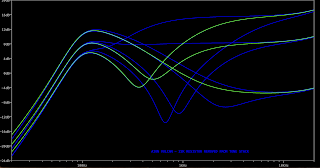
I included comparisons of different values for the emitter capacitor on the boost stage (Q3 on my schematic).  The original has a 120u capacitor, which will be hard to find now.  There's not a huge amount of difference between 100u and 120u.  You could probably move the 47k resistor to the left, and add another capacitor in parallel if you want to get closer to the original value, or just go a bit larger and use a 220u.


Traces


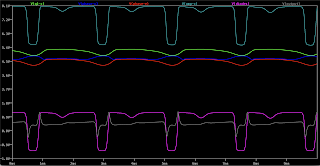
Below is the output of boost stage after the rectifier diodes, which, as you can see separates the positive and negative sides of the wave, and sends them to the differential amplifier.  Differential amplifiers as the name suggests, amplify the difference between the two inputs, which basically doubles the frequency, as you can see below.


Monday, March 21, 2022

EARTHQUAKER DEVICES: Hoof Reaper

I know one could make the three different effects and box them together, but I thought I might do a layout with them all on one board.  


EARTHQUAKER DEVICES HOOF REAPER - VERO LAYOUT

EARTHQUAKER DEVICES HOOF REAPER - VERO LAYOUT


REAPER VIDEO DEMO


Sunday, January 30, 2022

FOXX / AION: Tone Machine / Vulcan

After recently finishing a mojo size / vintage transistor Tone Machine that has been sitting on the bench for way too long, I decided to do a regular layout, as the practicality of some of my other layouts for the Foxx is probably not for everyone (maybe even me in retrospect).

So I've done a standard Foxx with the Aion Vulcan mods, and then took the Vulcan mods a step further by using a rotary switch for the mids.

By changing from an SPDT switch to a 2-pole rotary for the mids on the Vulcan, the optional 22k resistor in the tone stack can also be switched in and out.  So instead of three different mid-range options, you now have six, including a stock Tone Machine setting.

The rotary switch looks like this on the schematic.  


Unlike the Aion Vulcan, the rotary switch does not sum the capacitors (placed parallel), which is why there's a 3n3 on the rotary in place of the 2n2 on the Vulcan.  This also provides a bit of room to move in the selection of the 1n capacitor.  While 1n provides a sound of its own, it could easily be a little larger - maybe a 1n5 or similar.   I’d even suggest keeping the 3n3 and the 15n and pick a value in between to replace the 1n.  Maybe a 6n8 or a 10n.  


FOXX TONE MACHINE / AION FX VULCAN - VERO LAYOUT

FOXX TONE MACHINE / AION FX VULCAN - VERO LAYOUT


FOXX TONE MACHINE / AION FX VULCAN - LTSPICE

You can get an idea of the stock response and the range of the Aion Vulcan with these.  100% Sustain, Tone swept from 0 to 50% and 100%.

Adding the optional 22k resistor into the tone stack increases the mid-range scoop, similar to a Big Muff.

The standard Foxx TM uses a lot of 10u caps, whereas the Vulcan’s uses 1u - it makes zero difference to the frequency response.


FOXX TONE MACHINE / AION FX VULCAN ON THE SCOPE

Start your device at low levels - this uses a straight sine wave.   
 
This is it sweeping through the six-tone settings, with the tone being turned from bass to treble on every setting.  The first three are 1n, 3n3, and 15n with the additional 22k resistor in.  The last three are 1n, 3n3 and 15n without the 22k resistor.  The second last one is a stock TM.


Diode switching - in, out and octave.  Note the changes to the harmonics


Saturday, August 21, 2021

FOXX: Tone Machine, BE Mods 2026

Updated Foxx Tone Machine layout on 0.15" vero.  This was inspired by the Aion mods - if you are unfamiliar with the Aion Vulcan, it's a Tone Machine with a modded EQ section (which is great) and an additional bypass option on one of the diodes - also a cool addition. 

I've tweaked a few values to suit my taste - this is not a stock Tone Machine.  

FOXX TONE MACHINE - BE 2026 V1


ADDITIONAL FOXX TONE MACHINE INFORMATION

Credit where credit is due - most of this information is from Aion build documents, which are excellent (go buy a kit, it will be easier than this...)

Transistors

The earlier Blue FTM used 2N3565 transistors with a hFE of around 230 to 245.   

The Red FTM used 2N3565 transistors with a hFE of around 450 - 550 

*I've also seen BC237B listed on the JD Sleep schematic from 2002.  

Treble Capacitor 

The earlier Blue used 3n3.   The Red used 2n7

Tone Control

Yes, it looks a bit like a Big Muff.   Can add a resistor after the treble cap to ground for BMP-like results.

The 4k7 resistor on the bass side of the treble control limits the range of the pot - jumper or remove for a tiny bit more range on the bass side.  

And of course, there is the mid-switch - basically adding more capacitance to the 3n3 treble cap, to boost mids.  I like a little bit of this action, but not too much.  15n is too much for me...  

Q3 bypass cap

Noted as 10uf on the schematic, measured at 22u, which does make a small difference to the bass response (more).  Basically, a 10u cap that is out of spec.

Additional Resistor

Red version had an extra 12k series resistor before the sustan pot, shaving a bit of level off.

Diodes

Use matched diodes in the octave section - originals used generic 1N34A diodes.  Matching just gives a better octave.   

Coupling Caps

Apart fromthe 100n on the input, the original used 10uf coupling caps.  They can be trimmed down to 1uf with no discernible difference.  

Optional Extras

The CBS Arbitier Doubler has a 10uf bypass cap on the emitter of Q1 - but is more gain here really needed?

Can add a 22u cap on the emitter of Q4 to bring the level up, as it can be a bit low.  


Sunday, April 4, 2021

MXR: M-103 Blue Box

The MXR M-103 Blue Box is a sub-octave fuzz (two octaves down).  It's not a clean sub-octave either, pretty dirty really, well it's a fuzz...  kind of synthy on some settings.

Might want to check how many 56k resistors you have before starting this.  


MXR BLUE BOX - VERO LAYOUT

MXR BLUE BOX - GUITAR EFFECT VERO LAYOUT STRIPBOARD LAYOUT


BLUE BOX OCTAVE MOD

Same again, but with the octave mod - this provides the option to switch between just one octave below or the standard two octaves below.  Very handy; I would recommend this over the stock version.

Another mod is replacing the 10n cap to ground on the output with a smaller cap, or remove it altogether, or putting it on a switch for the best of both worlds.  

The 10n does shave a lot of high frequencies off (see scope traces below) - even on a switch you may want a smaller cap.  


BLUE BOX ON THE SCOPE / FFT

Signal   440hz sine wave, approx 130mv TRMS

Out of the IC, on the 56k / 10k divider to drop the level to a reasonable amount (massive signal straight off the pin) - as you can see, it's pretty much a square wave now.


Blend set to max octave, switch on 2 octaves down, no cap across the output to ground.

 
Blend set to max octave, switch on 2 octaves down, 10n cap across the output to ground.


Blend set to max octave, switch on 1 octave down, no cap on output to ground.


Blend set to max octave, switch on 1 octave down, 10n cap on output to ground.


M-103 BLUE BOX VIDEO DEMO


Sunday, October 25, 2020

UNIVOX: Super Fuzz, Notch Filter Mod

This is a handy little mod for the Univox Super Fuzz - especially for those who always leave the tone switch on the notch setting.  

Instead of a tone switch, there's a pot from the 100n capacitor to ground in the bridged-t notch filter, so the amount of notch can be dialled in.  If you really want to, you can have almost no notch...  but why???    

I usually like to include an octave pot in my builds, but I decided to keep the knob count down on this one.  Easy enough to add; there's space for this if you want to add it.

UNIVOX SUPER FUZZ - NOTCH FILTER MOD - VERO LAYOUT

UNIVOX SUPER FUZZ - NOTCH FILTER MOD - VERO LAYOUT


UNIVOX SUPER FUZZ - ON THE BENCH

I used a few old transistors for low gain and a Motorola dual transistor for the long-tailed pair.  The diodes are Soviet-era D9B, not that it makes much difference on a Super Fuzz (they don't really do much).

I intentionally made a few resistors standing to leave room around the many 10uf capacitors and the sizeable dual transistor.  2 x 47uf capacitors have been used instead of the usual 100uf on the power filter, as the 100uf was too cramped.  


UNIVOX SUPER FUZZ - NOTCH FILTER MOD - VERO LAYOUT

Sunday, August 16, 2020

EARTHQUAKER DEVICES: Tentacle, with buffer and blend

This is the octave portion of the Sunn Life pedal by Earthquaker Devices, taken from the Pedal PCB schematic.  

It's an EQD Tentacle (Dan Armstrong Green Ringer), with an input buffer and blend control.   I made this as an add-on for other builds - or if you want to build a Life pedal, add this in front of a modded Rat and add a MOSFET boost after it.  

EARTHQUAKER DEVICES TENTACLE - VERO LAYOUT, WITH BUFFER AND BLEND

eartherquaker devices tentacle with buffer and blend vero layout


And here’s a demo of this layout that I found on YouTube - thanks Adam 


Saturday, July 18, 2020

DAN ARMSTRONG: Green Ringer, Point to Point Layout (EQD Tentacle)

The classic Dan Armstrong octave effect - The Green Ringer. 

Great to put in front of a fuzz or distortion pedal.  The Earthquaker Devices Sunn Life pedal is basically a Green Ringer in front of a Proco Rat, with a booster.

DAN ARMSTRONG GREEN RINGER - POINT TO POINT LAYOUT

Dan Armstong Green Ringer p2p point to point


Earthquaker Devices have a version called the Tentacle, which is almost identical.  For the Tentacle, just do the following:

Change Q1 and Q3 to a 2N5089 
Change 1.5M resistor to 2.2M
Add 100pf capacitor from input to ground
1N4148 Diodes used


I've left some room on the board for power filtering if needed.


Saturday, July 11, 2020

FOXX: Tone Machine

One of my favourites - the Foxx Tone Machine.  I've posted a couple of layouts, one stock, the other is the Aion FX Vulcan.  The Aion FX mods make the Foxx even better - I prefer it with the mid switch mod.  

The mid switch mod really gives this circuit a lot more range.  The diode switch is also interesting - with the octave off, one diode remains in the signal path.  The diode switch bypasses this diode for a slightly different sound.

Apart from the 10uf from Q3 to ground, all other capacitors can be replaced with 1uf electrolytic or poly caps.  Might save some space, or maybe you prefer polys over electrolytic in the signal path.

My only disappointment with making the Foxx, is that I can't replicate the incredibly seventies looking velour stompbox enclosure.

FOXX TONE MACHINE - VERO LAYOUTS


foxx tone machine vero layout


Or something a little more traditional in terms of size and where the wires leave the board.  I could have made the board smaller, but I was going for something with plenty of room around components.  

FOXX TONE MACHINE - GUITAR FX VERO LAYOUT


FOXX TONE MACHINE / AION FX VULCAN - VERO LAYOUT

Read the build docs on Aion FX for the Vulcan to find out more.

FOXX TONE MACHINE VERO LAYOUT


AION VULCAN - TONE MOD

Here's what the responses look like on LTspice (distortion mode), with the tone control set to 50%.  

Increasing the 15n cap to 47n flattens the scoop, and the 1n and 2.2n can also go up a size if you prefer a flatter mid-range (not shown in responses below)

This is with the additional 22k resistor


Without the additional 22k resistor


FOXX TONE MACHINE - LTSPICE

Stock Tone Machine, no mods as a reference

Output in red, plus the response on either side of the tone pot on the distortion setting.  Mellow is blue, and bride is green.


Same again on the octave setting


STOCK FOXX SCHEMATIC


FOXX ON THE SCOPE

This is straight from the first boost stage


UNION TUBE & TRANSISTOR: Bumble Buzz

The Bumble Buzz is based on the Kay Fuzztone, which is a simplified Univox Super Fuzz.  It's a collaboration between Union Tube & Transistor and Third Man Records (Jack White).

There are no knobs; just stomp and go.  Raw octave fuzz....  

UNION TUBE AND TRANSISTOR BUMBLE BUZZ - VERO LAYOUT

UNION TUBE AND TRANSISTOR BUMBLE BUZZ - VERO LAYOUT


UNION TUBE AND TRANSISTOR BUMBLE BUZZ - VERO LAYOUT


UNION TUBE AND TRANSISTOR BUMBLE BUZZ - VERO LAYOUT


UNION TUBE AND TRANSISTOR BUMBLE BUZZ - POINT TO POINT LAYOUT

UNION TUBE AND TRANSISTOR BUMBLE BUZZ - POINT TO POINT LAYOUT


ON THE BENCH

I should have cleaned up the edges a bit - but hey...  it was a quick and dirty build. 

Bumble Buzz


ON THE SCOPE / FFT

440hz sine wave, approx 130mv TRMS

A very distinct octave can be seen, along with a lot of high-frequency content.  As you can see, the actual trace here, is almost identical to the LTspice sim shown below.


LTSPICE

BUMBLE BUZZ ON LTSPICE


BUMBLE BUZZ ON LTSPICE

BUMBLE BUZZ ON LTSPICE

BUMBLE BUZZ ON LTSPICE

BUMBLE BUZZ ON LTSPICE


VIDEO DEMO