Showing posts with label Speaker. Show all posts

Sunday, September 28, 2025

ELECTRONICS AUSTRALIA: Guitar Speakers

Just some historic speaker info from 1967 - although I had to leave a page of advertisements in, as it has a kit for a fuzz box available from Moody.   For those not from Australia, Moody was a guitar amp brand, which was one of the big names back in the day.  I had no idea that they delved into kits.


Thursday, May 1, 2025

CTS Speakers

Chicago Telephone Supply (CTS) originally built drivers for telephone network signaling and tone generation. By the late 1950s they expanded into loudspeakers, supplying the booming tube-amp market. 

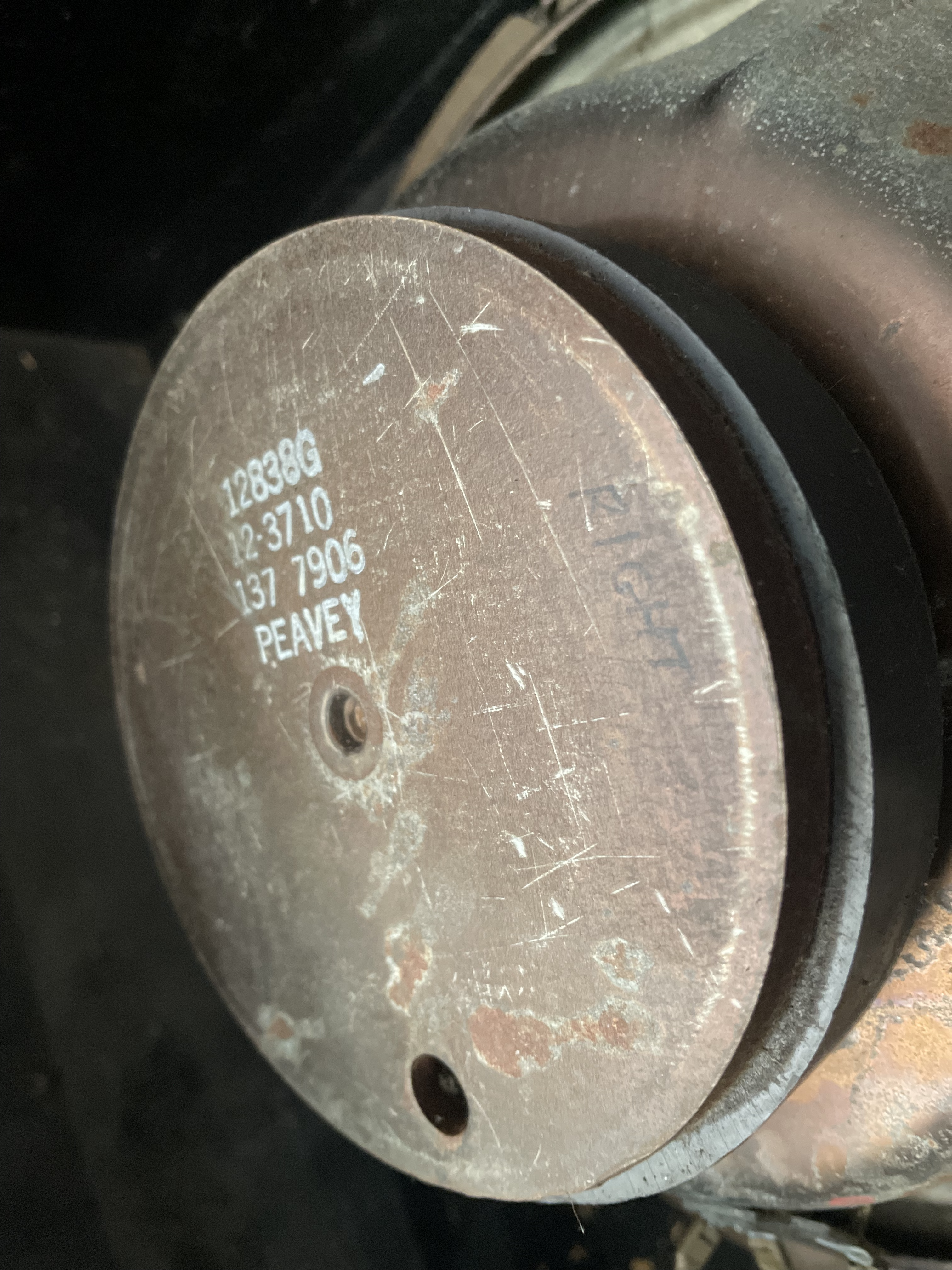
Their speakers, often marked with the EIA code "137," were used extensively by Fender, Ampeg, and many other amplifier companies from the 1950s through the 1970s.

Early CTS speakers used alnico magnets (square-back frames) prized for smooth breakup, while later ceramic-magnet versions (round frames) offered tighter lows at the expense of some warmth, but this is of curse a little subjective and varies with a lot of other factors.

Old CTS speakers do pop-up on eBay and Marketplace in Australia, and it can be hard knowing what you're looking at - are they hi-fi or guitar speakers?   The advertisement below might help.


Saturday, March 1, 2025

ETONE: Gold 12" Guitar Speaker

Etone speakers are a bit of a hidden gem in the guitar world, with their roots firmly planted in Australia. Manufactured in Sydney, these speakers were often considered the local (and cheaper) alternative to Celestion.

Unfortunately there isn’t much detailed information available on the specs, but it's widely believed that they have a ceramic magnet and handle around 40 watts of power. 

This particular speaker dates from 1975, as suggested by its code (thanks to the comment from Peter F). While the previous owner mistakenly marked the model with "975," that’s actually the date code, not the model number.

One of the most interesting things about the Etone gold speakers is their unique construction. Unlike most speakers, the frame and basket are one solid piece, which means the magnet is mounted from the front directly into the bell.

Etone gold speaker

Etone gold speaker

Etone gold speaker

I have two Vox AC15 amps, the newer AC15C1X with a celestion blue and an older AC15CC1 with a wharfdale GSH12-30 speaker.  Naturally the wharfdale was the one that I swapped out - I prefer the etone over the wharfdale.  The wharfdale wasn't terrible, it just wasn't a lively sounding speaker by comparison (if that makes any sense to you).  


Sunday, February 2, 2025

UTILITY: Speaker Cab Impedance / Speaker Switch

When I set out to build a proper test cabinet for amp building, I came across a great switch wiring setup that perfectly suited my needs. With the parts I had on hand, I was able to put together a versatile cab without risking damage to my favourite speaker cabs.  There are of course commercial products that achieve the same thing, and sometimes more.  But this is a DIY blog right.  

Why a test cab?  I already own several cabinets that I really like, however, I was a bit concerned about accidentally destroying a vintage speaker.  A dedicated test cab allows me to safely experiment with different speaker loads without worrying.

What You’ll Need

  • A twin-speaker cabinet with 8-ohm speakers
  • A 3-pole, 4-position rotary switch (Make sure it's a sturdy one, ideally rated at a couple of amps)

There are four switch positions, covering the most common loads:

  • The first two switch positions isolate the individual speakers, providing an 8 ohm load.  Handy if you have two different speakers in a cab that you want to isolate.
  • Position three is both speakers in series, providing a 4 ohm load
  • Position four is both speakers in parallel, proving a 16 ohm load
I kind of rushed into throwing this together, and now I want this to rework this to put it in sequential order...  4, 8, 8, 16.    


A Word of Caution

WARNING: If you wire this incorrectly, you could fry your amp’s output transformer - a costly mistake.  Always triple-check your wiring with a multimeter before plugging in your amp.  If you're unsure or don’t have the tools to verify your work, do not attempt this.

4-WAY SPEAKER / IMPEDANCE SELECTOR

Speaker Cab Impedance / Speaker Switch


The wiring diagram I used was posted by YellowBoots on the Tele forum


TEST CAB

The cabinet I’m using is a late '70s Peavey Deuce combo, minus the amp.  It houses two 12-inch CTS speakers, which I think are rated at 50W to 75W each.

It's quite a well built twin 12 combo cab, proper ply etc instead of the awful stuff they use these days in most amps.  I have it sitting on wheels, so it's easy to drag around the workshop.


Yes, I will eventually label it properly, but for now, this will do.  


I gave the new test cab a run with this little AWA PA 774 amplifier.  I modded it to have a Fender style preamp with bass and treble controls, cause I only had three knobs to work with.  It's a cool little amp and sounded great through the cab.  As I'm not a fan of the look of the old peavy cabs, I pulled the aluminium strip and logo off the front. 


Wednesday, November 13, 2024

BELL & HOWELL: Gaumont, Model 601 Projector Amplifier, 1949

I know, I know—this is starting to drift even further from pedal circuits with each post, but stick with me for a moment.

These old Bell and Howell projector amps have quite the following, so I’ve been keeping an eye out for one for a while. The catch is, they don’t pop up on the secondhand market very often—at least not the older valve-based models.

So when this one showed up on Marketplace at a reasonable price, I couldn't resist. It came from an older couple on the Sunshine Coast, which is about an hour from my place (Queensland, Australia). According to them, the amp originally belonged to a great uncle who bought it new in the early '50s. It had been in storage for about 20 years, and no one in the family was interested in keeping it. Apparently, it was still working when it was put away.

Basically the amplifier is hidden away under the projector (which is built like a tank by the way).   

BELL & HOWELL GAUMONT, MODEL 601

These amps are often called Filmosounds, or "Bernie" amps, named after a guy in Canada who’s believed to have been one of the first to modify them (or completely rebuild them) for guitar use. Bernie himself is something of a mystery—nobody seems to have ever met him or been able to track him down, and almost every amp he worked on has its own unique character.

Beyond their vintage charm, these amps are known for their unusual tone control. The tone circuit varies between different models, but this particular one is wired into the negative feedback loop and the cathode of one of the valves. When you adjust the tone knob, it feels like a lot of subtle things are happening at once.

Bell & Howell Gaumont, Model 601

The amp itself has;
  • 2 x 6V6GT  cathode biased, push pull, power amplifier
  • 1 x 6SL7GT (ECC35) dual triode for the phase inverter
  • 1 x 6J7GT (EF37A) pentode for the preamp
  • 1 x 5Z4 full-wave rectifier (Model 179 lists a 5Y3GT on the schematic).  
No little mini 9 pin bases here - all octal bases.  There's an additional 6V6GT as part of the projector system, and some other random valve that has no place on a guitar amplifier.

Bell & Howell Gaumont, Model 601

I really like the little grill cloth protector panel. 

Bell & Howell Gaumont, Model 601

Bell & Howell Gaumont, Model 601

This is actually the back, despite looking a bit like a speaker grill.

Bell & Howell Gaumont, Model 601

Unfortunately the rubber had hardened and has become so fragile that the leads can't be used.  I am saving the metal connectors, as they still seem good.  The cable is so bad, I can't even strip the outer layer to save the wires inside.  It's all gone.

Bell & Howell Gaumont, Model 601

The projector and speaker both came in really well made canvas cases.  Given that these were made in the late forties, perhaps someone with a bit of experience making kit for the military put these together?  The leather carry handle poked out the top - there's nothing left of it, apart from the wire frame.  Surprisingly the leather around the base is still in great shape.

Bell & Howell Gaumont, Model 601


While it doesn't have a label, these are usually marked as B.A.F.  Type T60 (British Audio Film Limited) and the general consensus is that they were made by Goodmans, and is similar if not the same as the Audiom series.   I have another Ampro projector speaker cab with a Goodmans in it that sounds great.  This one is not as nice as the Ampro, but it’s still pretty good (the Ampro has a physically larger cab, and a different model speaker) I was happy to see this speaker in such good condition.

And thanks for checking the speaker GB - in April 1949...  

Bell & Howell Gaumont, Model 601

And if you've seen photos of the projector and wondering how difficult it is to get the amp out - it's not.  It drops out the base after removing four screws.

Bell & Howell Gaumont, Model 601

These amps are notoriously tricky to work on—there seems to be two main schools of thought: strip the circuit out and start from scratch, or, leave them almost untouched and run with it as is.

Since this one’s from the late '40s, I’m not too confident about the state of the capacitors.  That said, there are people who using this model of a similar vintage without mods or repairs, so it’s not entirely out of the question. Maybe there’s hope!

Bell & Howell Gaumont, Model 601

BELL & HOWELL, MODEL 621 SCHEMATIC

BELL & HOWELL, MODEL 621 SCHEMATIC


I hope you don't mind the post John - so far your schematic is the only one that I can read (unlike the one above), that matches the 601.

Note that the schematic below contains an error / misplaced dot.  It looks like the 22k resistor in the tone control is attached to ground - it clearly can't be, as the OT would also be completely grounded.  The 22k resistor is negative feedback from the output transformer to the wiper of the tone pot.


Sunday, September 22, 2024

WHARFEDALE: W12 / EG - Vintage English Guitar Speaker

This speaker had been sitting on Gumtree for months, so I thought I may as well give it a try.  I know that Wharfedale doesn't have the best reputation among some speaker aficionados, but a lot of people seem to do just fine with them, and it did tick a few boxes for me: It was cheap, made in England in the sixties and it was pulled from a Vase Split Sound, which is a very rare amplifier from my hometown (so rare that I've never seen one).

The Split Sound would have been pretty fancy back in the day, so I'm guessing that this must have been considered a better than average speaker - at least by the folks at Vase, or the person that bought it.

Note:  This speaker has unusual mounting dimensions - it does not drop straight into standard 12" speaker mounting points.

12" speaker
Ceramic magnet
15 watt RMS, 30 peak
10 - 15 ohms
Maybe from 1966
40hz to 17khz which is very hi-fi for a guitar speaker

Wharfdale vintage 12" speaker guitar amplifier

I think it is inscribed   I/W12 EG  and what looks like  5/66  with chinagraph pencil.

Wharfdale vintage 12" speaker guitar amplifier

It has a strange green felt surround that is starting to deteriorate a little, but it's holding on OK.  As you can see, there were a few cracks / tears / small punctures in the cone.  The damage is small and localised, so not a concern.  The rest looks and feels very solid.

Yes it has a 'whizzer' cone, which is something a few speakers used to have to try and extend the upper frequency range.

Wharfdale vintage 12" speaker guitar amplifier

I really like the big speaker wire connections, although I do prefer good solder joins myself for reliability.

Wharfdale vintage 12" speaker guitar amplifier


The speaker cab instructions are interesting - who has speaker cabs rocking sand filled walls these days?  That's some serious deadening / mass going on there.

Wharfdale guitar speakers w12 EG specs


AMPRO: Vintage Projector Extension Speaker Cabinet

This is an extension speaker from a vintage projection system, and I wanted to jot down a few notes since information on this particular version seems scarce.

Most examples I’ve seen online are housed in brown cases from the USA (Ampro, based in Chicago). Those typically feature Jensen or Ampro-branded speakers, and some even include a built-in valve amplifier.

This particular unit, however, contains a Goodmans Audiom 60 speaker—12", 15 watts, 15 ohms, with an alnico magnet—made in England. These speakers were popular in the 1950s and very early 1960s, even appearing in guitar amps like the Vox AC30.

Unfortunately, I couldn’t locate a date code on this speaker, so pinpointing its exact age is tricky. That said, I tested it with my alnico blue-loaded AC15, and the sound is incredible—so I’ll leave it at that!

Dimensions:

  • Width: 45 cm
  • Height: 50 cm
  • Depth: 27 cm


Ampro speaker cabinet, Goodmans Audiom 60 speaker

Cast aluminium speaker grill cover, looks to have a light coat of hammered paint.

Ampro vintage speaker cab

The colour pallette of the tolex on the box reminds me of an old typewriter that my mother used to have.  It's quite well put together, the handle is metal, not plastic and it's spring loaded, so it folds down when not in use.

Ampro vintage speaker cab

Ampro vintage speaker cab

Ampro vintage speaker cab

Nice touch using a film spool to hold the speaker cable

Ampro vintage speaker cab

The spool also looks to have a light coat of hammered paint.  The jack is closer to the older telephone style than the modern 1/4" jack.

Ampro vintage speaker cab

Apart from the jack on the spool, there's a parallel speaker in / out

Ampro vintage speaker cab

There's also some insulation inside, which I hope is a natural fibre.  

Ampro speaker cabinet, Goodmans Audiom 60 speaker

Ampro speaker cabinet, Goodmans Audiom 60 speaker

Ampro speaker cabinent, Goodmans Audiom 60 speaker


Goodmans Audiom 60 speaker specs


Goodmans Audium 60 advert


Monday, July 15, 2024

PLESSEY: Vintage Australian Guitar Speakers

Following on from the Rola post, I thought I'd split the posts, as it was getting a tad long.    Long story short, Plessey bought Rola in the mid-sixties and the line evolved into the seventies.  For a while they carried Rola and Plessey names.  

PLESSEY SPEAKERS

The Plessey C12P is the go to for guitar speakers, and you can find Rola Plessey branded 12PEG, which are also an excellent choice.   The C12PX has a 'whizzer' cone to extend high frequencies, which can be surgically removed if you have a steady hand and something scalpel like.

vintage Plessey guitar speaker C12P

vintage Plessey guitar speaker C12P

vintage Plessey Rola guitar speaker 12PEG

vintage Plessey Rola guitar speaker 12PEG advert


ROLA: Vintage Australian Guitar Speakers & Transformers

Rola is better known as an American speaker maker, but there was also Rola Australia, based in Melbourne, which made speakers, transformers, chokes, and other related items. They also produced speakers in the UK and NZ.  As a local manufacturer of quality products, Rola Australia found its way into many Australian-made guitar amps. Their biggest sellers were used in console valve radios back in the day.

Plessey Electronics took over Rola in the sixties and continued to make speakers locally through to the mid-seventies. During this period, their speakers were branded as Rola / Plessey.

The 12U, 12 PEG, and 12 UEG are the most desirable Rola speakers, as they were specifically made for guitars. The 12M is also popular, but at 10 watts peak, it's cutting it close for even a small 4-watt valve amp, given how we like to run them hard these days.

I've saved the Rola catalogs here if anyone is interested, as I've just taken a few screen grabs of the bits that interest me to use in this post.

ROLA 12 PEG vintage speaker

ROLA ELECTRIC GUITAR SPEAKERS

From the 1957 catalog


From a later catalog, not sure what year

Rola guitar speaker specs


From the 48 catalogue - the 12R looks like a beast

Rola 12-r speaker


ROLA 12-O

I don’t know how this little 12" from 1959 will go, but it was cheap and in pretty much mint condition, so thought I would give it a try.  There may be a small bonus in it for me, as the previous owner is cleaning out some old gear and apparently has a stock of germanium transistors to offload….  


note to self:  recommend Rola transformer for the 12-O using as 6V6, 5k load @ 2 ohms
EHL32
CGB81
CDH75


ROLA HI-FI SPEAKERS 

Some folks also like the dual cone models, as they're very close to the guitar speakers, with the addition of a 'whizzer' cone to help with high frequencies.   Despite being Hi-Fi speakers, these do show up in some old amps.  They are a bit bright for some, as the do have quite an extended range compared to a regular guitar speaker.


ROLA TRANSFORMERS

Short story - type B is probably the go for general use single-ended amps.


Rola Transformers from the 1948 catalog

rola transformers 1948 catalog


ROLA DATES CODES

Care of P Field, https://www.aggh.net/discussion/index.php?topic=49255.0
The date code is an ink-stamp on the rim of the speaker frame, and it consists of a series of numbers and letters.  First is a one or two digit number for the day.  Next is a letter for the month, as follows:


A = January
B = February
C = March
D = April
E = May
F = June
G = July
H = August
I = September
J = October
K = November
L = December


This is followed by a single digit number, which is the least significant digit (last digit) of the year. Sometimes this is followed by another letter, which possibly indicates the person who stamped it. The decade is not specified by the code, and the same date codes get reused each decade. The date code 1A2, for instance, was used for the 1st January in the years 1942, 1952, 1962 and 1972. To determine the decade, features such as the label, model, magnet type (alnico or ceramic), finish etc. can be helpful.