Showing posts with label DISTORTION PLUS FAMILY. Show all posts

Monday, February 16, 2026

DOD: 250

So by this stage, I think we can all assume that I'll be the only one making this.  I have a bunch of tin can LM741 opamps that I forgot about, so I thought why not...  


DOD 250 / DISTORTION + LAYOUT


Sunday, February 15, 2026

DOD / MXR: 250, Distortion + component values table

This is probably where it all started in terms of opamp-driven distortion -  in one side of 741 opamp, out the other with some hard clippers.  

DOD 250 / MXR DISTORTION + SCHEMATIC

DOD 250 / MXR DISTORTION + SCHEMATIC


741 SPECS

Numbers vary slightly by manufacturer and grade, but these headline specs are what give the 741 its “personality” in effects land:

  • Supply voltage: works on dual or single supplies (it was designed with ± supplies in mind, but can be run single-supply with proper biasing).
  • Gain-bandwidth product: around ~1 MHz class.
  • Slew rate: about ~0.5 V/µs typical.
  • Input bias current: tens of nA typical (bipolar input).
  • Not rail-to-rail: inputs/outputs can’t swing anywhere near the rails, especially on a 9V battery. 

What that means in practice: a 741 can sound/feel a bit rounder and more easily pushed in simple dirt circuits, partly because it’s relatively slow and because it doesn’t have huge clean output swing on a 9V single supply.


LM741 PINOUTS

Note the little tab on the side of the opamp is pin 8.

LM741 TIN CAN PINOUT


OFFSET NULL

Offset null is a pair of pins on the 741 that lets you trim out its small DC offset so the output sits where you want it (often 0V on a dual-rail supply). 

In pedals it’s usually ignored because stompboxes are typically single-supply with a virtual ground and AC-coupled stages, so capacitors block DC and the tiny offset isn’t audible.

While the pins aren't used, be sure to isolate them anyway.


Friday, July 29, 2022

GRETSCH: Controfuzz

The Gretsch Controfuzz is yet another variation on the Distortion + the key point of difference this time is the clean blend, which makes this a little different than the rest.

This layout does include a mod that increases the 10k distortion control to 100k, as 10k seems to be too small to be workable with this design.  I think it must be a typo, as the design really doesn't work with 10k.

GRETSCH CONTROFUZZ - VERO LAYOUT


ORIGINAL BOARD & SCHEMATIC

The original used a slightly odd opamp that required external compensation.

image care of reverb


This is a relatively awful scan of the schematic that was included inside the pedal, which was common practice back in the day to some degree.   


LTSPICE


GRETSCH CONTROFUZZ - VIDEO DEMO


Tuesday, July 26, 2022

DAN ARMSTRONG: Blue Clipper

I thought I might finish off layouts for the rest of the Dan Armstrong series, as I've already done a few.  Anyways, while I was looking at schematics of the Blue Clipper from all the usual sources online, I noticed that the opamp bias looked a bit odd.  Then I noticed a few layouts used different values, so I checked out some photos to see if I could make sense of it.

I found a clean photo on a Japanese listing for a Blue Clipper, and these are the values that I could see (trace image below).  There was another shot that I found online from a different source that has the same values, so the one below is not an aberration of some kind.

Significant differences are the input bias and the resistor controlling gain.  The schematics online that I've seen have a 20k / 240k pair of bias resistors (8.3v bias), whereas the one I'm looking at is a relatively normal 200k / 240k pair (4.9v bias).  Did someone miss a zero once and the mistake was copied by others?

The other difference is the online schematics usually have a 2.4k resistor for gain, whereas this one has 150 ohms.  That's a pretty big difference on a circuit like this (about 1000 times gain vs 63 times).

So what does it all mean?   Well, I do know that I'm certainly not the first person to work this out, as I've since found a few mentions elsewhere of correct values (from decades ago) - and there are of course layouts out there with correct values right now along with the incorrect ones.  


DAN ARMSTRONG Blue Clipper trace


The opamp outputs are completely different due to the odd bias and to a lesser extent the lower gain.  Blue = traced values.   Green = online schematic values

DAN ARMSTRONG Blue Clipper trace


Output level differences aside, the waves are at least similar by the time it's heavily filtered by the 33n cap across the output.

DAN ARMSTRONG Blue Clipper trace

Drop that 33n on the output down to 3.3n and you can start to see some real difference - probably going to sound a bit fuzzy.  Blue = online schematic.  Green = trace  (both using 3.3n on the output).  33n is often reported as being too dark for most people.  

3.3n might be too big a drop, so maybe start with something around 10n and see where you land.  

DAN ARMSTRONG Blue Clipper trace


Using the 33n cap on both, the frequency response is about the same.  The difference is output level is very clear.  The peak is at around 250hz / 300hz, which is pretty muddy by most standards.  


Here are a few values from the stock 33n to 3.3n.  Left to right, 33n, 22, 15n 6.8n 3.3n


DAN ARMSTRONG BLUE CLIPPER - VERO LAYOUT

DAN ARMSTRONG BLUE CLIPPER - GUITAR FX VERO LAYOUT


DAN ARMSTRONG BLUE CLIPPER - VIDEO DEMO

Now I know people hate on JHS for various reasons - but this is a good demo...  and face it, the guy is living the dream, right?


Sunday, July 10, 2022

DOD: 250 Overdrive Pre-amp

A nice simple one - the DOD 250, which is a Distortion + variant.  Or is it the other way around?  Either way, it's a classic.

DOD 250 OVERDRIVE PREAMP - VERO LAYOUT

DOD 250 OVERDRIVE PREAMP - GUITAR EFFECT VERO LAYOUT


DOD 250 OVERDRIVE PREAMP - SCHEMATIC

DOD 250 OVERDRIVE PREAMP - SCHEMATIC


DOD 250 OVERDRIVE PREAMP - VIDEO DEMO


Saturday, April 9, 2022

GREER AMPS: Tomahawk Deluxe Drive

This is a simple one from Greer Amps - the Tomahawk Deluxe Drive.  It has some distinct similarities to a Rat or Distortion +, in that there's opamp clipping, driving hard clipping diodes, and a tone control. 

Schematic from PedalPCB.   I added a buffer on vref, as half the opamp wasn't being used, so why not.


GREER AMPS TOMAHAWK DELUXE DRIVE - VERO LAYOUT

GREER AMPS TOMAHAWK DELUXE DRIVE - STOMPBOX VERO LAYOUT


GREER AMPS TOMAHAWK DELUXE DRIVE - VIDEO DEMO


Sunday, October 31, 2021

CORNISH: SS-3 Modded Diode-Compression Opamp

Details of this project can be found here - as I started with a modded Pete Cornish SS-2 using the Joe Davvisson diode-compression op-amp, and then moved on to this.  Essentially the same as the SS-2, but with the addition of a lo-cut.  

After a bit of testing, I’d suggest a C50k for the sustain pot, followed by B50k, and A50k if you have none of the previous.


CORNISH SS-3 WITH DIODE-COMPRESSION OP-AMP - VERO LAYOUT

CORNISH SS-3 MODDED WITH DIODE-COMPRESSION OPAMP - VERO LAYOUT


The layouts works - I added a buffer on top of this build.  

CORNISH SS-3 WITH DIODE-COMPRESSION OP-AMP - VERO LAYOUT BUILD PHOTO


Sunday, October 17, 2021

CORNISH: Modded Cornish SS-2 using Diode Compression Op-amp

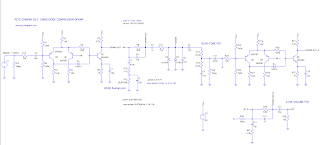
This is a Pete Cornish SS-2 using Joe Davisson's diode-compression op amp.  It sounds pretty good - a lot like the regular SS-2, but without any distortion artifacts on sustained notes as it fades outs.  It's also quieter in terms of noise.  This one is getting boxed up, and now I want to try a SS-3 version.

For my ears it sounds best at 18v, and with a Cornish buffer in front.  You can notice the buffer on cleaner sounds in particular, as the high frequencies are a little brighter. 18v sounds more open with better string clarity.  9v still sounds good, but it's more compressed and less dynamic in my opinion - may be a tad thicker sounding as a result of this, which some people may like.

Being based on the MXR Distortion +, higher gain settings roll off bass and treble to provide more of a mid-hump.  It also sounds pretty good with the tone control wound all the way back.  Low gain settings sound pretty nice too, as the frequency response flattens out.  

The tone control is definitely needed as the treble can need a bit of smoothing out on some settings.  It works well for a simple tone control.

I tested it on a transistor and valve amp - both had their own charms.  Could not say which one I preferred.  The valve amp liked it more when it was just breaking up, and then pushed with the SS-2 - but then again when doesn't a valve amp not like being pushed on breakup?


Things to tweak if you feel like playing around with the tone;

  • C2 - definitely increase to 22n (input cap).  10n forms a 66hz HPF with R8, 22n forms 30hz HPF
  • C8 - 10n capacitor paired with diodes to ground (forms a 1.5khz LPF with R11)
  • C5 - 10n capacitor from clipping section into tone 3, rolls off some bass (I'm using a 22n here)
  • C9 - 10n capacitor from tone 1 to ground
  • Germanium Diodes:  different combinations, types - usual diode mods...
  • Reverse log gain pot like the SS-3


CORNISH SS-2 USING DIODE COMPRESSION OP-AMP - VERO LAYOUT

CORNISH SS-2 USING DIODE COMPRESSION OPAMP - GUITAR FX VERO LAYOUT


SCHEMATIC

CORNISH SS-2 USING DIODE COMPRESSION OPAMP - SCHEMATIC

FREQUENCY RESPONSE - LOW TO HIGH GAIN


ON THE BENCH TESTING SOME CAP VALUES


And a buffer to match


ON THE SCOPE

caution - start with low volume levels 

 
First adjustments to gain, then tone.   440hz sine wave input source

 
This is at the diodes, after the first opamp, with adjustments to gain


Gain off the first opamp is pretty high, it's really squashed by the germanium diodes.   Like hard clippers, diodes are fun to play with.  With silicon diodes, it looks like there's some additional clipping happening in the second stage.


VOLTAGES


Strangely at 18v it behaves a little differently compared to 9, 12 & 24.  Here's 18v - note the mix of harmonics compared to other voltages.  


All other voltages to follow in ascending order - no changes to any settings, just the voltage.


ON THE BREADBOARD

And here’s the mess that was the breadboard 


Tuesday, September 28, 2021

BARBER ELECTRONICS: Edge Hog

Check out the video, as it includes a tear down, schematic and a great explanation of the Barber Edge Hog circuit by Gray Bench Electronics.  He has a few other video that are worth a look too - hopefully more traces to come...   


BARBER ELECTRONICS EDGE HOG - VERO LAYOUT

note that I did change the 4.7u to a 100u for power filtering, and I skipped the power protection diode on the layout.  Still room for it if you want to drop one across V+ / V-    I also used regular caps instead of tantalum, for no specific reason other than I don't have any in stock.   

BARBER ELECTRONICS EDGE HOG - VERO LAYOUT


Saturday, April 17, 2021

PETE CORNISH: SS-2, Vero Layout, Modded Buffer, SS-3 Values

Like the very lengthy title below suggest, it's a Pete Cornish SS-2 with mods.   After finishing the SS-3, they're almost the same, so I thought I would also do a SS-2 layout.


Changes

  • Swapped the Cornish buffer for a standard opamp based buffer
  • Ran the reference voltage through the spare opamp
  • Used a quad opamp instead of 2 x single op amps
  • Left SS-3 values throughout (which are mainly cap values and opamp gain)

PETE CORNISH SS-2 WITH MODDED BUFFER & SS-3 VALUES - VERO LAYOUT

PETE CORNISH SS-2 WITH MODDED BUFFER & SS-3 VALUES - VERO LAYOUT


PETE CORNISH: SS-3 Soft Sustain, Vero Layout, Buffer Mod

The Pete Cornish SS-3 is one of my favourite overdrives - so I thought I might make another one with a different layout and buffer.

Changes

  • Swapped the Cornish buffer for a standard opamp based buffer
  • Ran the reference voltage through the spare opamp
  • Used a quad opamp instead of 2 x single op amps


PETE CORNISH SS-3 SOFT SUSTAIN WITH BUFER MOD - VERO LAYOUT

PETE CORNISH SS-3 SOFT SUSTAIN WITH BUFER MOD - GUITAR EFFECT VERO LAYOUT


Thursday, October 22, 2020

MXR: Distortion +

Something of a classic and many other designs are based on the MXR Distortion + so no real need for an introduction.

MXR DISTORTION PLUS - VERO LAYOUT

MXR DISTORTION PLUS - VERO LAYOUT


DISTORTION PLUS ANALYSIS

There's an excellent analysis of the Distortion + here on Electrosmash including a schematic (be prepared for some maths)

Note that I have used alternate pot values, compared to some of the schematics out there.   There’s evidence to support this on DIY Stompboxes.   


Friday, September 4, 2020

PETE CORNISH: SS-2 Soft Sustain

The Pete Cornish SS-2 Soft Sustain is Pete's interpretation of a MXR Distortion +   and it's not a bad one at that (it's very nice actually).  If you prefer a bit more control, try the SS-3, as it has bass and treble controls.  The same overall sound, just more tweakable (if that's a word).

Like all things Pete Cornish related, put the Cornish buffer in front of it and wire it buffered bypass.  Why use two single opamps instead of a dual - I don't know, ask Pete.

I did find that in my SS-3 build, using an old tin can single opamp gave me a certain grit and feel that I just wasn't getting with the modern equivalent, at the cost of a bit more noise.  Both options sounded very good - I could have gone either way really.  


PETE CORNISH SS-2 SOFT SUSTAIN - VERO LAYOUT  

PETE CORNISH SS-2 Soft Sustain Vero Layout Guitar Effect


LTSPICE

This is from the PedalPCB trace.

PETE CORNISH SS-2 SOFT SUSTAIN - SCHEMATIC


This is the frequency repose at a few different points in the signal path, with the sustain on full.
  
PETE CORNISH SS-2 SOFT SUSTAIN - LTSPICE


Below is the output, with varying amounts of sustain - as gain changes, so does the frequency response.  One lower gain settings the tone control is really necessary to cut down the high peaks.  Higher gain settings provide a prominent mid-range.  

PETE CORNISH SS-2 SOFT SUSTAIN - LTSPICE


Sustain on 100%, tone at 0, 50% and 100% 

PETE CORNISH SS-2 SOFT SUSTAIN - LTSPICE


This gives a clear progression of the signal - sine wave, clipped to a square wave in the first opamp, which is rounded out by the diodes, then it changes quite a bit as soon as it passes the 10n capacitor before the tone control (C5).   Increasing the 10n cap changes the response of the circuit quite a bit.
PETE CORNISH SS-2 SOFT SUSTAIN - LTSPICE


Here's C5 with some different values - 10n is stock.  As you can see, increasing C5 starts to return the signal to something resembling a square wave again as more low frequencies are allowed to pass.

PETE CORNISH SS-2 SOFT SUSTAIN - LTSPICE


Sunday, August 23, 2020

DEARMOND: Square Wave

The DeArmond Square Wave - it's pretty much an MXR Distortion + with a couple of minor values changed.  It does come in a cooler-looking box...   

There's a great analysis of the Distortion Plus on Electrosmash, which will apply equally to the DeArmond Square Wave.


DEARMOND SQUARE WAVE - VERO LAYOUT

DE ARMOND Square Wave Vero Layout


MODS

The most obvious place to start - swap the germanium diodes for silicon.

Brian Wampler provides a list of mods here on Premier Guitar from back in the day (2008).  Some can be done on this layout, while others would need a completely new layout.  


Saturday, July 11, 2020

PETE CORNISH: SS-3 Soft Sustain

Pete Cornish's excellent take on the MXR Distortion +  the Pete Cornish SS-3 Soft Sustain.

I used a vintage tin can IC in the first gain stage, and while it added a bit of noise, it certainly added some grit and character.  There's certainly nothing wrong with a standard single op-amp - potentially better, depending on what you want out of this.

The Cornish buffer is included in this layout.

PETE CORNISH SS-3 SOFT SUSTAIN - VERO LAYOUT


PETE CORNISH SS-3 SOFT SUSTAIN GUITAR EFFECT VERO LAYOUT


SCHEMATIC

A schematic from Aion Electronics and their tracing journal can be found here.  This is quite possibly a better source of information for what the SS-2 should be, as there are a couple of different values for capacitors etc.


POTENTIAL MODS

While building this, I tried a few different things with the diodes - maybe too many things.   

Try adding clipping diodes on the first opamp like a Tube Screamer, and swap between these and the hard clippers (sounds bad when on simultaneously).   Different combinations of germanium and silicon are also fun.  There are so many options to try.  I did a crazy layout with a bunch of switching for this, but I gave up on it as it was just too many options for a pedal that already sounds really good as it is.


Build photos below are care of Palelite from Freestompboxes.   It's a really nice-looking build using a slightly earlier version of the layout above.


LTSPICE


Frequency response of treble and locut on a medium gain setting


Same again but with sustain on 100%


Frequency response at various gain settings, with tone control completely open


Output trace at various gain settings, with tone / locut controls completely open


Output trace at various gain settings, with tone / locut controls completely open, at various stages in the circuit