Showing posts with label EQUALISER. Show all posts

Friday, January 5, 2024

SPACEMAN: Equinox Equaliser

The Equinox is Spaceman's trimmed-down version of an old-school studio equaliser - it’s definitely inspired by Pultec, but with a few key differences.  I’m fine with the differences, as it makes it practical to build.

Schematic can be found here on PedalPCB.  

If you don't have a power supply that kicks out 18v, Dirtbox layouts have a vero layout with a charge pump included.  One could be tacked on the bottom of this board - which is how I started doing the layout until I noticed that the Spaceman version doesn't appear to have this, and my power supply does 18 volts.

This is probably a good candidate for an additional loop to be added, so another pedal can be switched on with this at the same time.  There's certainly going to be enough room for a couple more jacks in the enclosure, and this could really tailor the sound of your favourite fuzz / drive / distortion pedal.

I may even make a point-to-point version of this to keep the vintage vibe of the Pultec.


SPACEMAN EQUINOX EQ - VERO LAYOUT

Clearly, this is not for the faint-hearted in terms of off-board wiring - I would not recommend trying this unless you are quite confident with your wiring.  


SPACEMAN EQUINOX - VERO LAYOUT


ENCLOSURE SIZE & LAYOUT

A sizeable box will be needed and you will need to do some planning before getting started.   Spaceman uses a 1590XX which has internal dimensions of 139mm x 115mm.  You may even want to go up to a 1590DD, which has internal dimensions of 179mm x 112mm, which is a lot of real estate on a pedalboard,  but it will be comfortable for the build and will allow better knob placement.  As a reference, the vero layout above is 71mm x 54mm.  

At this size, the vero will have to sit on top of the pots.  Rotary switches are usually too tall to sit boards on top of them, apart from the height, there are a lot of wires going on straight off the top.  With this in mind, the rotary switches will have to be the top row of knobs on the enclosure.  Could probably sneak the level control in next to them on one side.

A big vero board in a large box with a lot of wire should be well secured.   Some kind of mounting is a must.  There's some space on the layout for mounting, but you may need to add a little more, depending on your preferred method.  I often use adhesive stand-offs.  These have a 13mm clearance, which gets the board just above pot height, which is usually around 10mm.  

I'd suggest doing a mockup of the internals using the actual parts you plan on using, on a piece of cardboard before you start drilling an enclosure (including the mount positions).  I often use cardboard templates to pre-wire circuits before I finish them off in the enclosure.  It tends to be a bit neater and access is easier as you don't have to worry about the sides of the enclosure getting in the way.


EQUINOX VIDEO DEMO


Sunday, August 7, 2022

NEVE: High Low Shelf EQ - Simplified Version

This is a simple adaptation of the Neve high / low shelf EQ found on a few famous model consoles.  I had never noticed it on the online tone stack calculator before, so I thought I would try it out in spice using a Neve Preamp.  The TSC version has a generic opamp in there for gain.

Speaking of gain, this doesn't have much - the input signal I used is -20db, which is roughly unity gain when set flat.  Bear in mind that this is just one of several EQ sections, preamps and amplifiers in a channel strip - it should not have a lot of output, or it might overload other sections of the channel strip.  

How is it different to the actual Neve circuit?  The simplified version uses one capacitor value for set shelf frequencies.  The Neve has a few capacitors on a rotary switch for variable shelf frequencies.


NEVE HIGH LOW SHELF EQ


Sunday, January 23, 2022

UNKNOWN: Parametric EQ / State-Variable Bandpass Filter

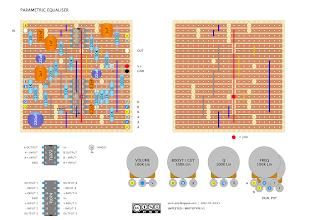
I found this schematic a little while ago and thought I might give it a try, as I've been looking to make a single band parametric equaliser, in this case, based on a State-Variable Bandpass Filter.   It's supposed to be from a Japanese textbook, but I'm not sure of its origin.  It looks remarkably similar to a schematic in an article published by John Roberts in Popular Electronics back in 1979.   


PARAMETRIC EQUALISER ORIGINAL - VERO LAYOUT

I've not built this yet, and I've only tested it on LTspice, so I can't vouch for how it sounds yet.  Could be a hot mess for all I know.  I'll update once I get around to testing this - fingers crossed...    

PARAMETRIC EQUALISER ORIGINAL - VERO LAYOUT


PARAMETRIC EQUALISER ORIGINAL SCHEMATIC

PARAMETRIC EQUALISER ORIGINAL SCHEMATIC


It has a broad frequency range of 70hz - 7khz, and approx 10db of boost and cut.  The Q also has a decent range, although I wouldn't mind making it a little tighter on the most extreme setting.

I added an extra opamp stage, as the stock version doesn't have a volume control, and it there would be a volume drop when cutting the signal.  I also like the idea of being able to hit whatever is following the EQ hard with a spike in the frequency range.


PARAMETRIC EQUALISER - MODDED SCHEMATIC


Sunday, April 18, 2021

PETE CORNISH: ST-2 (Colorsound Overdriver)

The Pete Cornish ST-2 is a Colorsound Overdriver with a few mods.  The ST-2 is intended to be a tone-shaper; it's not actually an overdrive.  So if you are looking for dirt, you have come to the wrong place with this one.  Although one can make a few tweaks to bring some dirt to this, but I'm not sure it would sound that great.  Could also make it a little hotter on the output by adjusting the gain of the op-amp, if you really want to push some tubes over the edge.

It has the usual Cornish buffer (two in fact) and an additional buffered/boosted output via an op-amp.   The power supply is a little over the top too.  Several feeds for different sections of the circuit.  

All of the extras make for quite a large vero layout, and after all it is really just a bass and treble control - I'll probably do a simplified layout at some stage with a single buffer, or maybe no buffer at all and a smaller power supply.  It should cut down the size and complexity quite a bit.

The wiring is for buffered bypass, which I don't mind.  It bothers some people... 

Schematic and tracing details can be found here, at Aion FX.  Instead of using this gigantic layout, maybe consider buying a board from Aion.  


PETE CORNISH ST-2 - VERO LAYOUT

PETE CORNISH ST-2 - GUITAR EFFECT VERO LAYOUT


ST-2 ON LTSPICE


ST-2 ON LTSPICE

As expected, there's a fairly standard bass/treble response

ST-2 ON LTSPICE - FREQUENCY RESPONSE


There's nothing to see on the output trace - no distortion on this one, purely tone shaping.

ST-2 ON LTSPICE - WAVE TRACE


CORNISH ST-2 VIDEO DEMO