Showing posts with label ONE KNOB. Show all posts

Sunday, January 26, 2025

COLORSOUND: Sakata Hybrid One Knob Fuzz Box

Macari's often release pedals that are minor variations on the same circuit - in this case the "Sakata" Colorsound hybrid one knob fuzz has quite a few value changes compared to the previous hybrid they released, which was closer to a stock fuzz box.   Macari's describe the Sakata as being tuned closer to a MK1.5 

I was going to add this to my previous post about the Colorsound hybrid fuzz box, but I thought there are enough differences to deserve it's own post.  For one, this is a positive ground effect, with the previous is a standard negative ground set-up.

Personally, I would not pick up the soldering iron until I'd tested this on a breadboard.  Being a small circuit it will be quick and easy to do, and you can test a few values / transistors to see what you think.

COLORSOUND "SAKATA" ONE KNOB FUZZ 

COLORSOUND "SAKATA" ONE KNOB FUZZ vero layout


Transistors: BC179C for Q1 and an STC TK22C for Q2.  Both PNP transistors.  Like any fuzz face style circuit, transistor choices in this circuit will matter, as will the bias resistors.

Q1:  The BC179C lists hfe in the 380-800 range - it's the PNP compliment to the BC109C if this helps you think of alternatives or as to how it might behave in the circuit.

Q2:  If you can't access a TK22C, try an OC71.  Without knowing the leakage and hfe range of the TK22C they selected, there will be some guess work here, even if you have some on hand (note my point above re breadboarding).

The bias resistors on Q2 look like 520 ohms and 5k6.   The feedback resistor is 100k.  These values are important.  

The input cap is an electrolytic - I can't read the value, which isn't all that important, as once the input cap is over 1uf differences become minor (stock value on the fuzz box is 100n).   A MK1.5 is 4u7 so I'd run with that.  If you don't have a 4u7, 2u2 will be close enough.

Same with the bypass cap that's paired with a 1k resistor.  I can't see the value, it's most likely 22u, which is what appears in a MK1.5, Fuzz Face etc.   

Output cap is 100n 250v.   Stock value is 220n.

Sakata hybrid one knob fuzz

Sakata hybrid one knob fuzz


Thursday, December 26, 2024

COLORSOUND: Hybrid Fuzz Box

The Colorsound Fuzz Box has to be one of my favourite fuzz circuits, due to its simplicity and reliable results.  It's very much a one trick pony, but if you just want a nice thick fuzz, this will to that trick quite well.   The original silicon circuit is said to be a Dick Denny design, found in the Vox V1141 Super Beatle solid state amplifier.

The layout is the same as the traditional all silicon version, with some component values changed - most notably Q2 is now a germanium NPN transistor and the bypass cap has jumped up from 10u to 22u. 

If you want a bit more than the Fuzz Box, check out the D*A*M Meathead series or Drag n Fly, as they appear to be a very close relative to the Fuzz Box.  They're also a good reference to see the range of possible component values to play with.

COLORSOUND HYBRID FUZZ BOX - 0.15" VERO LAYOUT

colorsound one knob hybrid fuzz box vero layout

If you don't have the CV7112, try any low leakage NPN germanium transistor that you can get your hands on, and see how it sounds.  The CV7112 is a mil spec OC140.  

Maybe you will need to tweak the resistor values a little (the 2k2 and 82 ohm in particular), hopefully you have a breadboard that you can experiment on, rather than unsoldering and soldering resistors on the board.

I was testing it on the breadboard with a 10k pot in place of the 2k2 and found that about 4K was the sweet spot for the AC127 I was using.  I also increased the 82 ohm resistor to 120 for higher output.

colorsound hybrid fuzz gut shot

I've not found reliable photos of the low value resistor paired with the 2k2 (the one on the far left). I've left what I consider the stock value of 82 ohms on the layout.  It might be a little different to this - who knows...  increasing the 82 ohm resistor increases output, which might be a good thing in some cases.  It doesn't need a substantial increase to see higher output - even taking up to 120 is noticeable.

I'm sure you've seen other layouts with 820 ohm resistor instead of 82 - debate / clarification on FSB can be found here and on DIY Stompboxes.   I mostly use values that I can see in photos or verified circuit traces.  If you don't have an 82, I'm guessing you probably have a 100 ohm resistor - just use that, it will be fine.


LTSPICE RESULTS

Here's the difference between 10u and 22u on the bypass cap.  


And for the diagram below, this is what happens when the input cap is changed (retaining the 22uf bypass cap).  

In this circuit, the input cap, along with the 150k resistor and the bypass cap, mainly control the frequency response. If you want to tweak the response, the easiest way is to increase the input cap. The 220n cap on the output doesn't do much for the frequency response, so if you're looking for a bit more thickness, you could try swapping the input and output caps. For reference, a Fuzz Face uses a 10n cap on the output, so even dropping to a 100n cap still gives you plenty of room to play with.


No doubt there will be some colouration as a result of the germanium transistor, as it's not entirely unusual for some to sound tonally different to others.  i.e.  fatter or thinner at times, maybe more or less highs.  

LTspice is a handy guide, but it by no means replaces real world testing with a breadboard and a guitar plugged into an amplifier running at an obnoxious level.   

Changing the 82 ohm resistor has no effect on frequency response - the level increase is very obvious.


Saturday, December 21, 2024

DEATH BY AUDIO: Evil Fuzz

Thought I was overdue for a regular vero layout, as it has been a while - schematic available at PedalPCB.   

It has the usual DBA weirdness - upside down low-gain silicon transistors etc (reverse beta).  

DEATH BY AUDIO - EVIL FUZZ VERO LAYOUT

DEATH BY AUDIO - EVIL FUZZ VERO LAYOUT


Monday, October 7, 2024

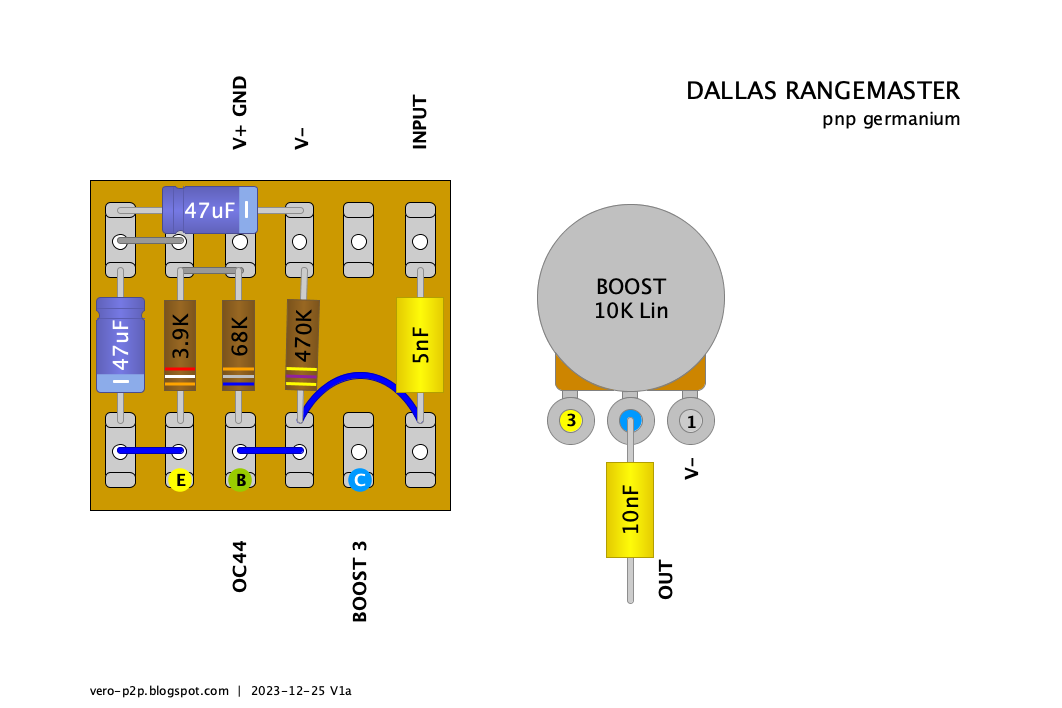
DALLAS: Rangemaster, 8 lug tag strip version

Here’s a simple Rangemaster treble booster.  I’m jotting down some notes from my recent builds because I really dig this layout.  I used a 1590BBS enclosure and an 8-way tag strip. It’s pretty similar to the Pigdog Eel Pie layout, which inspired my design.

Inside, you’ll find a Mullard OC71 transistor. But honestly, the specific transistor isn’t a huge deal—pretty much any PNP germanium transistor will sound great in a Rangemaster. You definitely don’t need an OC44 to get that sweet sound.

What really makes this pedal shine is a couple of key factors:

  1. Hitting Your Valve Amp Hard: The Rangemaster works best when you crank it into the front of a valve amp.
  2. Adding Harmonic Distortion: That germanium transistor adds some nice harmonic distortion, which enriches the overall tone.

For the best results, pair it with a valve amp that’s just on the edge of breakup or slightly dirty - there's always a bit of a balancing act between the amp and the boost level.  Once you find your happy place, set and forget.  Keep in mind that once the amp is clipping, it doesn't really get louder, it gets more saturated, and some bass is trimmed off the signal - for many people, this is the sound that they're looking for.

If you run it into a super clean amp—especially a solid-state one with lots of headroom—you won’t get great results, as it just sounds thin.


Rangemaster tag strip 8 lug layout


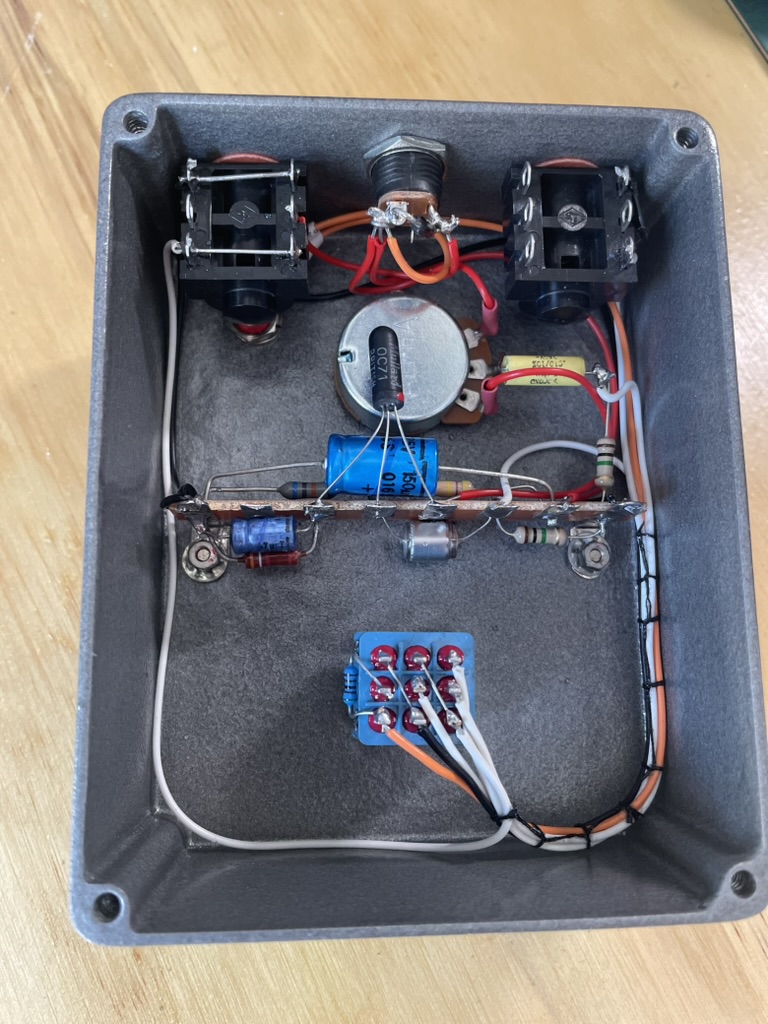
Which looks like this in practice.

Rangemaster gut shot

There's just enough room in there for a battery, but I decided to skip it for this one.


Friday, March 3, 2023

MYTHOS: Golden Fleece

In Australia we have a lot of unusual sayings - one that comes to mind here is "you've been fleeced".  i.e. you paid too much money for something - specifically a Golden Fleece on the secondhand market when you can still buy perfectly good new one.  

The Mythos Golden Fleece is pretty much a part for part copy of the Alan Yee Fuzzy Nuts, which is a slight variation on the humble Electra Distortion.  Description here from Mythos.

Things to note:  47k on the input drops the input impedance right down.   100pf on the input is an estimate, as far as I'm aware the exact value is unknown.   I think the output pot is actually linear instead of log - you choose.

The Electra is quite a forgiving circuit as far as component values go - as long as you loosely stick to the program you'll probably have something that sounds good.


MYTHOS GOLDEN FLEECE - VERO LAYOUT

MYTHOS GOLDEN FLEECE - GUITAR FX VERO LAYOUT


Monday, February 27, 2023

ELECTRA: Distortion

I accidentally messed up a small Colorsound Fuzz Box board by drilling mounting holes in the wrong place - but I didn't want to waste the vero board, and I thought an Electra Distortion & Colorsound Fuzz Box might make a nice pair of one-knob pedals.  

Perhaps not the most exciting post to return with after a short break.  I’ve been busy with other projects and haven’t had much time for layouts.  I even took part in a panel discussion about guitars recently, which was a lot of fun.

ELECTRA DISTORTION - 0.15” VERO LAYOUT 

ELECTRA DISTORTION - 0.15” VERO LAYOUT FOR DIY GUITAR EFFECTS


Wednesday, October 26, 2022

LOVEPEDAL: JTM45

A nice easy one - and I'm not sure if anyone has done more versions of an Electra Distortion than Lovepedal has.  But hey if it's working for them and people like it, who am I to judge?   A JTM45 it is not.

LOVEPEDAL JTM45 - VERO LAYOUT

LOVEPEDAL JTM45 - VERO LAYOUT DIY STOMPBOX


Saturday, September 10, 2022

CHRISTIAN HOLMBERG (HEMMO): Bazz Fuss, Tag Board & Vero Layouts

This is a nice easy one for tag board off-cuts.  The Christian Holmberg (AKA Hemmo) Bazz Fuss.   

A simple one transistor monster of a fuzz.  Kind of surprised that I had not done a layout or actually built one of these...  how did this not happen earlier?  I was prompted to do this after browsing on Ditrbox Layouts and saw the Walrus Audio Contraband fuzz - link here which is a Bazz Fuss with an input cap switch. 

So here it is.  Will probably post a couple of other versions for 0.15" and the standard vero later.  Being such a simple circuit, it's ripe for modding and component value tweaks.  

Mods (Which are almost every part on the board):

  • size of the input and output caps (input cap most critical)
  • type of diode used between the bass and collector of the transistor
  • the transistor itself (NPN silicon)


CHRISTIAN HOLMBERG (HEMMO) BAZZ FUSS - TAG BOARD LAYOUT 

CHRISTIAN HOLMBERG (HEMMO) BAZZ FUSS - TAG BOARD LAYOUT


0.15" VERO LAYOUT 

CHRISTIAN HOLMBERG (HEMMO) BAZZ FUSS - 0.15" VERO LAYOUT

STANDARD VERO LAYOUT 

CHRISTIAN HOLMBERG (HEMMO) BAZZ FUSS - VERO LAYOUT GUITAR EFFECT


BAZZ FUSS ON LTSPICE

I haven't shown changes in diodes and transistors below, as while they might sound different (I'm yet to test this myself), they don't appear all that different on LTspice.  The waveforms are quite similar, with variations in level and minor variations in shape.

For me, the key driver of changes in this circuit appears to be the input cap.


Volume on 50% - not quite a square wave, but most of the way there.


With a 4.7u input cap and a 100n output cap the frequency response is almost flat - note the db scale (volume at 50%). 


Change the input cap value, and things start to happen with the response 


BAZZ FUSS - VIDEO DEMO

I've used the Walrus Audio Contraband Fuzz as a demo, as it's the best demo I could find of a Bazz Fuss circuit, even though it isn't strictly a stock circuit.   

The only significant difference is the input cap switch, which handily demonstrates the differences when changing C1.   220n and 33n are the values used on the Contraband. 


Saturday, August 27, 2022

EARTHQUAKER DEVICES: Erupter

So it's another Fuzz Face variant - but no doubt.  good one.   The Earthquaker Devices Erupted is a one-knob Fuzz Face with a single-knob controlling bias.  Quite a few layouts included volume pots; if you prefer to have one, I'm sure you can work out how to do it.

Signal path:   buffer > pickup simulator (transformer) > Fuzz Face with external bias control.  The internal trimmer is to help set the external bias control to a suitable position.


EARTHQUAKER DEVICES ERUPTER - VERO LAYOUT

EARTHQUAKER DEVICES ERUPTER - VERO LAYOUT STOMPBOX


ERUPTER VIDEO DEMO


Wednesday, May 4, 2022

ANALOG MAN: Beano Boost

The Analog Man Beano Boost takes the classic Rangemaster treble booster and adds a very useful function — a switched input capacitor that widens the tonal range beyond the original’s treble boost.

Because it’s a single-transistor germanium circuit, the choice of transistor does shape the tone and clipping character, especially at higher gain settings.  That said, you don’t need to hunt down an expensive vintage OC44 to get great results.  Many germanium transistors will work really well in this circuit — just be mindful of noise, as a bit of hiss is common with older germanium devices.

Quite a bit of info here on Analog Man's website 


ANALOG MAN BEANO BOOST - TAG BOARD LAYOUTS

ANALOG MAN BEANO BOOST - TAG BOARD LAYOUTS


Same again, but with a pot to control the gain - with the 5k pot at around 50% the series resistance is about 3.5k depending on component tolerances.  I think this is close enough to the stock 3.9k - you could use something a bit larger than 1k to get it closer, but it really doesn't make a massive difference.

This is handy for finding the sweet spot for just the right amount of grit in the boost.  Another useful option is to replace the 68k resistor with a pot (100k as an example).  One of the Steve Williams boosters has this addition - minor downside, the pot has DC on it, so it will sound scratchy / crackly.


ORIGINAL BEANO BOOST LAYOUT

This is one of the layouts used by Analog Man.  Note that I've done it in two layers, as it's hard to show parts directly underneath each other in this format.  


IMPORTANT: the mounting points on the strip must be isolated from the enclosure 

VIDEO DEMO


Saturday, January 1, 2022

EARTHQUAKER DEVICES: Bows

The Earthquaker Devices Bows is a straight-up germanium Rangemaster with some modern tweaks.  It uses an NPN transistor and has a switch to swap to a larger input capacitor for a full-range boost.

The space above the transistor on this layout allows it to be mounted on its side (bent over 90 degrees), as OC transistors are pretty tall, and if you use the mounting points, you will need to reduce the height of the transistor in the enclosure.  It's generally a good idea to place insulation on the legs of the transistor so they don't short when you bend them.  If not all the legs, at least the base leg in the centre of the three.


EARTHQUAKER DEVICES BOWS - VERO LAYOUT

EARTHQUAKER DEVICES BOWS - STOMPBOX VERO LAYOUT


Tuesday, October 12, 2021

VOX: Super Beatle Distortion Booster

This is the distortion section from a Vox Super Beatle V1141 amplifier, which happens to be almost identical to the Colorsound one knob fuzz.   So much so that I used the layout and transistor selection from the D*A*M version.

Interesting when you look at the schematic, as the distortion effect is first in the signal chain, ahead of the preamp.  There's a relay to switch it in and out.  In addition, the circuit is running at 10v, while the rest of the preamp is running at 20v.   So it's very much like an effect pedal in the signal path in front of the amp.


VOX SUPER BEATLE DISTORTION BOOSTER -  0.15" VERO LAYOUT

VOX SUPER BEATLE DISTORTION BOOSTER - VERO LAYOUT


SUPER BEATLE V1141 SCHEMATIC

VOX SUPER BEATLE - SCHEMATIC


Wednesday, May 19, 2021

EARTHQUAKER DEVICES: Acapulco Gold

This is a nice easy one - think it might have been my first IC-based guitar pedal builds.  

The Earthquaker Devices Acapulco Gold is quite the beast.  So loud...  the 22k resistor going to volume 3 helps pull the level down a bit.  It could even be a bit bigger or not there at all if you want something monstrous.

It just does one thing, and it does it pretty well.  If you like 386-based distortions, well, this is one 386 firing straight into another 386.   It’s a Doom box, which is perhaps why it has been compared to a Sunn amp.  The circuits are not even vaguely similar, but I can see where the comparison comes from.

There’s a reasonable amount of room on the board, but given it’s such a small circuit, it hardly matters.  It still easily fits in a 1590B enclosure.   I’d even be tempted to add another row to get the two 10u caps a tad further apart (I have built this using this layout, and they fit just fine).   I replaced the 1u electros with box poly caps just because I felt like it on my last build.


EARTHQUAKER DEVICES - ACAPULCO GOLD

EARTHQUAKER DEVICES: Acapulco Gold, Guitar Effect Vero Layout stripboard layout


EQD ACAPULCO GOLD MODS

It's so loud that some people like to add a 1M pot to control input levels.   Input to pin 3, pin 2 to the regular input on the board, and pin 1 to ground.


EQD ACAPULCO VIDEO DEMO


Saturday, May 8, 2021

ZVEX: Super Hardon, Point to Point Layout

Here's a nice easy one if you haven't done anything point to point before - the Zvex Super Hardon.  


ZVEX SUPER HARDON - POINT TO POINT LAYOUT

ZVEX SUPER HARDON - POINT TO POINT GUITAR EFFECT LAYOUT


I've left some room on the board for added power filtering / protection.


Wednesday, January 27, 2021

DALLAS: Rangemaster, Tag Board Layout

A bit of a classic - well one of the first guitar effects really, the Dallas Rangemaster.  A nice simple one for a quick build using leftover tag board.   

In theory there is room to fit the output cap on the board too, but I liked the straight lines of the components.  


DALLAS RANGEMASTER TREBLE BOOSTER - TAG BOARD LAYOUT

DALLAS RANGEMASTER TREBLE BOOSTER - TAG BOARD LAYOUT


Saturday, November 14, 2020

COLORSOUND: Fuzz Box

They don't come much more straightforward than this - said to be a Dick Denney design, the Colorsound Fuzz Box is a one-knob silicon fuzz face with a couple of value tweaks, but other than that, you know what you're getting here.   

This circuit is also found in the Vox V1141 Super Beatle solid state amplifier.

The layout below is the D*A*M / Macari's reissue, which is a great way to use up the little bit of vero left over from making other circuits.

COLORSOUND FUZZ BOX   -   0.15" VERO LAYOUT

COLORSOUND FUZZ BOX VERO LAYOUT

There's a few comments below regarding values - yes, they can vary a bit in the wild.   I think the different Macari's releases have slight tweaks to some resistor or transistor values.   From what I gather, this is normally the bias resistors on Q2 (2k2 and 82 ohm as shown above).  

There's also a bit of debate on the topic at FSB


The Colorsound Hammer House Fuzz Box uses what looks to be 5k6 and a 270 ohm resistor, so there is some room for movement or experimentation in this area.  I've certainly needed to change values occasionally to get the best results out of some vintage RCA silicon transistors that I was using.

Increasing the 82 ohm resistor lifts the output a bit.  With the 82 it's a bit above unity running full tilt.   


Same again but with a 120 ohm resistor - you can see it has a bit more beef now compared to the input signal, despite only having an extra 38 ohms of resistance.


Below is the Hammer House version - even hotter again


Wednesday, September 23, 2020

MUSITRONICS: Mu-Tron Micro V

The Musitronics Mu-Tron Micro V is a cool old auto-wah / envelope filter from the seventies - I feel I need to be wearing a valour tracksuit, possibly with a half-unzipped jacket exposing generous chest hair with a gold dangler to really play this properly.  Maybe a moustache too...   

I've used a LM13700 instead of the near impossible to find CA3080 (real ones that is).  In the thread on DIY Stompboxes there's a reference to changing the 1M resistor on the collector of Q2 to 470k / 500k for a better sweep (I have not tested this yet).

If you're interested in how envelope filters work and have some spare time to read and wrap your head around this, here's an excellent reference by Mark Hammer.

MU-TRON MICRO V  - VERO LAYOUT

MU-TRON MICRO V  - VERO LAYOUT

This one is verified.  Note the two sides of the LM13700 are tied together.  I'm yet to test them being split.  In the thread, they say that it just sounds a bit sweeter with both sides running together, so I'll probably leave it that way.


It did take some filing to make it fit, but I did manage to fit it in a smaller than planned enclosure.


ORIGINAL SCHEMATIC 


VIDEO DEMO


Thursday, September 17, 2020

EMANATING FIST: Black Dust

The Emanating Fist Black Dust is yet another one-knob Fuzz Face variant.  Emanating Fist is part of the D*A*M family of effects.


EMANATING FIST BLACK DUST - VERO LAYOUT

EMANATING FIST BLACK DUST - VERO LAYOUT


VIDEO DEMO


Wednesday, September 16, 2020

D*A*M: Meathead M-25

So after a couple of larger than necessary layouts, I thought I might go small and simple: I give you, the D*A*M Meathead, which is of course a one-knob silicon Fuzz Face variant.  This has a small input cap for a fuzz face type circuit - expect it to be very midrange focused.  

D*A*M MEATHEAD M-25 - VERO LAYOUT

D*A*M MEATHEAD M-25 - VERO LAYOUT


Notes on variations by the Captain on the D*A*M Forum.  
Transistors and capacitors included;

Late 2004
2N3904, BC107B, 47n input cap, 100n output cap, 15u electro on Q2 E

Early 2005 - germanium model
AC128, the rest as above

2005 - mid-range focused
2n3904, BC182L, 10n input cap, 22n output cap, 10u electro on Q2 E

My personal preference is for the earlier model with larger caps, but I can see how the mid-focused would be better for hitting an amp that's already running hot with more level without turning to flubber.