Friday, July 31, 2020

ROSAC: Nu-Fuzz, Point to Point layout

The Rosac Nu-Fuzz is an Ed Sanner design, of Mosrite fame, so there's an element of Fuzzrite happening with the Nu-Fuzz.  The Nu-Fuzz was released after the Fuzzrite.

ROSAC NU-FUZZ - POINT TO POINT LAYOUT

There's some odd resistor values used, just try the nearest match that you can find, and maybe experiment a little.  You could increase the 10uf cap to something much larger and add some filtering via the usual 100ohm / 100uf RC filter combo.  Like anything of this vintage, batteries were the go to power supply.   


ROSAC nu-fuzz point to point layout


Thursday, July 30, 2020

MOSRITE: Fuzzrite (germanium), Point to Point Layout

The Mosrite Fuzzrite - two transistor fuzz mayhem.  This is the earlier germanium version.  

MOSRITE FUZZRITE - VERSION 1 - GERMANIUM POINT TO POINT LAYOUT

mosrite fuzzrite point to point germanium
 

MOSRITE FUZZRITE GERMANIUM ON VISUAL ANALYSER

INPUT SIGNAL: 440hz sine wave.  130mv TRMS


Q1

Q1 is an OC75 - very leaky and high gain (can't recall the exact measurements)

Q2

Q2 is a IT308b, about 50hfe, very little leakage.

Q2 output is looking a little low compared to Q1- decreasing the 100k resistor to 50k brings it to about the same level as Q1


Tuesday, July 28, 2020

SOLA SOUND: Tone Bender MKII Hybrid, Point to Point Layout

Here's a hybrid Sola Sound Tone Bender MKII using a single germanium transistor at the front, and 2 x silicon at the back - all NPN so it can run off a standard power supply.  

This is a modern bender, made by David Main from D*A*M, for Sola Sound (Macari's Music).  

Apart from running off a normal power supply, AC127 transistors are not super expensive or hard to come by.  

This layout is on my ever growing 'to build' list, so consider it unverified.  I have cross checked the schematic a few times and looked at the gut shots to check part values as much as possible, so it should be fine.

If you prefer vero, then there's a few good layouts out there, including a direct replication of the proper board.  

SOLA SOUND HYBRID TONE BENDER MKII - POINT TO POINT LAYOUT


Sola Sound Tone Bender MKII Hybrid point to point layout


Monday, July 27, 2020

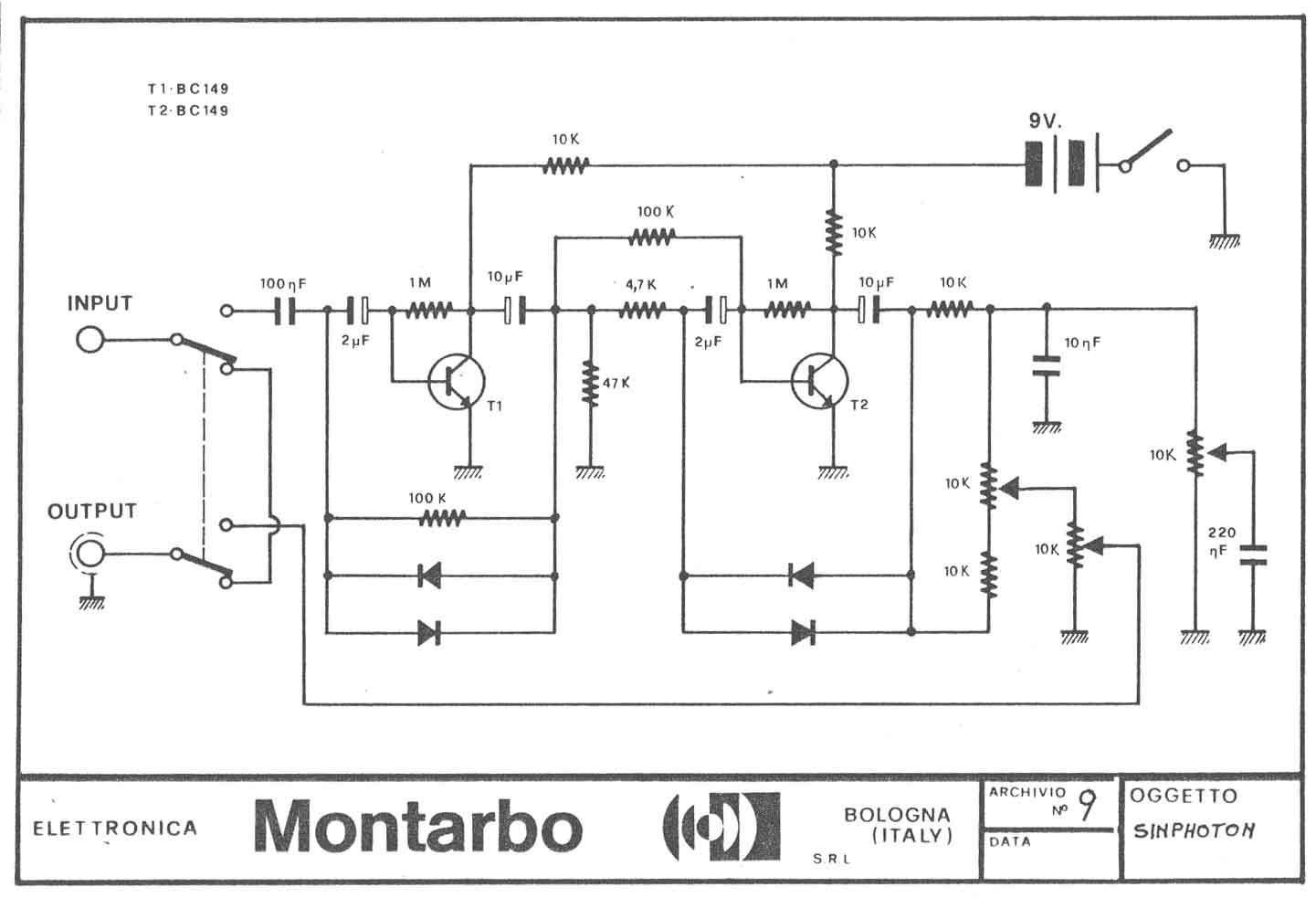
MONTARBO: Sinphoton

This one looks like a real oddball on paper, kind of a very strange Big Muff in some ways, but not really...    The case is a piece of art in itself - this is where the Italian design aesthetic comes into play.   Maybe not the most practical case, but damn it looks cool.

The tone controls are interesting - not a huge amount of value added to the sound.  I might have to give linear pots a try, as quite a bit happens in towards the end of the range.  Might also try the two knob version, to see how different that is.

In terms of sound, it sits somewhere between distortion and fuzz, but not firmly with one or the other (at least the one I made sounds this way).

MONTARBO SINPHOTON - POINT TO POINT LAYOUT

montarbo sinphoton point to point layout

NOTE:  needs power filtering if you plan to run off a power supply.  Quiet on a battery, I had a fair bit of noise on my power supply without filtering.  Try the usual 100ohm resistor / 100uf capacitor combination.  There's maybe just enough room to sneak it on this layout.

MONTARBO SINPHOTON - SUGGESTED MODS

I haven't tried all of these yet, so I can't vouch for any of them.  They're all listed here on Guitar FX layouts.
  • 100nf cap to ground on the input to increase compression / focus
  • Try a LED for the diode on the bottom right - said to make a big difference
  • Remove or tweak the 100k resistor across the Q1 diodes to increase / decease fuzz (maybe even try a pot or a switch)  remove = more fuzz, increase = less fuzz
  • Check bias on Q1 / Q2 collectors, may need to reduce 
  • Change 2.2uf caps to 10uf (as seen on the later version)
  • Change the 47k resistor to ground to a B25k pot, in series with a 180k resistor - said to be a fuzz control


MONTARBO SINPHOTON - VERO LAYOUT

montarbo sinphoton vero layout

MONTARBO SINPHOTON SCHEMATIC

There's a few schematics out there - all the same topology, just some variations in a resistor here and there, the odd capacitor change.


COLLECTOR Q1

Input signal:  sine wave, 440hz, approx 130mv TRMS

Transistors are vintage silicon NEC C959
Diodes are silicon 1S1588

stage 1

COLLECTOR Q2


Sunday, July 26, 2020

SHIN-EI: Companion Fuzz FY-2, Point to Point Layout

One of the early Japanese fuzz pedals to mark it's mark with the classic notch filter - the Shin-Ei Companion Fuzz FY-2.   

The fuzz control is more about texture rather than the amount of fuzz present.  They're notorious for being a little low in level, which is why I have included the second option with the boost stage after the filter (last stage of a Big Muff).


SHIN-EI COMPANION FUZZ - POINT TO POINT LAYOUT


Shin-ei companion fuzz fy-2 point to point p2p layout


SHIN-EI COMPANION FUZZ - POINT TO POINT LAYOUT, WITH BOOST MOD


Shin-ei companion fuzz fy-2 point to point p2p layout


Instead of the usual demo video, this probably demonstrates it best and it may be one of the most famous uses of the Shin-Ei Companion Fuzz.  The Jesus and Mary Chain, Just Like Honey from their 1985 album Psychocandy.  

1985 being the dark years when fuzz was not considered cool.  Cool was a fluro Jackson strat with humbuckers and a floyd rose, possibly teamed up with every Boss pedal ever made (which wasn't that many at the time), along with mandatory big hair. 


POWER: MAX1044 Charge Pumps and Inverter


MAX1044 charge pumps and 9v inverter


Note:  Normal power ripple filtering can be added to these.  Probably better to add filtering after the IC rather than before (or both ends if you are really keen).  

HUDSON ELECTRONICS: Dual Broadcast, Point to Point Layout

I quite liked the single Hudson Electronics Broadcast; the Dual is just that little bit more practical.  It can run from clean through to downright nasty tones.   The low-cut is really great too.

You will need to build a 24v charge pump for this or run the entire thing at 9V - which does work, albeit with a slightly different tone.  Anything in-between also works - 12V and 18V are also OK if you have either option on your power supply.

If you want to build this as the original Hudson Broadcast, just remove the second volume control and adjust the switching to suit (I'm sure you can work it out).  If you have taken one look at this and thought, nah, might stick to vero, there are some great layouts on Guitar FX Layouts, including the original layout used by Hudson, which also includes transistor voltages from an original unit.  The original used a larger vero board, so it will be a bit cramped on standard .1 pitch vero.

HUDSON ELECTRONICS DUAL BROADCAST - POINT TO POINT LAYOUT

HUDSON ELECTRONICS DUAL BROADCAST - POINT TO POINT LAYOUT


HUDSON ELECTRONICS DUAL BROADCAST - WORK IN PROGRESS

It's passing signal, just need to do some further testing with the guitar before adding the transformer etc, and making sure I'm happy with Q2 (currently an OC45).


Then I got bored and decided to start fresh and rework things....   it now has external pots instead of trimmers, and I made some minor tweaks to the layout.  For some reason, I also thought it would be a good idea to twist wires together to give it more of a vintage look.   

I have stuck with an OC45 as Q2.  I tested a few different options, it didn't really like anything high gain, and while the Soviets were pretty good, they were just missing something compared to the OC45.  I can see why they use them in production units, as they're cheap and readily available, unlike OC45s or equally hard-to-come-by parts.   


HUDSON ELECTRONICS DUAL BROADCAST


As you can see, I'm not one who does incredibly neat internal wiring.  I've seen worse, but it's not going on Instagram is it.  

HUDSON ELECTRONICS DUAL BROADCAST - MODS

Transformer

The transformer is not essential by the way.  If you wanted to, you could quite easily change the entire configuration coming off the emitter of Q2 to something a little more normal without substantially altering the tone and feel of the pedal (the 100uf running into the 15k / 33k resistor and the transformer).  Being a point-to-point layout, there are plenty of opportunities for experimentation available.

Note:  If you use a different isolation transformer, you may need to adjust the 15k / 33k resistors before the transformer.  The resistors and one-half of the transformer form a RL high pass filter - I had this issue and could not for the life of me work out what was happening until someone more experienced than I pointed this out.  I couldn't work out why I had a full range signal coming from Q2 and the coupling cap, but it disappeared at the transformer.  

Trimmers

Take one or both of the internal trimmers and make them external pots.  While the extra knobs are a little annoying, I like the added functionality.  

NOTE:  One trimmer sets the overall gain of the pedal (bottom left), and the other trimmer sets the boost level.  So if they are both cranked, there will not be much boost.   Set the low-gain first, then adjust the boost.  Adjusting the low-gain, will also change the other channel.  

Single channel

If you're never going to use both channels, why not make it a single and save a switch.  If you're feeling really minimal, the Broadcast could quite happily be trimmed down into a two-knob beast.  Just the High setting and no lo-cut.  

Tone controls

A treble pot could be added to the output stage, if you really wanted to go nuts with extra knobs.  As there's already a lo-cut control, a simple low-pass filter would do the job nicely.  It's mostly not needed, but on some settings the tops could be tamed a little.   I tried this, and it worked pretty well.  I can't remember what values I used; it was quite mild, I remember that much.  

While I like the lo-cut, to remove it, just join the two points that connect to the pot.  

Transistor

I've listed an OC71 as that was on the schematic, but I have seen photos of this with a Soviet MN20.  Make sure it's a low-gain PNP germanium transistor, and you will be close.  I'd recommend testing a few if you have that option.

Saturday, July 25, 2020

EARTHQUAKER DEVICES: Tone Reaper

Bit of a mix of a Tone Bender MKIII and a Big Muff Tone stack.   Earthquaker Devices have made quite a few pedals that are Tone Bender / Big Muff inspired - I guess why wouldn't you?

EARTHQUAKER DEVICES TONE REAPER - VERO LAYOUT


earthquaker devices tone reaper vero layout

The tone control is based on the Big Muff design and can be changed to tase accordingly.


STOCK RESPONSE

The pedal has a bit of a mid hump, which can work, or you can adjust to suit your taste.  


Change 470pf to 10n

This is reasonably flat; best to try it using the online tool, breadboard, then commit to solder if you have that option.


EARTHQUAKER DEVICES: Dirt Transmitter

The Earthquaker Devices Dirt Transmitter is basically a silicon Fuzz Face with a pot to control the input level and a tone stack.  The bias for Q2 is external.  But gotta love a tricked-out fuzz.  

EARTHQUAKER DEVICES DIRT TRANSMITTER - VERO LAYOUT


earthquaker devices dirt transmitter vero layout


EARTHQUAKER DEVICES: Crimson Drive

The Earthquaker Devices Crimson Drive uses a JFET to push level into a germanium transistor, pushing it into overdrive territory.  Diode clipping is added after to smooth things out a little / add some extra texture.

ORIGINAL EARTHQUAKER DEVICES CRIMSON DRIVE - VERO LAYOUT

earthquaker devices crimson drive vero layout


VERSION 2 EARTHQUAKER DEVICES CRIMSON DRIVE - VERO LAYOUT


EARTHQUAKER DEVICES: Black Ash

The Earthquaker Devices Black Ash is their take on a Tone Bender MKII, using low-gain silicon NPN transistors, with a bit of tone shaping added at the end.   


EARTHQUAKER DEVICES BLACK ASH - VERO LAYOUT

earthquaker devices black ash vero layout


Thursday, July 23, 2020

SPACEMAN EFFECTS: Saturn V Harmonic Booster, Point to Point Layout

Just a straight up boost / low gain overdrive from Spaceman Effects - the Saturn V Harmonic Booster.  It's a pretty quick and easy build & does it's job well.
 

SPACEMAN EFFECTS SATURN V HARMONIC BOOSTER - POINT TO POINT LAYOUT


spaceman saturn v point to point layout


SATURN V ON THE BENCH

Build in progress pic below, which is a little different to the layout, as I changed my mind about where + - V should be after making it (I just flipped them around).  I also subbed in a couple of caps as I didn't have a 27nf or 180nf caps.  I went with the next nearest value that I had, which was 33nf and 220nf.  Probably won't make much difference.  

I also removed the millennium bypass LED circuit, and combined drain resistor values.  The drain had two resistors in series, which has no purpose.

If you don't have ferrite beads, just leave then out.  Makes no audible difference.


POWER UTILITY: Power Filter / Capacitance Multiplier, Point to Point and Vero Layouts

Power your fuzz / high gain circuits with noise problems from this.  Like most things, it's not a silver bullet for your problems, but it will probably help.

Here's a better technical explanation than I will ever manage.  There's a few variations of this circuit - google is your friend if you want to find out more.

TLDR:  It will reduce ripple on DC power supplies a lot.


DC POWER FILTER / CAPACITANCE MULTIPLIER - POINT TO POINT AND VERO LAYOUT


DEATH BY AUDIO: Interstellar Overdriver, Point to Point Layout

The Interstellar Overdriver is possibly the only normal pedal Death By Audio makes, and it's not challenging to get to work either.  Some are a nightmare.  

Sorry about the weird layout with the dual 100k gain pot - there isn't one in DIY Layout Creator, so had to make it work as best I could.  Hope that makes sense...   you can always cross check with s schematic on the web.

If you don't have a dual 100k pot, try it with a regular pot, as gain-b isn't essential to get a sound out of this.

I also dropped a germanium transistor in as Q2 once, and it sounded pretty interesting.   

DEATH BY AUDIO INTERSTELLAR OVERDRIVER - POINT TO POINT LAYOUT

Death By Audio Interstellar Overdriver point to point layout p2p

ROLAND: AF-60 BEE GEE

This one is interesting; it's a bit MXR Distortion + at the front and a Big Muff tone control at the back.  Here we have the Roland BeeGee - I have no idea where the name came from back then. That is an interesting choice from Roland.  

ROLAND AF-60 BEE GEE - VERO LAYOUT


roland bee gee vero layout


ROLAND AF-60 BEE GEE - VERO LAYOUT, WITH GAIN MOD

Same again but with added gain control.  This allows the gain to be dialled back, as the stock setting is full fuzz on the original.
roland af-60 bee gee vero layout gain mod


Probably best to use an old tin can single op-amp if you find one.  From my experience, the new op-amps just don't sound the same.  They don't sound bad, just different.  The newer op-amps are usually quieter and perform better in nearly every respect - which is why they were developed.  There's something about the poor performance of old op-amps that can bring a bit of extra character that I like (not enough to spend exorbitant amounts on NOS op-amps, though).


Wednesday, July 22, 2020

ELK: Super Fuzz Sustainar

Another variation on the Big Muff, the Elk Super Fuzz Sustainar from the early seventies - one of the earliest Japanese copies known.  The Elk Super Fuzz Sustainar originally used PNP transistors, which is completely unnecessary now, given the availability of good NPN transistors. 

The tone section is slightly different from a regular Big Muff, and retains more high-end across the range.  This is what makes it stand apart from other Big Muffs - which is just one capacitor.  Note that the new Earthquaker Devices version has a 3n3 capacitor instead of the 330p in the filter section.  There are some other small differences, 50k pots instead of 100k, but that’s mainly it.  3n3 takes it closer to a regular BMP.

There's an interesting article here from Tym guitars about cloning an Elk.  TLDR version:  The values on the schematic needed tweaking to match the sound of the vintage pedal he had on his bench to clone, likely due to components drifting over time (a lot).  BC547's matched the original transistors the best - unfortunately, no mention of the values he used in his clone...  

Looking at gut shots, there are clearly a few manufacturing differences between manufacturers back in the day in Japan - who knows what this resulted in?


SUPER FUZZ SUSTAINAR CIRCUIT ORIGINS

It's based on an early V1 Triangle Big Muff, which also used PNP transistors. 

Transistors
I've seen 2SA733 listed on the schematic, as well as SA495 in photos.  Both are Japanese PNP transistors of around 240hfe.     

Resistors
Some versions have used carbon comp resistors and some carbon film.  While that generally doesn't have any effect on the sound as such (although some will argue it does).  Carbon comp was never that tight in terms of tolerances to start with (often +/-10%), and they do tend to drift upwards in value over time.  This will add to variances between different examples, especially when combined with capacitors to form filters.  So on to capacitors now.   

Capacitors 
Elk seems to have used cheap ceramic capacitors, which have had a massive range of allowable variance even when they were new.  This might help explain why some Elks are thought of as good and some not so good.   

Note the values on the capacitors - 104Z.  That's 100n, with a tolerance of +80% / -20%.   Basically the worst tolerance you can find on a capacitor.  So that 100n cap could be anywhere between 80n to 180n.   Add to this the variance of resistors, and you have some quite variable filters.  

I haven't seen any of the tolerances or values of the capacitors in the tone section, as who knows, they may have a better spec than the 100n capacitors used.  If they aren't - this would really make the Elks quite variable between different examples.   The filter values would be all over the place.

Example:  A 39k resistor and a 330pf capacitor form a 12.3khz high pass filter in the tone section (which is incredibly high).  If the 330p cap has a plus / minus variance of 80 and 20%, like some of the other capacitors, the resulting HPF could be anywhere from 6.8khz to 15.4khz.  This is a pretty large difference.  Note that the HPF for a Triangle Muff from this era is approx 1khz (39k resistor with a 4n cap)

Elk Sustainer ceramic caps
image courtesy of sound gas

Gutshot from an Electro Sounds version - some capacitor values are different.  


The 50n capacitor in the clipping section of this example below is also a Z spec.  Could be right on 50n, or anywhere between 40 and 90n


ELK SUPER FUZZ SUSTAINAR - VERO LAYOUT

And if you haven't worked it out yet, I like clean-looking layouts with nice lines.  Probably totally unnecessary, but I like it.  

Noting all of the variables mentioned above - if you have a breadboard, I'd suggest using it to tweak some values to get it to a place where you are happy with it sounding like a vintage version.

I would go as far as to say that you will probably be dissatisfied with the stock values listed on the schematics and this layout. 

ELK sustainer big muff vero layout


ELK SUSTAINAR - COMPACT VERO LAYOUT

And clearly, this is a more compact version that will be a tad trickier to solder.  Note the grey and red lines are just a reference in terms of power and earth rails.  

ELK sustainer big muff vero layout


SUPER FUZZ SUSTAINAR SCHEMATIC

Values from Kit Rae's Big Muff site - note that the original used PNP transistors; swapping to NPN makes no difference to the sound.  

The only real difference between this and an early Triangle Big Muff is the capacitor C9, which forms a high pass filter with R5.   The Big Muff value was 4nf, and it's 330pf in the Elk.   One could easily add a Triangle switch, with an extra capacitor added to the 330pf to get around 4nf.  

Do not expect it to sound like any of the video demos you hear using stock values.  Note everything mentioned above.  

ELK SUPER FUZZ SUSTAINAR - SCHEMATIC


LTSPICE FREQUENCY RESPONSE


Sine wave, 100mv, 440hz:   output response:  gain 100%, tone at 0, 50k & 100k

ELK SUPER FUZZ SUSTAINAR - FREQUENCY RESPONSE


Boost, clipping stages response:  gain 100%

ELK SUPER FUZZ SUSTAINAR - FREQUENCY RESPONSE


This is the tone section response isolated from the rest of the circuit.


As above with Big Muff values


LTSPICE TRACES

Sine wave, 100mv, 440hz:  gain 100% taken at boost, first and second clipping stage

ELK SUPER FUZZ SUSTAINAR - TRACES


gain 100% taken at tone control output, with the tone set to 0, 50k & 100k

ELK SUPER FUZZ SUSTAINAR - TRACES


EARTHQUAKER DEVICES: Hoof Fuzz & Cloven Hoof, Vero Layout

The Hoof Fuzz - a great variation of the venerable Big Muff from Earthquaker Devices.  I think this was the one that really put Earthquaker Devices on the map back in the day.  The Cloven Hoof is very similar, but without the germanium transistors.

What really helps these is the mid-shift pot.  Being able to flatten the notch filter to restore some mids is very handy.

EARTHQUAKER DEVICES HOOF FUZZ - VERO LAYOUT 

EARTHQUAKER DEVICES HOOF FUZZ - GUITAR FX VERO LAYOUT


EARTHQUAKER DEVICES CLOVEN HOOF FUZZ - VERO LAYOUT 

The Cloven Hoof Fuzz - much closer to a normal Big Muff, still pretty nice.  It really has some sizzle to it.   Use the updated layout above, and then just tweak the values to match these.

earthquaker devices cloven hoof vero layout


Tuesday, July 21, 2020

UNIVOX: Super Fuzz

The Univox Super Fuzz is indeed super - possibly my most favourite octave fuzz ever...   that was until I discovered the Foxx Tone Machine.  It's now second on the list, although it's kind of special to me, largely due to Poison Ivy from the Cramps.

It's a legendary fuzz sold under many different names, with early beginnings in Japan as the Honey Psychedelic Machine.  


UNIVOX SUPER FUZZ - VERO LAYOUT

Note:  with the exception of the cap from Q4 & Q5 to ground, all 10u caps can be 1u without much effect on the frequency response.

Sixties version (grey box)


UNIVOX SUPER FUZZ - VERO LAYOUT

Seventies version with trimmer (super fuzz on stomp switch)

UNIVOX SUPER FUZZ - VERO LAYOUT


ORIGINAL UNIVOX SUPER FUZZ SCHEMATIC

There are two versions around - one is referred to as the sixties version, the other is the seventies.   

The sixties version has a 1n cap across the collector and base of Q2.  

The seventies version has a 2n cap in the same position mentioned above, and the 10k internal trimmer to adjust the octave


vintage univox super fuzz schematic

SUPER FUZZ LTSPICE ANALYSIS

Note:  all responses below use the first schematic, without the trimmer / 2n cap unless marked as such.


Reference voltages (approx, VCC ≈ 9.5V):

Use as a guide; results will vary.

Q1:   C 5.6V,   B 0.8V,   E 0.2V

Q2:   C 9.5V,   B 5.6V,   E 5.0V

Q3:   C 6.4V,   B 3.7V,   E 3.0V

Q4:   C 2.1V,   B 1.9V,   E 1.3V

Q5:   C 2.1V,   B 1.9V,   E 1.3V

Q6:   C 4.0V,   B 1.2V,   E 0.6V

Octave effect

The octave effect is probably clearer on the actual scope screen grabs at the end of the post, but here it is anyway.


Frequency response - pre-output stage

SUPER FUZZ LTSPICE ANALYSIS


Output tone 1 and tone 2

SUPER FUZZ LTSPICE ANALYSIS


SUPER FUZZ LTSPICE ANALYSIS

Caps

Firstly, with the exception of the 10u cap on the emitter of Q4 & Q5, all 10u caps can be replaced with 1u caps with almost no impact on the frequency response.

As a reference, this is the output of the boost stage with a few different cap values.  At 40hz there's less than half a db difference between using 470n caps and 10u caps.  

1u is a safe bet, and you can easily avoid electrolytic caps with this value - why avoid electros?  Well at least try and avoid them on the input and output caps as electros leak, contributing to any potential switch pop.  The bigger the value, the higher the leakage.

SUPER FUZZ LTSPICE ANALYSIS


If you do want to play with the frequency response, here are two caps that may not come to mind immediately.  The 10u from the emitter of Q4 and Q5 (C9) has a pretty large effect on the bass / low-end response.  The 1n cap on Q2 (C4) has a direct effect on high frequencies.


SUPER FUZZ LTSPICE ANALYSIS

SUPER FUZZ LTSPICE ANALYSIS

Trimmer

I'd never looked at the 10k trimmer properly until recently.  It's a common mod to adjust the amount of octave to account for using unmatched transistors for Q4 and Q5.   I'd built pedals using it, and could hear the differences, just never ran it on spice before.

As you can see, the trimmer affects the frequency response and output in certain positions.  No doubt a result of less octave being produced.

The trimmer does change the total resistance from the base of Q4 and Q5 from 22k to anywhere in the range of 22k - 32k depending on where you like to set it.


SUPER FUZZ LTSPICE ANALYSIS

SUPER FUZZ LTSPICE ANALYSIS


Alternatives to the stock trimmer set-up:

Reduce the 22k resistors to 18k - this way when the 10k trimmer is set to the middle position (5k), the total resistance is 23k, which is closer to the original value of 22k.

Another option is to only have the trimmer on the base of a single transistor, to adjust it to match the other.  Same values as above work just fine.   


SUPER FUZZ ON THE SCOPE - BENCH TEST

These are screen grabs from my oscilloscope. The input signal is a 440hz sine wave, approx 130mv RMS

This is the output of the first gain stage - which is just a boosted signal that has some clipping already.

The fuzz was sitting on around 50% for all below.  I didn't include the output of the long-tailed pair, as it just looks almost the same as the output without the notch filter (I may have even gotten these two images mixed up that are so similar).

This is a reasonably hot signal, I have other Super Fuzz builds where it's still a fairly clean sine wave at this stage.

SUPER FUZZ SCOPE ANALYSIS


This is the collector of Q3, which is where the signal is split and inverted from both the collector and emitter, which feeds into either side of the long-tailed pair.  

SUPER FUZZ SCOPE ANALYSIS

Now here's the emitter of Q3, which always seems a bit different to the collector

SUPER FUZZ SCOPE ANALYSIS

This is the output with the notch filter on

SUPER FUZZ SCOPE ANALYSIS

and again with the notch filter off - but who does that, right?

SUPER FUZZ SCOPE ANALYSIS

This is fuzz on zero, with the notch on - quite the strange looking wave

SUPER FUZZ SCOPE ANALYSIS